
Hold too little, and a market downturn or unexpected bill forces you to sell stocks at the worst possible moment. Hold too much, and inflation quietly eats your purchasing power while your money sits on the sidelines missing gains. Neither mistake announces itself immediately. Both compound over years.
Most guidance points to 2%-10% of a portfolio as a reasonable cash range, but that number shifts based on your age, income stability, and upcoming expenses. This article breaks down where that range comes from, what pushes it higher or lower, and what to do with cash once your true liquidity needs are covered.
Key Takeaways
- General guidance places portfolio cash around 2%-10%, adjusted for personal circumstances
- Cash is a distinct asset class built for liquidity and stability, not growth
- Age, income stability, risk tolerance, and near-term expenses all move the ideal percentage
- Holding above 20%-25% cash typically creates a measurable, hard-to-justify return drag
- Surplus cash beyond emergency reserves often belongs in diversified, tax-efficient investments
What Cash Represents in a Portfolio
Cash and cash equivalents include savings and checking accounts, money market funds, certificates of deposit (CDs), and short-term Treasury bills. They're the most liquid, lowest-risk pieces of your financial picture.
Inside a portfolio, cash isn't there to grow your wealth. It's a liquidity and volatility buffer — funds you can access without selling stocks or bonds at an inconvenient time. That's a different job than what equities or fixed income are supposed to do.
There's no fixed formula here. Fidelity has noted there's no single best asset allocation across stocks, bonds, and cash; the right mix depends on your goals, time horizon, and financial situation. Schwab's own portfolio illustrations use 5% cash for aggressive, long-horizon investors and as much as 30% cash for conservative, short-horizon portfolios. Your number should reflect your life, not a textbook rule.
Emergency Fund vs. Investment Portfolio Cash
These are two separate buckets, and conflating them is a common mistake.
- Emergency fund: 3-6 months of essential living expenses, held entirely separate from your investment accounts and untouched except for genuine emergencies
- Investment portfolio cash: The 2%-10% held within your brokerage or investment accounts, used for rebalancing, seizing opportunities, or covering planned near-term withdrawals
Business owners and commission-based earners typically need larger reserves. With variable income, a thinner cash cushion can turn a slow month into a forced liquidation.
Why Cash Isn't a Substitute for Stocks or Bonds
Cash also carries reinvestment risk: when a CD or T-bill matures, you may have to reinvest at a lower yield than you started with, especially in a falling-rate environment.
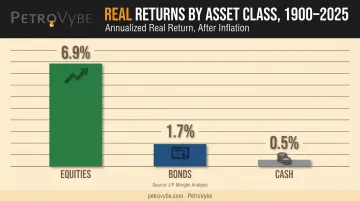
The bigger issue is the long-run growth gap. According to J.P. Morgan's analysis of U.S. asset returns from 1900 to 2025, annualized real (after-inflation) returns broke down as follows:
| Asset Class | Annualized Real Return (1900-2025) |
|---|---|
| Equities | 6.9% |
| Bonds | 1.7% |
| Cash | 0.5% |
Over decades, that gap is enormous. Cash preserves nominal dollars. It doesn't build wealth.
Factors That Determine Your Ideal Cash Percentage
Five variables push your cash allocation up or down from the general 2%-10% starting point.
Risk tolerance covers two things: your psychological comfort with watching your balance drop, and your actual financial capacity to absorb a loss without derailing your plans. Conservative investors tend to sit at the higher end of the range; aggressive investors gravitate toward the lower end.
Age and timeline matter just as much:
- Younger accumulators with decades ahead often hold 2%-5% cash
- Retirees prioritizing capital preservation often hold 10%-20%+
Income stability is often underestimated. A salaried employee with predictable paychecks can typically run leaner on cash than a business owner or commission-based earner facing income swings.
Upcoming known expenses override every general guideline. Money you'll need within 1-3 years, such as a home down payment, tuition, or a major purchase, belongs in cash or near-cash vehicles regardless of your target percentage.
Inflation and opportunity cost are the silent tax on excess cash. As of mid-2026, CPI-U inflation ran at 3.5% year-over-year, while national average savings and money market deposit rates sat around 0.38% and 0.65%.
On $100,000, that's roughly $380-$650 in annual interest against 3.5% inflation, a real loss in purchasing power before taxes. Investors looking to redeploy excess cash into inflation-resistant assets sometimes turn to alternatives like PetroVybe's oil and gas partnerships, which target tax-advantaged passive income.
The Recommended Range: How Much Cash Should You Hold
Financial advisors commonly recommend a 2%-10% range as a starting point, not a hard rule. Here's how it typically breaks down by investor type:
| Investor Type | Typical Cash Range |
|---|---|
| Growth-focused investors | 2%-5% |
| Conservative investors | 10%+ |
| Business owners | 15%-25% |
| Pre-retirees and retirees | 5%-20% |
Boundary Limits: When Cash Becomes Too Little or Too Much
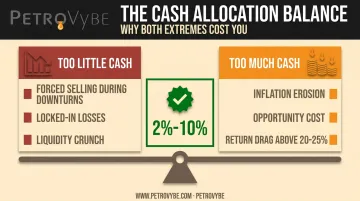
Go too low, and you risk being forced to sell investments during a downturn or emergency, locking in losses at the worst time. A retiree holding just 2% cash, for instance, may need to liquidate stocks mid-decline just to cover living expenses.
Go too high, and you cross into territory (generally above 20%-25%) where the drag on long-term returns becomes hard to justify without a specific reason for holding it.
Matching Cash Vehicles to Time Horizon
Not all cash needs to sit in the same place. Match the vehicle to when you'll need the money:
| Time Horizon | Vehicle |
|---|---|
| Immediate access | Checking or savings account |
| 1-3 months | Money market fund or account |
| 3 months to 3 years | Laddered CDs or Treasury bills |
Risks of Getting It Wrong: Too Much vs. Too Little Cash
Too much cash costs you upside, and the math is stark. A Fidelity analysis of the S&P 500 from 1996 to 2025 found that $100,000 fully invested grew to $1,921,677.
Miss just the 10 best market days over that period, and the same investment ends at $854,910 — less than half. Market timing rarely pays off, because the best days often cluster right around the worst ones.
Too little cash creates a different problem: forced selling. Without a buffer, an emergency or an unplanned expense means liquidating stocks or bonds, possibly at depressed prices, to cover it.
Two behavioral mistakes make both risks worse:
- Reactively raising cash during a downturn: Selling into a decline locks in losses and requires a second correct call on when to reinvest.
- Treating 2%-10% as an absolute rule: Ignoring your income stability, timeline, and upcoming expenses defeats the purpose of having a plan.
Beyond Cash: Putting Excess Reserves to Work
Once your emergency fund and near-term cash needs are fully funded, additional idle cash stops providing any safety benefit. At that point, it's pure opportunity cost.
This is where many high-income investors look beyond the traditional stock-bond-cash mix. Real asset investments with built-in tax advantages can offset both inflation and a heavy tax bill in ways that a savings account simply can't.
PetroVybe is one example in this category. As a private natural gas development company operating in South Texas's Gulf Coast Basin, PetroVybe gives accredited investors direct equity participation in upstream development projects. This capital deployment works only with money already beyond your liquidity needs.
Partners have historically received substantial first-year intangible drilling cost (IDC) deductions against active income, including W-2 earnings and capital gains. Long-term passive distributions follow as the underlying wells move into production, typically over a 10-year hold period.

A few things to know upfront:
- This is suited only for accredited investors with capital genuinely beyond emergency and near-term needs
- PetroVybe ONE carries a 10-year hold period with no redemption or secondary market, making it fundamentally illiquid
- It's not designed for money you might need in the next few years
The core principle holds regardless of where you put surplus cash: fund your reserves first, then decide where the rest should work harder.
Frequently Asked Questions
What is a cash portfolio?
A cash portfolio, or the cash allocation within a broader portfolio, refers to the portion held in highly liquid, low-risk vehicles like savings accounts, money market funds, and short-term CDs or Treasury bills. It exists for stability and access, not growth.
How much cash should a 60 year old have in their portfolio?
Investors around 60, nearing or in early retirement, often hold roughly 10%-20% of their portfolio in cash to reduce the need to sell investments during downturns. The exact figure varies based on other income sources and spending needs.
How much cash is too much in a portfolio?
Holding above roughly 20%-25% without a specific near-term need typically creates a meaningful opportunity cost. It's usually a sign of excessive conservatism rather than a deliberate strategy.
Should you increase cash during a market downturn?
Reactively raising cash after a downturn often locks in losses rather than reducing risk. A predetermined allocation strategy set before volatility hits is generally far more effective.
How often should I review my portfolio's cash allocation?
Review your cash allocation quarterly or semi-annually, and after any major life or income change. This keeps your reserves aligned with your actual goals rather than outdated assumptions.
Is cash a good hedge against inflation?
Cash yields sometimes rise with inflation in the short term, but historically cash has failed to outpace inflation over the long run compared to stocks and bonds. It preserves nominal dollars, not purchasing power, which is why some investors offset cash-heavy positions with income-producing real assets like private energy partnerships.