

Plenty of six-figure earners feel rich on paper and broke in practice. Taxes take a bite. Inflation erodes what's left. Without a structured plan, income never converts into lasting net worth.
This article breaks down what wealth actually means, the seven pillars that make it up, and the practical strategies, including tax-advantaged alternative investments, that turn income into durable, generational wealth.
Key Takeaways
- Wealth is a stock: your net worth at one moment, not a flow like income
- True wealth blends financial capital with health, relationships, time, and purpose
- Building it requires saving, investing, diversifying, and cutting tax drag
- Alternative assets like natural gas projects can accelerate legacy wealth for accredited investors
What Is Wealth? Defining Net Worth, Income, and True Prosperity
Wealth is the total value of everything you own minus everything you owe. Cash, investments, real estate, business equity: add those up, subtract your debts, and you have your net worth. That's the standard financial definition, and it's the one economists and financial planners use.
But wealth has never been a fixed concept. Ancient societies measured it in land, livestock, or gold. Modern accounting just gave the old idea a formula.
Here's how abstract that number can feel: according to the 2025 Schwab Modern Wealth Survey, Americans said it takes an average of $2.3 million in net worth to be considered wealthy, and $839,000 to feel merely financially comfortable. Neither number is small, and both moved down slightly from 2024, when the wealthy threshold sat at $2.5 million.
The Net Worth Formula
The math is simple, even if reaching the number isn't:
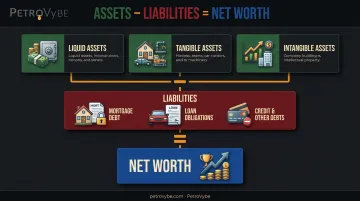
Assets − Liabilities = Net Worth
Assets break into three buckets:
- Liquid assets: cash, checking and savings balances, money market funds
- Tangible assets: real estate, mineral royalties, vehicles, physical business equipment
- Intangible assets: stock portfolios, business equity, retirement accounts, intellectual property
Liabilities include everything you owe: mortgages, auto loans, credit card balances, student debt. Subtract one from the other, and that's your true financial position, not your salary, not your job title.
Wealth vs. Income vs. Money
Income is a flow. It's what moves through your hands over a given period: a paycheck, a bonus, a commission check. Wealth is a stock. It's what remains after that flow gets captured, invested, and grown.
This distinction explains why plenty of high earners never build real wealth. The Federal Reserve's 2022 Survey of Consumer Finances found that only 82% of families in the top income decile reported saving anything at all that year.
Even within that top decile, wealth varies wildly. Median net worth was $2.556 million, but the mean was $6.63 million, a gap that shows just how unevenly wealth accumulates even among people earning similar paychecks.
Contrast that with lower income brackets: only 43% of families in the bottom half of earners reported saving. Income opens the door to wealth. It doesn't walk you through it.
The 7 Pillars of Wealth
Ask a financial planner what wealth means and you'll get a net worth figure. Ask someone who actually has it, and the answer gets bigger. Research on wellbeing and financial happiness consistently points to seven interconnected pillars.
Financial Capital
This is the traditional pillar: net worth, income streams, and diversified assets. It's the foundation everything else rests on, but it's not the whole house.
Health & Longevity
Wealth without health is wealth you can't enjoy. In Schwab's 2025 survey, 37% of respondents tied their sense of wealth to physical health, and 32% tied it to mental health. Medical bills and lost earning years can undo decades of financial discipline fast.
Relationships & Social Capital
Quality relationships shape both happiness and opportunity. Schwab found 24% of respondents connected wealth to quality relationships, and separate research from Empower found 84% of people associate financial happiness with being able to care for the people they love.
Time & Freedom
Control over your schedule is a wealth marker in its own right. Empower's research found 64% of Americans would rather have more time than more money, and 63% described themselves as time poor, regardless of income level. Passive income is often the mechanism that buys this freedom back.
Knowledge & Skills (Human Capital)
Education and expertise compound just like money does. Gallup research shows people who use their strengths daily are three times more likely to report an excellent quality of life, and that compounding effect shows up in earning potential too.
Purpose & Mental Wellbeing
A paycheck without purpose feels hollow. Empower found 17% of people define financial happiness partly as the ability to give back to their community, a reminder that meaning matters alongside money.
Legacy & Generational Impact
The final pillar looks beyond your own lifetime. 84% of respondents in Empower's research said financial happiness helps them build generational wealth. Yet 67% still prioritize caring for themselves today over leaving an inheritance. Good legacy planning balances both.
How to Build Wealth: Proven Strategies for Long-Term Financial Success
Building wealth follows simple principles. The challenge lies in executing them consistently over decades, not in clever market timing.
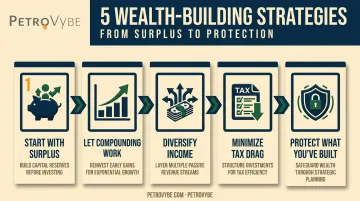
Start with the surplus. Spend less than you earn, and direct the difference toward savings and investments. The U.S. personal saving rate, according to Bureau of Economic Analysis data, sat at just 4.6% of disposable income in 2025, down from 5.4% the year before. That gap between what's possible and what's typical is where most wealth-building opportunity lives.
Let compounding do the heavy lifting. Consistent, long-term investing beats trying to time the market. Fidelity reports the S&P 500 has averaged roughly a 10% annual return since 1957, with 11.5% over the 40 years ending in 2025. Time in the market, not timing the market, is what builds the curve.
Diversify your income. A single paycheck is a fragile foundation. Passive income streams and income-producing assets add resilience:
- Dividend-paying stocks or index funds
- Rental real estate
- Royalties or licensing income
- Direct participation in income-producing ventures, such as oil and gas development partnerships
Minimize tax drag. This is the step most people skip, and it's one of the fastest ways to preserve wealth you've already built. Legal deductions, retirement account structuring, and tax-advantaged vehicles, such as intangible drilling cost deductions in energy investments, keep more of every dollar earned working for you instead of the IRS.
Protect what you've built. Insurance, estate planning, and resisting lifestyle inflation as income rises all guard against the wealth you've accumulated evaporating through neglect or bad luck.
Where Tax-Advantaged Alternative Investments Fit Into Your Wealth Strategy
Traditional portfolios of stocks, bonds, and real estate still matter. But a growing number of investors are diversifying further, seeking better risk-adjusted returns and tax efficiency that conventional assets simply can't match.
Oil and natural gas development is one such category, and its tax treatment sets it apart. Under Section 263(c) of the tax code, investors can elect to deduct Intangible Drilling Costs (IDCs), expenses like drilling labor, fuel, and site preparation, rather than capitalizing them over time.
Here's what makes this structure unusual: for holders of a working interest, these deductions aren't limited to passive income. They can offset active income, including W-2 wages and capital gains, something real estate deductions generally can't do unless the investor qualifies as a full-time real estate professional.
This is the space PetroVybe operates in. The Texas-based natural gas development company gives accredited investors direct equity participation in early-stage development projects across South Texas and the Gulf Coast Basin, through its PetroVybe ONE partnership structure. A few specifics worth knowing:
- The minimum investment is $100,000, open only to accredited investors under SEC Regulation D 506(c)
- 2024 partners received a 94% tax deduction against active income, while 2025 partners received a 91% deduction
- Projects target a 10-year MOIC of roughly 2.2x to 5.8x and an IRR near 26%, alongside monthly passive distributions once production begins
- The company's proved reserves carry a third-party engineered $48 million PV-09 valuation

PetroVybe's Chief Geophysicist, Michael Stamatedes, brings a 48-year track record with a 75.2% hit rate on profitable well selection, well above the industry peer average of below 40%. That kind of site-selection accuracy directly affects how reliably production forecasts hold up over the life of a project.
None of this replaces a diversified core portfolio. It supplements it, offering a tax lever that's hard to find anywhere else in the market.
Accredited status and suitability should be confirmed with a CPA or tax attorney before committing capital.
Common Wealth-Building Mistakes to Avoid
Even disciplined savers derail their own progress with a handful of predictable errors.
Lifestyle inflation. As income rises, spending tends to rise with it, quietly consuming the surplus that should be going toward investments. Fidelity describes this pattern as spending expanding "while saving falls by the wayside." A raise that immediately becomes a bigger car payment or a nicer apartment isn't wealth building. It's a wash.
Over-concentration in one asset class. FINRA's 2024 Investor Survey found 80% of investors with non-retirement accounts own individual stocks. Owning stocks isn't the problem. Owning only stocks, or too much of one company or sector, creates concentration risk that can amplify losses when that single market segment stumbles.
Ignoring tax strategy. Investment planning that overlooks taxes erodes net worth for decades. Every dollar lost to avoidable tax drag is a dollar that never compounds. Building a plan around tax-efficient vehicles, whether retirement accounts or alternative assets like IDC-eligible energy investments, is not optional if the goal is long-term wealth.
Frequently Asked Questions
What are the 7 pillars of wealth?
The seven pillars are financial capital, health, relationships, time and freedom, knowledge and skills, purpose, and legacy. Together they define wealth as more than a net worth figure.
What is considered "wealthy" in America today?
According to the 2025 Schwab Modern Wealth Survey, Americans said it takes $2.3 million in net worth to feel wealthy, and $839,000 to feel financially comfortable.
What's the difference between being rich and being wealthy?
"Rich" typically describes high income or spending power in the moment. "Wealthy" describes sustained net worth, financial security, and assets that continue generating value over time.
How much money do I need to start building wealth?
There's no minimum dollar figure required. Wealth building starts with consistent saving and investing habits, and tools like fractional shares now make it possible to start with very small amounts.
Can alternative investments like oil and gas help build wealth faster?
For accredited investors, tax-advantaged energy investments can accelerate net worth growth. PetroVybe partners have achieved 91-94% deductions against active income, improving after-tax returns compared to standard taxable accounts.
What is the fastest way to build generational wealth?
Combine consistent, long-term investing with tax-efficient structures, then pass down income-producing assets rather than just cash. That combination compounds across generations instead of resetting with each one.