For high-net-worth Americans, this isn't abstract policy chatter. It's real uncertainty about whether unrealized gains, family businesses, and illiquid assets could someday face annual taxation, not just income when it's actually earned or sold.
This article breaks down both sides of the debate, but leans into the strongest arguments against a wealth tax: the enforcement problems, the revenue shortfalls, and the unresolved constitutional questions. We'll also cover how investors can manage their tax exposure today, regardless of how Congress votes.
Key Takeaways
- A wealth tax targets net worth, not income, taxing unrealized gains for the first time
- Valuation headaches, enforcement gaps, and constitutional doubts have stalled every proposal since 2019
- Most OECD nations that tried a wealth tax repealed it after capital flight and weak revenue
- Tax-advantaged investments cut your active income tax bill today, regardless of future policy
What Is a Wealth Tax, and How Would It Work?
A wealth tax is an annual charge on a person's total net worth, meaning assets minus debts, above a set exemption threshold. Unlike income tax, it doesn't care whether you sold anything or earned a paycheck. It taxes what you own.
The base would include both financial assets (stocks, bonds, cash) and non-financial assets (real estate, private business equity, art, jewelry). That's a critical distinction from today's system, which taxes realized income and gains, not the paper value of what you hold.
A Simple Example Calculation
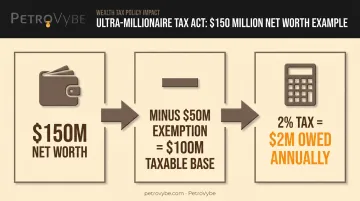
The current Warren-Jayapal bill proposes 2% on net worth above $50 million, plus an additional 1% above $1 billion. Here's how that plays out for someone with $150 million in net worth:
- Taxable base: $150M minus $50M exemption = $100M
- Tax owed: 2% of $100M = $2 million per year
- Annual obligation: due every year regardless of whether the person sold any assets
That last point is the crux of the entire debate. Under the current system, a business owner whose company grows in value pays nothing until they sell. Under a wealth tax, they'd owe money every year based on an estimated value, even if the business generated no cash that year.
The Case For a Wealth Tax
Supporters argue wealth concentration has reached a point that demands correction. According to the Federal Reserve's Distributional Financial Accounts, the top 10% of U.S. households controlled roughly 68% of total household wealth in early 2026, with the top 1% alone holding nearly a third.
Economists Emmanuel Saez and Gabriel Zucman modeled the Warren-Jayapal structure and projected it could raise about $3 trillion between 2023 and 2032, close to 1% of GDP annually. That's the revenue argument in a nutshell: tax a small, concentrated pool of assets to fund broader government priorities.
Advocacy groups add a fairness angle. According to ProPublica's analysis of leaked IRS data, the 25 richest Americans saw their wealth grow by $401 billion between 2014 and 2018. They paid just $13.6 billion in federal income tax over that span, a "true tax rate" of only 3.4% by ProPublica's calculation. Proponents say this shows billionaires often pay a lower effective rate than middle-class earners who rely on wages.
Arguments Against a Wealth Tax
Despite the appeal of taxing concentrated wealth, a wealth tax runs into practical, economic, and legal obstacles serious enough that most countries that tried one have since walked away from it.
Enforcement and Valuation Challenges
Public stocks have a market price every second. Private businesses, art collections, and family real estate don't. Someone has to estimate their value, every single year, and that someone is the IRS.
The Congressional Research Service notes that annual valuation would sit at the center of implementation. Formulaic approaches simplify administration but can misstate true market value, while individual appraisals invite disputes and litigation.
This matters because the IRS is already stretched thin. The agency projects a $696 billion gross tax gap for tax year 2022, with an 85% voluntary compliance rate on taxes that are far easier to calculate than fluctuating net worth. Layering a wealth tax on top of existing enforcement gaps is a tall order.
Revenue Shortfalls and Capital Flight
Wealthy households don't sit still when facing a new tax. They restructure. Assets move into trusts, foundations, or offshore entities. Some people simply leave.
Norway offers a live case study. The country raised its wealth tax rate in 2022, and according to Reuters' reporting on Civita data, 261 residents with assets above NOK 10 million left in 2022, and 254 left in 2023, more than double the pre-increase pace.
This behavioral response is exactly why U.S. revenue estimates vary so widely: Saez and Zucman project $3.0 trillion over ten years, while the Penn Wharton Budget Model's dynamic estimate lands at $2.3 trillion for the same window, roughly $700 billion lower.
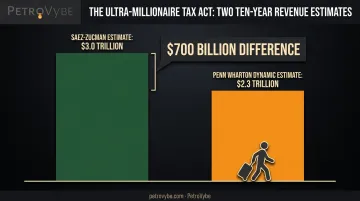
That's not a rounding error. It's the difference evasion, avoidance, and behavioral change make when real money is on the line.
Economic Efficiency and Investment Disincentives
Here's the "ability to pay" problem in plain terms: a wealth tax can hit people who don't have cash sitting around to pay it. A founder whose company is valued at $60 million on paper might have almost no liquid income.
To pay the tax bill, they may need to sell equity or take on debt, just to cover a tax on money they haven't touched.
Critics argue this creates a chilling effect on risk-taking. Entrepreneurship and angel investing, both major drivers of job creation, depend on people willing to lock up capital for years without guaranteed returns.
A recurring tax on unrealized value makes that bet less attractive. The Penn Wharton Budget Model's earlier analysis of Senator Warren's 2019 proposal projected the U.S. economy could end up 0.9% to 2.1% smaller by 2050, largely due to reduced capital accumulation.
Is a Wealth Tax Constitutional in the United States?
This is the question nobody can fully answer yet. Article I of the Constitution requires that direct taxes be apportioned among states by population.
In Pollock v. Farmers' Loan & Trust Co. (1895), the Supreme Court ruled that taxes on income from property counted as direct taxes, and struck down the unapportioned income tax then in place.
The 16th Amendment fixed this specifically for income taxes, allowing them without apportionment. It says nothing about an annual tax on net wealth. That gap is where the legal fight lives today.
- Some scholars, citing the American Bar Association's analysis, argue apportionment is impractical enough that a wealth tax could still survive
- Others, including University of Chicago law professor Daniel Hemel, express real doubt about its constitutionality
- Legal researchers broadly agree: this remains unresolved and would likely require a Supreme Court ruling, or a constitutional amendment, to settle
What Global Experience Tells Us
The U.S. wouldn't be the first country to try this, and history isn't encouraging. The OECD counted 12 member countries with a net wealth tax around 1990. By 2017, only four remained: France, Norway, Spain, and Switzerland. France has since dropped its broad wealth tax too, leaving Norway, Spain, Switzerland, and Colombia as the main holdouts today. Spain and Switzerland account for two of those four, and the table below shows how modest their revenue collection remains.
| Country | Status | Revenue as % of GDP (2022) |
|---|---|---|
| Spain | Still active | 0.19% |
| Switzerland | Still active | 1.19% |
| Austria | Repealed 1994 | — |
| Germany | Repealed 1997 | — |
| Finland | Repealed 2006 | — |
| Sweden | Repealed 2007 | — |
The repeal pattern is consistent across countries. Common reasons include:
- Administrative difficulty enforcing consistent asset valuations
- Widespread noncompliance among high-net-worth residents
- Wealthy residents relocating to lower-tax jurisdictions
Germany's constitutional court objected to unequal property valuation methods, while Sweden's repeal debate centered heavily on capital flight. Even the countries still running a wealth tax collect a relatively modest share of GDP, far less than the revenue projections that typically accompany new proposals.
Protecting Your Wealth Regardless of Policy Outcomes
Here's the reality check: whether or not a wealth tax ever becomes law, high-income earners already face a heavy tax burden today, on W-2 income, active earnings, and capital gains. Waiting to see how Congress votes isn't a strategy.
Tax-advantaged alternative investments that offer deductions against active income, not just passive income, give investors a proactive way to manage that exposure right now.
This is where structures like PetroVybe's natural gas development model come in. PetroVybe operates as a private, Texas-based natural gas developer offering accredited investors direct partnership units in upstream projects through PetroVybe ONE. Because of how Intangible Drilling Costs (IDCs) are treated under federal tax code, deductions from these projects aren't limited to passive income the way most real estate deductions are.
Partners can apply the deduction against:
- W-2 earnings
- Capital gains
- Active business income
In 2024, PetroVybe partners received a 94% first-year tax deduction against active income. In 2025, that figure reached 91%. These aren't projections. They're documented outcomes reported on partner K-1 forms.

Beyond the tax treatment, this kind of investment diversifies wealth beyond the usual stocks, bonds, and real estate mix, while targeting long-term passive income. PetroVybe's projections for its current offering include:
- 10-year MOIC of roughly 2.2x to 5.8x
- IRR near 26%
- Monthly distributions projected to exceed $10,000 once production peaks
For accredited investors already carrying significant tax exposure, this approach offers a way to build legacy wealth and reduce today's tax bill, independent of how future wealth tax legislation unfolds. Details on project structure and reserve reports are available through PetroVybe's investor data drive.
Frequently Asked Questions
Is a wealth tax unconstitutional in the United States?
It's genuinely unresolved. The Constitution requires direct taxes to be apportioned by population, an issue that shaped 1895's income tax ruling before the 16th Amendment fixed it. Scholars remain divided on a wealth tax's status.
Which president taxed the wealthy the most?
Measured by top marginal income tax rates, not a wealth tax, the Truman and Eisenhower administrations had the highest rates, reaching 91-94% in the 1950s. The U.S. has never enacted an actual wealth tax.
Does the United States currently have a wealth tax?
No. The U.S. has no federal wealth tax today. Current proposals like the Ultra-Millionaire Tax Act remain under Congressional committee review and have not been enacted.
What is the difference between a wealth tax and an income tax?
Income tax applies to earnings and realized gains, meaning money you receive or profit you lock in. A wealth tax would apply annually to your total net worth, including unrealized asset appreciation you haven't sold.
How can high-net-worth investors prepare for potential future wealth tax proposals?
Diversifying into tax-advantaged, cash-flowing hard assets, such as natural gas development partnerships, is one strategy to manage current tax exposure while building resilient wealth regardless of how policy shifts.
Have any countries successfully maintained a wealth tax long-term?
Only a handful of OECD countries, including Norway, Spain, Switzerland, and Colombia, still impose one. Even these generate a relatively modest share of total government revenue compared to other tax sources.