

Introduction
Private equity deal sourcing is the systematic process of identifying, evaluating, and securing investment opportunities before competitors ever see them. It directly shapes returns, yet most firms still rely on the same investment banker auction lists and end up competing for the same overpriced deals.
This guide serves two audiences. First, PE professionals and emerging fund managers building a sourcing engine from scratch. Second, accredited investors who want to understand how quality deals get found and vetted long before a term sheet ever appears.
Here's what this guide covers:
- What deal sourcing actually means and why it matters
- The step-by-step process top firms follow
- Strategies separating winners from laggards
- Why sourcing matters more in 2026 than it did five years ago
- Where direct-access investment partnerships fit into this conversation
Key Takeaways
- Disciplined, continuous sourcing beats reactive, auction-based buying nearly every time
- Top firms build relationships with owners 12-36 months before a sale timeline exists
- Blending proprietary relationships, data signals, and sector focus beats any single-channel approach
- Record dry powder and mounting deal competition make repeatable, tech-enabled sourcing essential
What Is Private Equity Deal Sourcing?
Private equity deal sourcing is the process of identifying, evaluating, and initiating contact with potential investment opportunities in privately held companies, ideally before those companies enter a formal sale process. It's the front door to every deal a firm eventually closes.
People often use "sourcing," "origination," and "dealflow" interchangeably, but they're not quite the same:
- Deal origination refers to identifying a single target, one company, one opportunity
- Dealflow is the resulting volume and rate of opportunities reaching the firm over time
- Deal sourcing is the broader discipline that encompasses both
For example, a call with a promising founder is origination. The dozens of similar calls arriving each quarter make up dealflow. Sourcing is the discipline that generates both, consistently and on purpose.
A Continuous Cycle, Not a One-Time Event
Sourcing works best as a loop:
- Source - cast the net through relationships, data, and outreach
- Screen - filter for thesis fit
- Evaluate - dig into the details that matter
- Decide - pursue, pass, or park for later
- Learn - feed outcomes back into the next cycle
Firms that treat sourcing as a one-time project end up with lumpy, reactive pipelines. Firms that run this cycle continuously build compounding advantages, better market maps, deeper owner trust, and pattern recognition that sharpens with every deal.
Why Deal Sourcing Matters More Than Ever
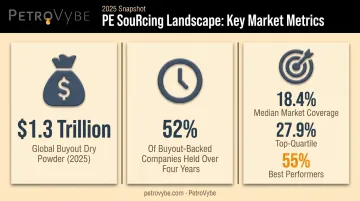
Capital has never been more abundant, and that's exactly the problem. Global buyout dry powder hit $1.3 trillion as of Q2 2025, according to Bain & Company's 2026 Global Private Equity Report, with most of it raised during the 2022-23 fundraising boom. That capital needs a home, and it's chasing a pool of quality targets that hasn't grown nearly as fast.
The Exit Backlog Is Real
Portfolios are aging at the same time. McKinsey's research on private equity exits found that roughly 16,000 buyout-backed companies, about 52% of total inventory, had been held for more than four years as of 2025. Average holding periods stretched to a record 6.6 years, up from 6.1 years the decade prior.
That backlog means more sellers eventually waiting, more buyers competing for the deals that do surface, and more pressure on every firm to get to owners before a crowded auction starts.
Execution, Not Just Access, Separates Winners
Having a big network isn't enough anymore. The SPS Deal Origination Benchmark Report, covering 177 qualified PE firms, found median market coverage across the industry sat at just 18.4%, while top-quartile firms reached 27.9% and the best performers topped 55%. That gap comes down to execution: firms that treat sourcing as a repeatable process consistently outperform those that treat it as a side project.
What Breaks When Sourcing Fails
- Missed opportunities go to better-networked, faster-moving competitors
- Valuations inflate because every remaining deal ends up in a bidding war
- Analyst hours get wasted chasing low-quality targets that never should have entered the pipeline
- Pipelines go boom-and-bust, flush one quarter and empty the next
With dry powder far outpacing quality deal flow, disciplined sourcing processes will keep separating top performers from the rest of the field.
The Private Equity Deal Sourcing Process
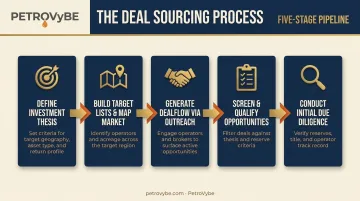
Sourcing works best as a five-step cycle that turns a firm's investment thesis into a qualified, active pipeline. Skip a step, and the whole system gets noisier and less efficient.
Step 1: Define the Investment Thesis
Everything starts here. A clear thesis specifies:
- Target market or industry vertical
- Deal size and stage (growth equity, buyout, distressed)
- Valuation parameters and return expectations
- The competitive advantage the firm brings to the table
Without this filter, teams waste weeks on deals that were never going to fit.
Step 2: Build Target Lists and Map the Market
Once the thesis is set, teams translate it into a structured, living list of target companies. This isn't a spreadsheet built once and forgotten. It gets updated as the competitive landscape shifts and new players enter the space. Mapping the market early lets a firm spot consolidation trends before competitors notice.
Step 3: Generate Dealflow Through Outreach and Relationships
This is where inbound and outbound tactics meet, and the strongest firms run both simultaneously. Inbound sources include:
- Referrals from trusted advisors and portfolio executives
- Thought leadership that attracts founders directly
- Warm introductions through portfolio company networks
Outbound work covers direct owner outreach, intermediary relationships, and industry events. Treating this outreach as a daily habit, not a start-and-stop campaign, is what separates active pipelines from stagnant ones.
Step 4: Screen and Qualify Opportunities
Not every opportunity deserves a deeper look. Initial screening typically checks four things: thesis alignment, market position, management strength, and financial or capital efficiency. A well-run screen protects analyst time for targets with genuine fit.
Step 5: Conduct Initial Due Diligence and Track Outcomes
Opportunities that clear screening move into early diligence, examining market position, financial trends, and management background. Every outcome, won or lost, gets tracked. That feedback loop is what makes the next cycle sharper than the last.
Top Deal Sourcing Strategies PE Firms Use
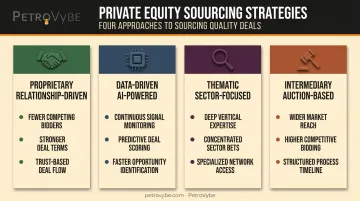
No single channel gets the job done alone. Firms consistently outperforming their peers layer several strategies together rather than betting everything on one approach.
Proprietary and Relationship-Driven Sourcing
Proprietary deals get sourced directly with owners, before any banker, before any formal auction. This access isn't built overnight. It comes from years of relationship maintenance with founders, management teams, and trusted intermediaries who know a firm will treat an owner fairly.
The payoff: fewer competing bidders, more room to negotiate terms, and a relationship that predates either side needing anything from the other.
Data-Driven and AI-Powered Sourcing
Technology has changed what "early" means. Firms now monitor signals like revenue growth, headcount changes, and leadership transitions to flag targets before they show any interest in selling.
Adoption has moved fast. According to EY's research on AI in private equity, nine in ten private equity clients used data analytics or AI across due diligence and target identification by 2024. EQT and Blackstone have run internal AI-driven sourcing platforms since 2018 and 2021, respectively.
Thematic and Sector-Focused Sourcing
Generalist firms cover more ground but go shallow. Sector-focused firms go deep in one vertical, and that focus compounds:
- Deeper, more current market maps within the specialty
- Faster evaluation because patterns from prior deals transfer
- Stronger credibility with owners who trust a buyer that actually understands their business
Intermediary and Auction-Based Sourcing
Investment bankers, brokers, and formal competitive auctions still generate real dealflow and shouldn't be ignored. The trade-off is straightforward: wider reach into deals a firm might never find alone, against higher competition and upward price pressure once every buyer sees the same teaser. Most firms use intermediary channels to supplement proprietary sourcing, not replace it.
Deal Sourcing Tools, Pitfalls, and Where Direct-Access Alternatives Fit
Modern sourcing runs on a small stack of core technology categories:
- Relationship intelligence and CRM platforms that track every touchpoint with owners, intermediaries, and portfolio contacts
- Data enrichment providers that layer financial, ownership, and firmographic data onto raw target lists
- Market intelligence tools that surface signals, revenue growth, hiring patterns, leadership changes, at scale
These tools don't replace relationships. They let a small team manage more pipeline without drowning in spreadsheets.
Common Sourcing Pitfalls
- Over-relying on one channel, usually intermediaries, and losing proprietary deal flow entirely
- Treating sourcing as reactive, spinning it up only when capital needs to be deployed
- Skipping pipeline metrics like conversion rates and time-to-close, the exact numbers that reveal where deals stall
Where Direct-Access Energy Partnerships Fit the Sourcing Conversation
Avoiding these pitfalls is one thing; matching institutional-grade rigor is another. Institutional PE firms apply real discipline to sourcing: proprietary owner relationships, rigorous technical screening, and independent third-party validation. That's precisely what accredited investors should look for when evaluating direct investment partners outside traditional fund structures. The tools change; the underlying test doesn't.
PetroVybe illustrates that discipline applied directly to energy assets. President & COO Blaine Yeary previously scaled a $5 billion asset from zero to 35,000 BOEPD over eight years, work that built the kind of off-market owner relationships institutional PE teams spend years cultivating.
On the technical side, Chief Geophysicist Michael Stamatedes brings a 75.2% well-success rate across a 48-year career, well above an industry average sitting below 40%.
That combination of proprietary access and rigorous technical vetting gets reinforced by independent third-party reserve engineering rather than internal assumptions alone. For accredited investors, it's sourcing-grade rigor without PE fund management fees or the multi-year lockups typical of pooled fund structures.
PetroVybe's direct partnerships do require accredited investor status and a $100,000 minimum, structured as an asset-level partnership rather than a pooled fund vehicle.

Frequently Asked Questions
How do private equity professionals get paid?
PE professionals earn a management fee, traditionally around 2% of committed capital though recent industry data shows buyout fund fees averaging closer to 1.74%, plus carried interest of roughly 20% of fund profits. Sourcing quality directly affects how much carry a deal ultimately generates.
What is the 80/20 rule in private equity?
Some investors apply an 80/20 lens to sourcing and concentration, where a small share of sourced deals drives most of a fund's returns. This mirrors the power-law dynamic well documented in venture capital, though hard PE-specific data on the exact split is limited.
What is deal sourcing in private equity?
Deal sourcing is the process of identifying, evaluating, and initiating contact with investment opportunities, ideally before a formal sale process begins. It's the discipline that fills a firm's pipeline with qualified, thesis-aligned targets.
What is proprietary deal sourcing?
Proprietary deal sourcing means reaching a company's owners directly, before any formal auction or competing bidder enters the picture. These deals typically involve fewer bidders and better terms for the buyer.
How do PE firms find off-market or proprietary deals?
Firms build direct relationships with owners and management teams over years. They also track signals like ownership transitions or leadership changes, using feedback loops from their own portfolio companies to generate introductions.
What is the difference between deal sourcing and due diligence?
Sourcing identifies and initiates contact with potential targets. Due diligence is the deeper evaluation, financial, operational, legal, that follows once mutual interest is established.