

High-ticket "done-for-you" business offers have exploded in the last few years. Many promise autopilot income but deliver vague scopes and heavy pressure to resell the same product to others. That pattern makes it worth separating real deliverables from marketing copy.
This review breaks down what's actually included in The Wealth Creator package, the red flags worth weighing, and why comparing it against tangible, asset-backed wealth vehicles matters before you commit your money.
Key Takeaways
- $2,447 covers automated emails, social automation, and 90 days of mentorship — though some extras aren't confirmed.
- Affiliates earn 45% commission (~$1,101 per sale), making resale central to the business model.
- Independent review evidence is thin: just 13 Trustpilot reviews on an unclaimed profile.
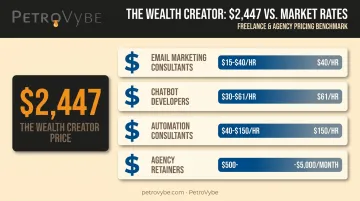
- Comparable freelance funnel-and-automation builds typically cost $500 to $5,000, a useful pricing benchmark.
- Tangible alternatives like oil and gas development offer tax efficiency and physical collateral digital products can't match.
What Is The Wealth Creator Program?
The Wealth Creator markets itself as a "100% Custom, Done-For-You Business Build-Out," a ready-made online business engine meant to automate an internet-based income stream without requiring the buyer to build anything from scratch.
The headline claim is speed: "Built For You in just 3 Days!" That's the hook. But the fine print tells a slightly different story.
The three-day claim comes with conditions. According to the company's own legal terms, delivery happens approximately three days after you complete something called "Firm Foundation onboarding."
That's an important distinction. The three-day clock doesn't start the moment you pay — it starts once you've finished an onboarding process the marketing page doesn't clearly define upfront.
The core positioning is straightforward:
- A pre-built funnel and automation system aimed at aspiring online entrepreneurs
- Marketed as requiring no technical skill or business experience
- Sold under the operator name The Creators Co., d/b/a The Wealth Creator
There's also a built-in resale layer. Buyers aren't just purchasing a business system; they're immediately pitched on reselling that same system to others for a commission. This affiliate hook is baked into the offer from day one, shaping how you should think about the entire purchase. The purchase functions as a recruitment funnel as much as a standalone product.
What You Actually Get For $2,447
Here's where things get murky. Some deliverables are confirmed in the official terms; others appear in marketing but aren't textually backed up by the contract language.
| Item Marketed | Confirmed in Official Terms? |
|---|---|
| Sales funnel | Not expressly confirmed |
| Custom lead magnet | Not confirmed |
| Email automation | Confirmed ("automated emails") |
| ManyChat setup | Not confirmed |
| Stan Store / ReDirect funnel | Not confirmed |
| Social media automation & strategy | Confirmed |
| VIP mentorship | Confirmed as 90 days |
| Affiliate link access | Confirmed (within 24 hours) |
That gap matters. A $2,447 service should spell out exactly what you're buying, not leave buyers to infer details from a sales page.
The Mentorship Question
The "VIP mentorship" add-on sounds substantial. Ninety days is a real commitment on paper. But the terms don't specify:
- How many sessions are included
- Whether mentorship is live, recorded, or group-based
- What happens after the 90-day window closes
Without those specifics, "mentorship" could mean weekly one-on-one calls or a handful of pre-recorded videos dropped into a portal.
The Affiliate Commission Structure
The marketing promises "$1,101 with every sale." The math checks out: 45% of $2,447 is $1,101.15. But that's a commission rate, not a guaranteed payout. Affiliates must submit a W-9, get paid monthly, and can have chargebacks deducted from future payouts.
This structure means the offer functions as much as a resale opportunity as a standalone business tool. You're buying entry into a network that profits whenever you convince someone else to buy the same funnel.
What a Comparable Build Actually Costs
To gauge whether $2,447 is reasonable, look at freelance market rates for similar work:
- Email marketing consultants: $15–$40/hour
- Chatbot developers (ManyChat-style builds): $30–$61/hour
- Marketing automation consultants: $40–$90/hour, with experts charging $75–$150/hour
- Freelancer or small agency retainers for a comparable scope run $500 to $2,000 a month, with mid-sized agencies charging $2,000 to $5,000
A one-time custom build combining funnel copy, email sequences, and chatbot automation could land anywhere in that range depending on complexity.
The Wealth Creator's price isn't wildly out of line with agency work, but the real value still depends on execution quality and how well you can market whatever you're handed. A perfectly built funnel with no traffic strategy behind it won't generate income on its own.
Is The Wealth Creator Legit? Key Red Flags To Weigh
Legitimacy here isn't a yes-or-no question. It's a pattern of signals worth weighing carefully.
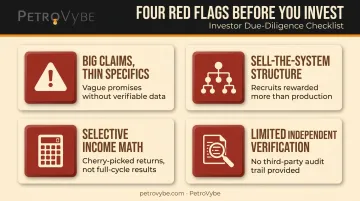
Big claims, thin specifics. The marketing leans hard on autopilot language ("built for you," "financial freedom," "3 days or less") while the actual scope of deliverables remains vague. For a premium-priced offer, that mismatch should prompt caution. A legitimate $2,000-plus service typically comes with an itemized deliverables list, not a highlight reel.
The "sell the system" structure. Heavy emphasis on recruiting others to buy the same package mirrors the structure of MLM-style and info-product resale schemes. That doesn't automatically make it a scam, but it does mean your success may depend more on your ability to recruit buyers than on the product's standalone value.
Selective income math. "$1,101 per sale" describes gross commission on a single transaction assuming a sale happens. It says nothing about:
- How many people actually convert
- Average sales per affiliate per month
- Refund and chargeback rates that eat into payouts
Under the FTC's Business Opportunity Rule, sellers making earnings claims are supposed to provide a formal disclosure showing what percentage of purchasers actually achieved the advertised result. The FTC's guidance is specific about this requirement. Best-case numbers on a sales page aren't the same as verified average outcomes.
Limited independent verification. The Wealth Creator's exact-domain Trustpilot profile showed 13 reviews and a 4.5-star rating, all five-star, on an unclaimed profile. That's a small, recent sample. No BBB profile was found for the operating entity. Refund terms are also narrow: all sales are final except for limited access-failure or hardship exceptions.
None of this proves the product is a scam. It means outcomes depend heavily on your execution, your existing audience, and your comfort with the resale model, not just the product itself.
Who Should (and Shouldn't) Consider It
Best-fit buyer:
- Wants a fast-launch, content-driven online business
- Comfortable with social selling and building an audience
- Willing to treat the affiliate commission as a genuine income stream rather than a guaranteed payout
- Has some marketing experience already, or is prepared to learn quickly
Poor-fit buyer:
- Wants predictable, passive income without ongoing hustle
- Uncomfortable recruiting friends, family, or followers into a resale structure
- Expects a fully automated system that generates sales without active promotion
Before paying $2,447, request in writing:
- An itemized list of every deliverable, tool, and platform included
- The exact number of emails, automations, and revision rounds
- Written refund terms, not just a verbal assurance
If the seller hesitates to put these in writing, treat that as information in itself.
Beyond Sales Funnels: Where Real Long-Term Wealth Gets Built
Products like The Wealth Creator sell a system: a funnel, a chatbot, a resale opportunity. That's different from wealth creation through tangible, cash-flowing assets that exist independent of anyone else buying in.
PetroVybe illustrates that difference well. It's a Texas-based natural gas development company giving accredited investors direct exposure to producing wells in Lavaca County and the Gulf Coast Basin, not a digital resale system dependent on recruiting new buyers.
Four structural differences stand out:
- Independent engineering validation. PetroVybe's reserves are valued at $48 million, determined by a licensed third-party engineering firm, not a self-reported estimate.
- Proven geological leadership. Chief Geophysicist Michael Stamatedes has posted a 75.2% career well-success rate over 48 years, well above the sub-40% industry peer average.
- Operational scale experience. President Blaine Yeary previously scaled a $5 billion asset from zero to 35,000 barrels of oil equivalent per day.
- Tax-advantaged structure. Direct natural gas development typically allows roughly 70% of first-year deduction against active income, including W-2 wages and capital gains, via intangible drilling cost deductions.
- Deductions in practice. PetroVybe's partners saw deductions reach 94% in 2024 and 91% in 2025, though results depend on individual tax situations and should be confirmed with a qualified advisor.
- Physical asset backing. Unlike a resold digital course, the investment ties to producing wells and documented acreage across two Texas basins, an inflation hedge rooted in real production, not repeat sales to new buyers.
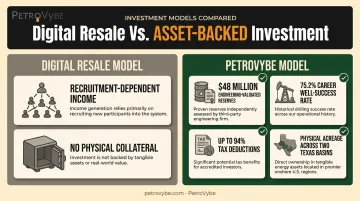
This isn't an apples-to-apples comparison: a $2,447 digital funnel and a $100,000 accredited-investor oil and gas position serve different goals. But the contrast is instructive. One model depends on recruiting the next buyer. The other depends on hydrocarbons already in the ground.
Frequently Asked Questions
What is a Wealth Creator?
In general wealth-management terms, a "wealth creator" refers to the first generation in a family who builds significant assets, as opposed to inheriting them. In this review, we're specifically covering the branded product, "The Wealth Creator," a prebuilt business system.
What is the Wealth Creator program?
It's a done-for-you funnel and business system marketed with a "3 days or less" setup claim, though delivery actually starts after onboarding is completed. It includes automation and 90 days of mentorship.
How much does the Wealth Creator program cost?
The listed price is $2,447, with custom payment plans available. Buyers are also given access to an affiliate program paying 45% commission, roughly $1,101 per sale.
Is Wealth Creator legit?
It isn't necessarily a scam, but vague deliverables, thin independent review evidence, and a resale-heavy structure mean it warrants careful due diligence before you pay.
What do customers actually receive with The Wealth Creator?
Confirmed deliverables include automated emails, social media automation, and 90 days of mentorship. Marketed items like a lead magnet, ManyChat setup, or Stan Store aren't explicitly confirmed in the official terms.
Are there better alternatives for building long-term wealth?
Tangible, asset-backed investments like oil and gas development offer physical collateral and tax efficiency that digital resale products can't match. PetroVybe, for example, gives accredited investors direct equity in oil and gas development projects, pairing up to 94% tax deductions against active income with a 10-year passive income structure.