
The real barrier isn't money, it's inaction. In 2024, only 35% of U.S. adults held stocks, bonds, ETFs, or mutual funds outside a retirement account, according to the Federal Reserve's 2024 Economic Well-Being of U.S. Households report. That means roughly two-thirds of adults are missing out on growth beyond their 401(k), if they even have one.
This guide walks through the foundation you need before investing, how to pick the right account, which investment types make sense for beginners, and where advanced investors eventually look once the basics are covered.
Key Takeaways
- Starting at 25 instead of 45 cuts your required monthly contribution by 80% to reach $1 million
- An emergency fund and paying off high-interest debt should come before your first investment
- Index funds and ETFs remain the most cost-efficient core holding for most beginners
- Automating contributions removes emotional decision-making from the equation
- Further down the road, accredited investors can explore alternatives like private energy partnerships for added diversification
Why Investing Matters: The Power of Starting Early
Saving means parking cash somewhere safe. Investing means putting that cash to work so it grows. The distinction matters because cash sitting in a low-interest account steadily loses value. With inflation running at 3.5% year-over-year in recent years, according to Bureau of Labor Statistics data, money that isn't earning at least that much is losing purchasing power every year.
Compound Growth Is a Snowball, Not a Ladder
Reinvested earnings generate their own earnings. A $10,000 investment growing at 7% doesn't just add $700 a year forever, it adds more each year as the balance itself grows. Over decades, that snowball effect does most of the heavy lifting.
Age matters more than most people think. Here's what it takes monthly to reach $500,000 or $1 million by age 65, assuming a 7% average annual return:
| Starting Age | Years Investing | Monthly for $500K | Monthly for $1M |
|---|---|---|---|
| 25 | 40 | $190 | $381 |
| 35 | 30 | $410 | $820 |
| 45 | 20 | $960 | $1,920 |
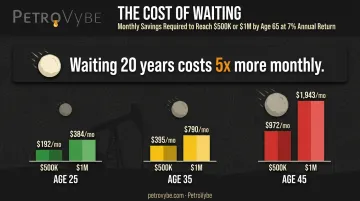
Wait ten years and your required contribution roughly doubles. Wait twenty and it's five times higher.
Risk and Return Move Together
Lower-risk assets like savings accounts and government bonds offer modest, predictable returns. Higher-risk assets like individual stocks offer bigger upside paired with bigger swings. The S&P 500 has averaged close to 10% annually since its 1957 launch, per Fidelity's historical analysis, though that average masks years of double-digit losses along the way.
The real lesson is to stay invested through volatility rather than trying to dodge it. Time in the market consistently outperforms attempts to time the market.
Before You Invest: Building Your Financial Foundation
Investing before your finances are stable is like building on sand. Two things need to happen first.
- Build an emergency fund covering 3-6 months of expenses. Without one, a job loss or medical bill can force you to sell investments during a downturn, locking in losses that would have otherwise recovered.
- Pay off high-interest debt. Credit card APRs averaged 21.52% in the Federal Reserve's latest G.19 consumer credit report. Paying down that balance guarantees a return no stock market can reliably match.
Once those two boxes are checked, define your goals:
- Short-term goals (under 5 years): house down payment, wedding, car. Keep this money in lower-risk assets.
- Long-term goals (10+ years): retirement, financial independence. This money can tolerate more volatility for higher growth.
Your time horizon determines your risk tolerance, and your risk tolerance determines which accounts and assets make sense.
How to Start Investing: Choosing the Right Account
Once your foundation is solid, the account you choose shapes your tax treatment, flexibility, and long-term growth.
Start With Your Employer's Match
If your employer offers a 401(k) or 403(b) with matching contributions, contribute at least enough to capture the full match. It's an immediate, guaranteed return before your investments even grow. Employee deferral limits sit at $23,500 for 2025, though most beginners are nowhere near that ceiling.
IRAs Offer More Control
Traditional and Roth IRAs let you invest beyond what your employer offers, with combined contribution limits of $7,000 for 2025. Traditional IRA contributions reduce your taxable income now, with withdrawals taxed in retirement, while Roth IRA contributions are taxed upfront so qualified withdrawals come out tax-free later.
Many providers have $0 account minimums, so the barrier to opening one is low.
Taxable Brokerage Accounts for Everything Else
No contribution limits, no withdrawal penalties, full access to your money anytime. These accounts work well for goals that don't fit neatly into retirement timelines, such as a home down payment or an emergency fund you might need before age 59½.
You won't get the upfront tax breaks of a 401(k) or IRA, but the flexibility makes a taxable account a useful complement once you've maxed out your tax-advantaged options.
Choosing How to Manage It
| Approach | Cost | Best For |
|---|---|---|
| DIY investing | Lowest fees | Hands-on investors comfortable researching |
| Robo-advisors | Low, automated fees | Set-it-and-forget-it investors |
| Human financial advisor | Higher fees | Complex situations needing personalized guidance |
Whichever route you choose, automate your contributions. Dollar-cost averaging, investing a fixed amount on a set schedule, removes the guesswork and the temptation to time the market.
Beginner-Friendly Investment Types Explained
Not every investment behaves the same way. Understanding the basic categories helps you build a portfolio that matches your goals.
- Cash equivalents (high-yield savings, CDs, money market funds): Highly liquid and safe, with yields recently around 5%—best for short-term goals or your emergency fund.
- Bonds: Government bonds are lower-risk and lower-yield; corporate bonds pay more but carry higher default risk.
- Mutual funds: Pooled, professionally managed portfolios, typically requiring $1,000-$3,000 minimums, though some start as low as $200.
- Index funds and ETFs: Track an index like the S&P 500 at a fraction of the cost of active management, with asset-weighted fees averaging 0.05%-0.14% versus 0.48%-0.64% for actively managed funds.
- Individual stocks: Ownership stakes in a single company, offering higher reward potential but also higher risk. A common rule of thumb: keep individual stocks to 10% or less of your total portfolio.
Quick Reference Table
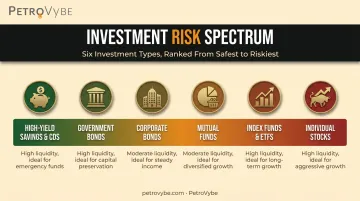
| Investment Type | Risk Level | Liquidity | Ideal Use Case |
|---|---|---|---|
| High-yield savings/CDs | Very low | High | Emergency fund, short-term goals |
| Government bonds | Low | Moderate | Stability, income |
| Corporate bonds | Moderate | Moderate | Income with some growth |
| Mutual funds | Moderate | High | Diversified long-term growth |
| Index funds/ETFs | Moderate | High | Core long-term holding |
| Individual stocks | High | High | Small portion of portfolio |
Diversifying Beyond Stocks and Bonds: Alternative Investments
Once your 401(k), IRA, and index fund portfolio are humming along, some investors start looking further afield. The appeal is diversification: assets that don't move in lockstep with the stock market.
High-net-worth clients now allocate an average of 9.1% of their portfolios to alternatives, with advisors expecting that to climb to 9.6% within two years, according to Cerulli's research on alternative investment adoption.
What "Accredited Investor" Means
Many alternative asset classes, including private equity, hedge funds, and natural gas or oil development, are legally restricted to accredited investors. The SEC's criteria include:
- Net worth over $1 million, excluding your primary residence
- Income over $200,000 individually (or $300,000 jointly) for the past two years
- Certain professional securities licenses
This restriction exists because these investments carry higher illiquidity and complexity than a standard index fund. Deal structures, holding periods, and cash flow timelines vary widely from one alternative asset to the next.
Investors need enough capital cushion to weather a multi-year commitment without needing quick access to their funds. Private natural gas development is a good illustration of what that complexity looks like in practice.
A Real-World Example: Private Natural Gas Development
PetroVybe is a Texas-based natural gas development company that gives accredited investors direct equity access to early-stage gas assets, an opportunity typically reserved for institutions.
Investors participate through limited partnership units with a $100,000 minimum, and the structure carries a tax feature worth understanding: Intangible Drilling Cost (IDC) deductions.
New partners can generally project around 70% of their investment as a first-year tax deduction against active income, consistent with the standard industry IDC range of 60-80%.
For context, PetroVybe's actual 2024 and 2025 partners saw even higher verified deductions of 91% and 94% respectively, though those figures reflect specific past results rather than a guarantee for new investors.
Beyond the tax benefit, PetroVybe targets a 10-year MOIC range of roughly 2.2x to 5.8x, with monthly passive distributions projected to peak above $10,000 during the production phase.
This isn't a starting point for a new investor. It's a consideration once the retirement accounts, emergency fund, and core index holdings are already in place.
Common Mistakes Beginner Investors Should Avoid
Even a solid strategy can be undone by predictable behavioral errors.
Three mistakes trip up most beginners:
- Trying to time the market: Chasing hot stocks or waiting for the "perfect" entry point usually backfires, costing the average investor 1.2 percentage points annually compared to buy-and-hold returns (Morningstar, 2024).
- Failing to diversify: Concentrating savings in one stock or sector amplifies risk unnecessarily, while spreading investments across asset types smooths the ride.
- Letting emotions drive decisions: Fear during downturns and greed during rallies drive buyers to buy high and sell low; automating contributions keeps the plan running regardless of headlines.
Frequently Asked Questions
What's the best thing to invest money in right now?
There's no universal answer. It depends on your goals, risk tolerance, and time horizon. Most beginners are best served by low-cost index funds, while accredited investors seeking diversification and tax efficiency may explore alternative assets such as private energy development projects.
How much do I need to invest to make $1,000 a month?
At a 5% annual yield, you'd need roughly $240,000 invested to generate $1,000 monthly. The exact figure shifts based on the investment type and prevailing market conditions.
How much money do I need to start investing?
Many brokers and apps let you start with $0 to $100. Consistency matters far more than your starting amount.
What's the difference between saving and investing?
Saving keeps cash in low-risk, low-return accounts like a bank savings account. Investing puts money into assets like stocks or bonds that carry market risk in exchange for higher long-term growth potential.
How do I determine my risk tolerance?
Consider your age, time horizon, financial goals, and how you'd react emotionally to a 20% portfolio drop. Younger investors with longer horizons can typically absorb more volatility.
Do I need to be an accredited investor to start investing?
No. Most beginner investing, including stocks, bonds, index funds, and IRAs, requires no special status. Accredited investor status is only required for certain alternative investments, like private natural gas development.