

This isn't just an academic distinction. RI measures dollars created above a required return. ROI measures efficiency as a percentage. Both matter, but they answer different questions.
This guide breaks down the definitions, formulas, and use cases for each metric, then walks through a head-to-head comparison. We'll also look at how sophisticated investors apply this thinking to alternative assets, including tax-advantaged private energy development deals.
Key Takeaways
- RI measures dollar profit earned above your minimum required return.
- ROI expresses that same return as a percentage, enabling size-independent comparisons.
- No single metric wins: combining RI, ROI, MOIC, and IRR gives the fullest picture.
- Tax-advantaged assets can generate strong residual value even when headline ROI looks modest.
RI vs ROI: Quick Comparison
Before going further, here's the side-by-side breakdown:
| Factor | Residual Income (RI) | Return on Investment (ROI) |
|---|---|---|
| Definition | Operating income minus a capital charge (required return × operating assets) | Net operating income ÷ average operating assets |
| Output format | Absolute dollar value | Percentage or ratio |
| Best for | Confirming a single investment beats its cost of capital | Comparing efficiency across differently sized investments |
| Weakness | Hard to compare across projects of different scale | Can reward smaller, less impactful projects with a shrinking base |
The core difference comes down to this: RI answers "did this create value in dollars?" while ROI answers "how efficiently did we use our capital?" Both questions matter, but they're not interchangeable.
What Is Residual Income (RI)?
Residual Income is the income left over after subtracting a charge for the capital tied up in generating it. Some call this an "equity charge" or "capital charge." Either way, the formula is straightforward:
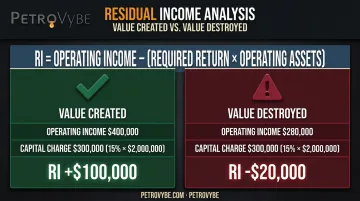
RI = Operating income − (Required rate of return × Average operating assets)
Why does this matter more than raw accounting profit? Because a project can look profitable on paper and still destroy value if it doesn't clear the cost of the capital used to fund it. RI forces that comparison directly.
The biggest practical benefit: RI encourages acceptance of any project earning more than its cost of capital, regardless of how that project compares to a division's existing average. This prevents a common and costly mistake, which we'll unpack in the next section.
That same hurdle-rate logic also powers Economic Value Added (EVA), a commercial variation of RI popularized by Stern Value Management. EVA applies the same logic using NOPAT and total capital instead of segment-level operating figures, and it's often used for executive compensation design, tying pay directly to economic profit rather than accounting profit.
Use Cases of RI
RI shows up most often in:
- Decentralized organizations evaluating investment centers or divisions, where each unit needs to clear a specific hurdle rate rather than beat a sibling division's average
- Equity valuation models, where analysts use residual income to estimate a stock's intrinsic value based on earnings above a required return
- Alternative asset evaluation, particularly real assets and energy development projects, where absolute value creation matters more than a headline percentage
Here's a simple numeric walkthrough. Say a division has $2 million in operating assets, a required return of 15%, and generates $400,000 in operating income:
- Capital charge: $2,000,000 × 15% = $300,000
- RI = $400,000 − $300,000 = $100,000 positive
That $100,000 is real value created above the hurdle. If the same division only generated $280,000 in operating income, RI would be negative $20,000, signaling the project actually destroyed value, even though it was technically profitable in accounting terms.
What Is Return on Investment (ROI)?
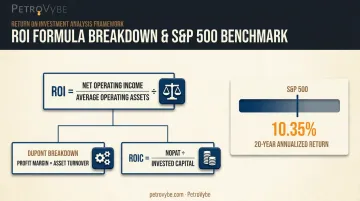
ROI is the ratio of net or operating income to average operating assets (or invested capital), expressed as a percentage. It is the most widely recognized performance metric in business and investing, and for good reason: the metric is straightforward and easy to apply across almost any context.
ROI = Net operating income ÷ Average operating assets
The core strength of ROI is instant benchmarking. Because it is a percentage, you can compare a $50,000 investment against a $5 million one without adjusting for scale. That makes it the default tool for quick decision-making across finance teams and individual investors alike.
Two related variations add diagnostic depth:
- ROIC (Return on Invested Capital): NOPAT ÷ invested capital, useful for measuring after-tax operating returns
- DuPont breakdown: splits ROI into profit margin × asset turnover, helping identify why a return is high or low, not just what it is
Use Cases of ROI
ROI dominates in scenarios where comparison across different investments is the goal:
- Corporate finance teams evaluating divisional managers on capital efficiency
- Individual investors comparing potential returns across stocks, real estate, and private alternative investments
- Capital budgeting decisions, where multiple competing projects need a common yardstick
For context on typical ranges: the S&P 500 posted a 20-year annualized total return of 10.35% through December 31, 2024, according to S&P Dow Jones Indices' SPIVA U.S. Scorecard. That figure sets a widely used baseline for what "market return" means in public equities — and it is the number most private alternatives are measured against, fairly or not.
RI vs ROI: Which Metric Should You Use?
The choice comes down to what question you're actually trying to answer.
Choose ROI when:
- You're benchmarking across business units or asset classes of different sizes
- You need a quick, comparable percentage across a portfolio
- You're screening multiple opportunities before deeper analysis
Choose RI when:
- You want to confirm a single investment maximizes total profit dollars, not just a ratio
- You're evaluating whether a specific opportunity clears your true cost of capital
- Value creation matters more than size normalization
A classic scenario illustrates the risk of relying on ROI alone. In a case study from OpenStax's managerial accounting curriculum, a division already earning a 20% ROI is offered a new project returning 18%, well above the company's 15% cost of capital.
Under pure ROI thinking, the manager rejects it, because accepting it would drag down the division's average. Under RI, the project adds value and should be accepted. That gap between "looks worse on a ratio" and "actually creates value" is exactly why both metrics matter.
Real-World Example: Applying This Thinking to Alternative Investments
This same tension shows up when accredited investors evaluate private, tax-advantaged assets against public market benchmarks.
Take natural gas development. PetroVybe structures its PetroVybe ONE partnership units around a targeted 10-year MOIC of roughly 2.2x to 5.8x and an IRR of approximately 26%, both well above a typical investor's cost of capital. PetroVybe is explicit that these figures are forecasts dependent on commodity pricing and production variables, not guarantees.
Here's the challenge: judging a deal like this on headline ROI alone can undervalue it relative to a public stock or index fund, especially before production income ramps up. That's where the residual income lens matters.
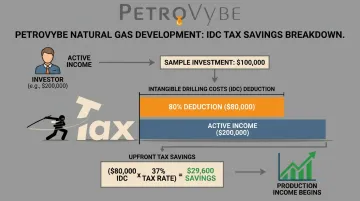
Consider the tax mechanics. Intangible Drilling Cost (IDC) deductions let qualifying working-interest holders deduct a substantial share of development costs against active income, including W-2 earnings and capital gains. PetroVybe partners received a 94% deduction against active income in 2024 and 91% in 2025.
On a $100,000 investment, a deduction in that range can generate tens of thousands of dollars in immediate tax savings, long before a single barrel is produced.
That upfront tax benefit functions like a residual income boost: it's dollar value delivered above and beyond what a standalone percentage return would suggest.
For comparison, the Cambridge Associates U.S. Private Equity Index returned 8.1% for calendar year 2024, net of fees and carried interest, according to Cambridge Associates' 2024 benchmark commentary. It's a useful institutional comparator, though a different asset class entirely with different liquidity and risk characteristics than a direct energy working interest.
The takeaway: an investment's true worth isn't captured by ROI or RI alone. It's the combination of percentage return, dollar-based residual value, and tax efficiency that tells the full story.
Curious how this plays out in practice? Explore how PetroVybe structures its natural gas development opportunities for accredited investors targeting strong IRR alongside meaningful tax-advantaged residual value.
Conclusion
RI and ROI answer different financial questions. RI reveals the dollar value created above your cost of capital, while ROI reveals relative efficiency. The strongest financial decisions, whether inside a corporation or inside a personal portfolio, come from using both together.
For corporate managers, RI-based thinking prevents rejecting projects that genuinely add value just because they'd lower an average. For investors, pairing ROI with RI-style analysis (alongside MOIC and IRR) helps surface opportunities like PetroVybe's tax-advantaged natural gas development projects, which perform well on both an absolute and relative basis.
Frequently Asked Questions
Which is better, residual income or return on investment?
Neither is universally better. ROI works best for comparing investments of different sizes, while RI is more reliable for confirming absolute value creation above your cost of capital.
Is residual income a good investment?
As an accounting metric, positive RI means value was created above the required return, which is favorable by definition. This differs from "residual income" as passive/recurring income streams, which can also build wealth when returns exceed your required rate.
How do you calculate return on investment (ROI) and residual income?
ROI = net operating income ÷ average operating assets. RI = net operating income − (required rate of return × operating assets). ROI yields a percentage; RI yields a dollar figure.
What is the main difference between residual income and ROI?
RI is expressed in absolute dollars, while ROI is expressed as a percentage. That makes RI better for single-investment value checks and ROI better for cross-comparison.
Can residual income be negative, and what does that mean?
Yes. Negative RI means the investment earned less than the minimum required return, signaling value destruction rather than value creation, even if the project was technically profitable.
Why would a company use residual income instead of just ROI?
RI prevents managers from rejecting profitable projects simply because they'd lower an already-high average ROI. It keeps decisions focused on maximizing total company value, not just improving a ratio.