

Here's the problem: most investors misunderstand it. Confusion between cost depletion and percentage depletion causes working interest and royalty owners alike to miss deductions they're entitled to. This guide breaks down what the depletion allowance actually is, who qualifies, how to calculate both methods, the limits that apply, and how it fits into a broader tax strategy for accredited investors.
Key Takeaways
- Depletion lets working interest and royalty owners deduct income as reserves are produced and sold
- Choose cost depletion (basis-based) or percentage depletion (flat 15% of gross income)
- Qualifying needs an "economic interest": capital invested plus rights to production income
- Paired with intangible drilling cost deductions, percentage depletion compounds returns for direct investors
What Is the Oil & Gas Depletion Allowance?
Depletion is the tax code's answer to a straightforward problem: oil and gas reserves run out. IRC Sections 611 through 613 let mineral property owners deduct a portion of income each year to account for the gradual exhaustion of that reserve as it's produced and sold. Think of it as depreciation's older cousin: instead of accounting for wear on equipment, it accounts for a shrinking underground asset.
This is often called the "wasting asset" concept. Because oil and gas reserves are finite, capital invested in them gets recovered gradually through the tax code rather than lost outright, which is one reason drilling ventures, inherently risky, continue to attract private capital.
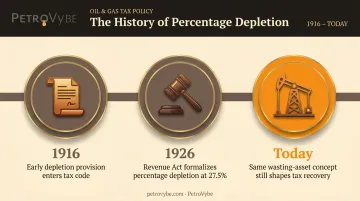
This wasting-asset logic isn't new, either. Its lineage stretches back over a century:
- 1916: An earlier version of depletion enters the tax code
- 1926: The Revenue Act formalizes the percentage-of-gross-income method, originally set at 27.5%
- Today: The same concept still shapes how producers and investors recover capital
It has stuck around because it works. The U.S. Treasury's FY2026 tax expenditure budget estimates the "excess of percentage over cost depletion" for oil and gas at $1.40 billion in FY2024 and $1.48 billion in FY2025 alone, revenue that flows to producers and investors instead of the Treasury.
Who Qualifies for the Depletion Deduction?
The IRS doesn't hand depletion to anyone who buys energy stock. Qualifying requires an "economic interest" in the mineral property, defined by Treasury Regulation 1.611-1(b)(1) as a two-part test:
- You've invested capital in the mineral deposit itself, not just in a company operating nearby.
- You hold a legal right to income from extraction, meaning you must look to production for a return on that capital.
A royalty check alone doesn't automatically satisfy this, and neither does a hauling or processing contract. The distinction separates genuine ownership from what the IRS calls a "mere economic advantage."
Two ownership types typically meet the test:
- Working interest owners who bear development costs and operate (or fund the operation of) the well
- Royalty interest owners who receive a share of production income without paying development costs
PetroVybe's limited partnership units, for example, grant investors a direct working interest in each well, satisfying both prongs of this test.
One detail that catches people off guard: the deduction only applies once oil or gas is actually sold and income is reported. Lease bonus payments and most advance royalties don't qualify for percentage depletion, though cost depletion can sometimes apply to them in the year received.
Cost Depletion vs. Percentage Depletion: Which Method Saves More?
The IRS requires you to calculate both methods each year you're eligible, then claim whichever produces the larger deduction. That single rule trips up more DIY filers than any other part of this code section.
Cost Depletion Method
The formula:
Cost depletion = (adjusted basis ÷ total recoverable units) × units sold
- Determine your adjusted basis in the property.
- Estimate total recoverable units (units sold plus units remaining).
- Divide basis by recoverable units, then multiply by units sold that year.
This method is capped at your total investment. Once you've recovered your full basis, it stops producing a deduction. It tends to deliver the biggest benefit early in a well's life, when your basis is still largely intact. IRS Publication 535 walks through this calculation step by step.
Percentage Depletion Method
The formula:
Percentage depletion = gross income from the property × 15%
Unlike cost depletion, this method has no ceiling tied to your original investment. It can continue even after your basis hits zero, an allowance defined in 26 U.S. Code § 613A — the method's real long-term advantage. A well can keep generating deductions for its entire producing life.
There's a volume catch. The 15% rate applies in full only up to a small producer's depletable quantity, generally 1,000 barrels of oil (or 6 million cubic feet of gas) in average daily production. Production above that threshold is simply excluded from the calculation.
Side-by-Side Example
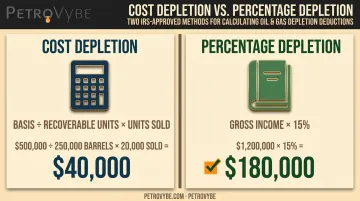
Say you hold a working interest with a $500,000 adjusted basis and 250,000 estimated recoverable barrels. In Year 1, you sell 20,000 barrels for $1,200,000 in gross income.
- Cost depletion: ($500,000 ÷ 250,000) × 20,000 = $40,000
- Percentage depletion: $1,200,000 × 15% = $180,000
Percentage depletion wins here, and that's the one you'd claim. Fast forward a few years, once your $500,000 basis is exhausted, cost depletion drops to zero. Percentage depletion, tied only to gross income, keeps producing a deduction as long as the well produces.
Depletion Limits, Caps, and IRS Reporting Requirements
Percentage depletion isn't unlimited. Two separate caps apply:
- Property-level limit: Your deduction can't exceed 100% of the property's net taxable income for the year, calculated before the depletion deduction itself.
- Taxpayer-level limit: Total percentage depletion across all your oil and gas properties is capped at 65% of your overall taxable income. Anything disallowed carries forward to future years under the same 65% ceiling.
Where you report the deduction depends on how you hold your interest:
| Interest Type | Where Reported | Self-Employment Tax? |
|---|---|---|
| Royalty interest | Schedule E (Form 1040) | Generally no |
| Working interest | Schedule C (Form 1040) | Often yes, via Schedule SE |
That difference matters. Investors holding working interest positions, such as through a limited partnership structure like PetroVybe's, report income on Schedule C and may owe self-employment tax. Royalty income on Schedule E usually avoids that tax, but royalty holders give up the IDC deduction rights working interest owners retain.
Documentation isn't optional if you want the deduction to survive an audit:
- Reserve engineering reports establishing recoverable units
- Production and sales records tying gross income to the specific property
- Adjusted basis calculations, updated whenever estimates change materially
Given the interplay between basis tracking, production records, and two different reporting schedules, a CPA who specializes in oil and gas earns their fee here. Their documentation work is what keeps the deduction intact if the IRS asks questions.
Depletion Rates by Resource: Why Oil & Gas Gets a Favorable 15% Rate
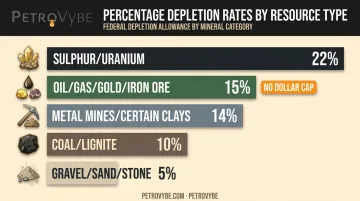
Oil and gas aren't the only resources eligible for percentage depletion, but they get one of the better deals in the tax code.
| Resource | Percentage Depletion Rate |
|---|---|
| Sulphur, uranium | 22% |
| Oil, gas, gold, iron ore | 15% |
| Most metal mines, certain clays | 14% |
| Coal, lignite | 10% |
| Gravel, sand, stone | 5% |
The rate looks modest next to sulphur's 22%, but oil and gas has something most other categories lack: no hard dollar cap. The only limits are income-based: the 100% property limit and 65% taxpayer limit covered above. Coal and gravel producers face lower percentage rates and often run into additional structural restrictions.
For private investors weighing extractive industries, oil and gas stands out: a competitive 15% rate paired with income-based rather than dollar-based limits makes it one of the more favorable depletion classes available.
Depletion Allowance as Part of a Complete Oil & Gas Tax Strategy
Depletion rarely works alone in a serious tax strategy. Its real power shows up when paired with Intangible Drilling Cost (IDC) deductions.
Here's how the two compound:
- IDCs hit first, and hit hard. In the year a well is drilled, IDCs, covering wages, fuel, supplies, and other non-salvageable drilling costs, can be deducted immediately against active income, including W-2 wages and capital gains.
- Depletion continues afterward. Once the well is producing, percentage depletion shelters a portion of income year after year, for the life of the well, not just year one.
- Only working interest investors get both. Royalty-only owners can claim depletion, but they never bear drilling costs, so they don't qualify for IDCs.
Working interest investors, by contrast, get both benefits stacked together. This is the structure behind PetroVybe's direct working interest natural gas development projects in South Texas and the Gulf Coast Basin.
PetroVybe's accredited investor partners have documented total tax deduction results of 94% against active income in 2024 and 91% in 2025. This reflects first-year IDC deductions, which alone can represent 60-80% of invested capital, combined with ongoing percentage depletion.
The tax benefit is only half the story. Ongoing depletion allowance supports the passive income partners collect as wells produce. PetroVybe targets a 10-year MOIC of roughly 2.2x to 5.8x and an IRR near 26% for its natural gas partnerships, with monthly distributions during peak production periods.
Before committing capital anywhere, verify the operator's reserve claims.
PetroVybe's projects back this up with third-party validation:
- A $48 million PV-09 proved reserves valuation, engineered by an independent firm
- A Chief Geophysicist with a documented 75.2% well success rate over a 48-year career, well above the industry average of below 40%
Third-party validation matters because depletion and IDC deductions are only as good as the reserves underneath them. Always confirm your specific calculations with a qualified CPA before investing.

Frequently Asked Questions
What is the depletion rate for oil and gas?
The standard IRS percentage depletion rate for oil and gas is 15% of gross income from the property. This is subject to the property-level 100% limit and the taxpayer-level 65% limit described above.
What qualifies for depletion deduction?
You need an "economic interest": invested capital in the mineral deposit itself, plus a legal right to income from its extraction. Owning energy stock or a service contract doesn't meet this test.
What is the difference between cost depletion and percentage depletion?
Cost depletion ties your deduction to your basis in the property and stops once that basis is fully recovered. Percentage depletion is a flat 15% of gross income and can continue after your basis reaches zero.
Can percentage depletion exceed my original investment?
Yes. Unlike cost depletion, percentage depletion isn't capped at your original capital invested. Over a well's producing life, cumulative deductions can exceed what you originally put in.
Is the depletion allowance the same as depreciation?
They're similar in concept but not identical. Depreciation applies to wear on tangible equipment, while depletion applies specifically to the exhaustion of a natural resource reserve.
Do I need to own an oil company to claim depletion?
No. Individual royalty owners and independent producers, including accredited investors in working interest partnerships, can claim depletion. Large integrated oil companies are excluded from percentage depletion.