

Incremental cash flow is the tool that answers this question. It isolates the cash impact caused only by the decision in front of you, stripping out everything that would happen anyway.
This math applies whether you're a manufacturer weighing a new production line or an oil and gas operator deciding whether the next well is worth the capital. In capital-intensive sectors, where a single project can require millions upfront, getting this calculation wrong is expensive.
This article covers the definition, the formula, a step-by-step calculation, why it drives capital budgeting decisions, and the mistakes that trip up even experienced analysts.
Key Takeaways
- Incremental cash flow isolates only the cash impact a decision causes, excluding sunk costs
- Core formula: after-tax cash flows adjusted for taxes, depreciation, and working capital changes
- Positive figures signal value creation; negative figures mean the project needs re-pricing
- Common pitfalls: sunk costs, ignored opportunity costs, and missed cannibalization effects
- Foundational to NPV and IRR, the core tools for ranking competing investments
What Is Incremental Cash Flow?
Incremental cash flow measures the difference between a company's projected cash flow with a project versus without it. According to the Corporate Finance Institute, it's the cash flow a business generates specifically because it undertook a new project, not the cash flow generated by the business as a whole.
Not every dollar tied to a project counts. Analysts apply a three-part test before including any line item:
- It must be an actual cash movement: not an accounting entry like depreciation, though depreciation still matters for its tax effect
- It must occur in the future: money already spent (sunk costs) never qualifies
- It must be incremental: costs the company pays regardless of the decision don't count

A positive result means the decision puts more cash into the business than it takes out. A negative result means the project drains cash and likely needs re-pricing, cost-cutting, or rejection outright.
The Incremental Cash Flow Formula
The most common way to frame the calculation:
Incremental Cash Flow = (Cash Inflows from the Project − Cash Outflows from the Project) − Initial Investment
You'll also see it framed as Cash Flow With the Project − Cash Flow Without the Project. Both approaches land on the same number: the first isolates project-specific inflows and outflows directly, while the second compares two complete forecasts and nets out the difference.
Whichever method you use, don't count the initial investment twice. If it's already embedded in your outflow projections, it shouldn't be subtracted again separately.
Key Components That Affect the Calculation
Six variables feed into nearly every incremental cash flow calculation:
- Incremental revenue: new sales or cost savings directly tied to the project
- Incremental operating expenses: added materials, labor, or overhead
- Tax impact: taxes owed on the additional profit the project generates
- Depreciation add-back: a non-cash expense, but it reduces taxable income and creates a tax shield
- Changes in net working capital: extra inventory, receivables, or payables the project ties up
- Initial investment and salvage value: the upfront outlay, plus any after-tax proceeds from selling equipment at the end
How to Calculate Incremental Cash Flow (Step-by-Step)
Building the calculation is a five-step process:
- Estimate incremental cash inflows. New sales, cost savings, or efficiency gains created directly by the decision.
- Identify incremental cash outflows. Added materials, labor, marketing, or operating costs tied to the decision.
- Calculate the tax impact. Add back non-cash depreciation for its tax-shield benefit.
- Adjust for working capital changes. Account for additional inventory or delayed customer payments the project ties up.
- Subtract the initial investment. Add any salvage or terminal value to reach net incremental cash flow.

Worked Example
Say a manufacturer is evaluating a new production line costing $500,000, with a $20,000 increase in working capital at the start.
| Line Item | Year 0 | Years 1-4 | Year 5 |
|---|---|---|---|
| Incremental revenue | — | $600,000 | $600,000 |
| Incremental operating costs | — | $350,000 | $350,000 |
| Depreciation (straight-line, 5 yrs) | — | $100,000 | $100,000 |
| EBIT | — | $150,000 | $150,000 |
| Tax (25%) | — | $37,500 | $37,500 |
| Net income | — | $112,500 | $112,500 |
| Add back depreciation (OCF) | — | $212,500 | $212,500 |
| After-tax salvage value | — | — | $37,500 |
| NWC recovery | — | — | $20,000 |
| Initial investment + NWC | -$520,000 | — | — |
| Net incremental cash flow | -$520,000 | $212,500 | $270,000 |
The project generates positive incremental cash flow every year after launch.
Compare this to a second option: a workover on an existing asset requiring only $150,000 upfront but producing $60,000 annually for three years. Running both streams through NPV or IRR reveals which option creates more value per dollar committed.
Why Incremental Cash Flow Matters in Capital Budgeting
Incremental cash flow isn't just an academic exercise. It's the raw input for Net Present Value (NPV) and Internal Rate of Return (IRR), the two metrics companies use to decide which projects get funded.
In a widely cited survey of CFOs, Graham and Harvey found that 74.9% of respondents always or almost always used NPV, and 75.7% used IRR when evaluating capital projects. Both tools depend entirely on accurate, dated incremental cash flow streams: garbage in, garbage out.
This discipline matters most in capital-intensive industries. Onshore drilling and completion costs alone have ranged from $4.9 million to $8.3 million per well, according to EIA historical cost data across major U.S. shale plays. When a single well requires that kind of upfront capital, operators can't afford to model the economics loosely.
Here's the trap: a company's overall cash flow can look healthy while one unvetted project drains cash underneath it. Total profitability masks individual bad decisions. That's exactly why per-project analysis matters more than headline numbers.
PetroVybe's leadership models this discipline directly:
- CFO Clayton Riddle, a financial strategist and petroleum engineer, built financial models and technical valuations across more than 70 upstream and midstream acquisition opportunities before joining the company.
- Chief Geophysicist Michael Stamatedes brings a 48-year track record and a 75.2% well-location success rate (well above the sub-40% industry average) to evaluating every prospect before it reaches accredited investor partners.
- Capital only flows toward new drilling, workovers, or acquisitions when the added cash flow clears the return bar, a standard that underpins compounding production and target returns over the 10-year hold period.
Incremental Cash Flow vs. Related Concepts
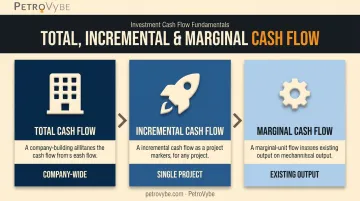
It's easy to confuse incremental cash flow with adjacent terms. The table below breaks down the key differences:
| Concept | Definition | Scope |
|---|---|---|
| Total cash flow | Tracks every dollar moving through the entire business, cumulatively, over a period | Company-wide, across all activities |
| Incremental cash flow | Isolates the change in cash flow caused by one specific decision | A single project, investment, or new initiative |
| Marginal cash flow | Measures the effect of producing slightly more of an existing product or service | Existing product or service output only |
A company can report strong total cash flow company-wide while a single project (such as a $2 million drilling initiative) sits at negative incremental cash flow underneath it. Incremental cash flow casts a wider net than marginal cash flow, covering entirely new projects, ventures, or acquisitions that didn't exist before.
The practical takeaway: never approve a project based on how the whole company looks financially. Evaluate it on its own incremental merits first.
Common Mistakes to Avoid When Calculating Incremental Cash Flow
Four errors show up repeatedly in real-world capital budgeting:
- Including sunk costs. Money already spent, like a completed feasibility study or prior R&D, can't be recovered and doesn't belong in the calculation.
- Ignoring opportunity costs. If a project uses space, staff, or equipment that could earn cash elsewhere, that forgone value counts as a cost.
- Missing cannibalization effects. A new product or well can pull revenue from an existing line, and that lost income must reduce the calculated benefit.
- Misallocating committed costs. Facility rent and other costs the company pays regardless of the decision aren't incremental, even if an accountant allocates a share to the project.
The test for all four: ask what happens to the cash flow if you don't take the project. If the number doesn't change, it doesn't belong in the calculation.
Frequently Asked Questions
What is the difference between cash flow and incremental cash flow?
Overall cash flow tracks all money moving through the entire business. Incremental cash flow isolates only the additional cash created or lost by one specific decision, like a new project or acquisition.
What is the difference between relevant and incremental cash flows?
Relevant cash flows are the broader category: future, cash-based, and different between alternatives. Incremental cash flow is the specific test within that definition that excludes committed or unavoidable costs.
What is the formula for incremental cash flows?
It's expressed as (cash inflows − cash outflows) − initial investment, adjusted for taxes, depreciation add-backs, and changes in working capital over the project's life.
What does a positive incremental cash flow indicate?
A positive figure means the decision adds net cash to the business beyond what would happen without it, strengthening the case for moving forward with the project.
Are sunk costs ever included in incremental cash flow calculations?
No. Sunk costs occurred in the past and can't be changed by the current decision, so they're always excluded from the calculation regardless of how large they were.
Why does incremental cash flow analysis matter for capital-intensive industries like oil and gas development?
With large upfront costs often running into the millions per well, operators must confirm each new well or acquisition adds real value on its own merits before committing significant capital.