
Introduction
Raising capital starts with knowing where to look — and accredited investors aren't easy to find through a Facebook ad or a cold email blast. Public advertising is often illegal, depending on your offering structure, which makes sourcing genuinely hard.
Only 18.5% of U.S. households qualified as accredited investors in 2022, up from just 1.8% in 1983, according to SEC staff research published in 2025. That's a real pool of capital, but it's scattered and protected by strict marketing rules.
Finding these investors requires a deliberate strategy, not luck, and results vary depending on your industry and outreach method. This guide covers the exact steps to find accredited investors, the best channels to use, what compliance requires, and the mistakes that sink otherwise good deals.
Key Takeaways
- Sourcing success depends on pairing the right channels with proper SEC Regulation D compliance
- 506(b) allows self-certification but bans public marketing; 506(c) permits solicitation but requires verification
- Verified reviews and transparent investor relations accelerate trust-building
- Wrong investor targeting and skipped compliance prep are the two costliest mistakes
- Platforms, broker-dealer networks, referrals, and industry communities remain top sourcing channels in 2026
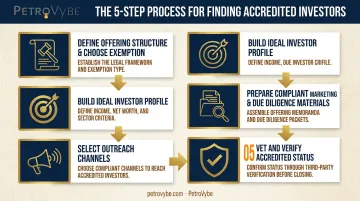
How to Find Accredited Investors: Step-by-Step
Finding investors follows a specific sequence, and skipping a step risks wasted outreach or a compliance headache down the road.
Step 1: Define Your Offering Structure and Choose Your Regulation D Exemption
This is the foundational decision. It determines whether you can publicly advertise at all.
| Requirement | Rule 506(b) | Rule 506(c) |
|---|---|---|
| General solicitation | Prohibited | Permitted, if all conditions are met |
| Investor accreditation | Self-certification via reasonable belief | Must verify every purchaser |
| Non-accredited purchasers allowed | Up to 35, if sophisticated | None |
| Offering amount | Unlimited | Unlimited |
Under 506(c), issuers must take documented, reasonable steps to verify accredited status rather than relying on a simple checkbox. PetroVybe, for example, structures its PetroVybe ONE offering under 506(c) and requires third-party verification before any investor is accepted.
Step 2: Build Your Ideal Investor Profile
Match your offering to the right investor type before you start outreach. Consider:
- Industry fit: energy, real estate, and tech investors have different risk appetites and hold periods
- Check size: SEC data shows real estate offerings carried a $2 million median size between 2009-2017, while non-financial operating companies averaged closer to $1 million
- Liquidity tolerance: long-hold private placements need investors comfortable locking up capital for years, not months
Step 3: Select Your Outreach Channels
Combine two or three methods rather than relying on one. Platforms, referrals, and direct outreach each fill different gaps, which we break down in the next section.
Step 4: Prepare Compliant Marketing and Due Diligence Materials
Have these finalized before any investor conversation begins:
- Private placement memorandum (PPM)
- Pitch deck and financial model
- Subscription agreement and limited partnership agreement
- Third-party engineering or valuation reports, if applicable
PetroVybe centralizes these on a dedicated Data Drive, giving prospective partners access to its PPM, ProForma P&L, reserve reports, and audited financials before any commitment is discussed.
Step 5: Vet and Verify Accredited Status Before Closing
"Reasonable steps" to verify status are a legal requirement under 506(c), not a best practice you can skip. Failing to document this step exposes issuers to rescission claims even after the investment closes.
Where to Find Accredited Investors: Best Channels & Platforms
Channel effectiveness depends on your offering size, your industry, and whether you're operating under 506(b) or 506(c). Here's where issuers actually find results.
Three channels do most of the heavy lifting:
- Online accredited investor platforms: Adviser-facing marketplaces like iCapital offer curated private equity, credit, and real-asset strategies distributed through financial advisors. Scale doesn't guarantee every lead arrives pre-verified.
- Broker-dealers and RIAs: These firms maintain rosters of accredited clients and introduce suitable deals for a placement fee, sometimes structured as a 10% cash commission plus warrants. Brokers must generally be registered first.
- Referral networks: Warm introductions from current investors, CPAs, and attorneys typically outperform cold outreach. Investor.gov names brokers, acquaintances, and relatives as common paths for private placements, though under 506(b) this outreach must stay non-public.
Industry Events, Conferences, and Trade Associations
Sector-specific events put you in a room with qualified investors face-to-face. PetroVybe has run its own version of this model, hosting a Partner Summit bringing together investors, bank partners, and royalty owners, plus a live "Rig Day" virtual session walking prospects through project economics.
Direct Digital Marketing and Content Authority
Trust gets built before a term sheet is signed. Educational content, transparent reporting, and third-party validation all matter here.
PetroVybe, for instance, points prospective partners to independent, verified reviews on Invest Clearly rather than only its own marketing copy. It also assigns a dedicated Director of Partner Relations to manage transparent, ongoing communication with both prospective and current investors.
What You Need Before Approaching Accredited Investors
Preparation prevents legal exposure and wasted effort. Before your first outreach, confirm you have:
- Formation and filing: Form D filed with the SEC (within 15 calendar days of first sale) plus any applicable state blue-sky notices
- Investor-facing documents: a finalized PPM, subscription agreement, and financial model ready for review
- A verification system: decide in advance whether you'll use internal review or a third-party letter, especially critical for 506(c) offerings
A PPM technically isn't required by law. However, the SEC's investor guidance notes it's the standard way issuers disclose management background, offering terms, and risk factors without running afoul of antifraud rules.
Common Mistakes When Finding Accredited Investors
Even well-intentioned issuers stumble here. Watch for these four traps:
- Publicly promoting a 506(b) deal: internet posts, social media, and seminars count as general solicitation, disqualifying 506(b) reliance instantly
- Targeting the wrong investor profile: retail-minded investors often struggle with illiquid, multi-year placements, and mismatched expectations create friction later
- Relying only on self-certification when 506(c) verification is required: one fund received a $50,000 SEC penalty for checkbox-only verification on a $600,000 raise from 22 investors
- Over-promising returns or tax benefits without proper disclosure: the SEC's oil-and-gas investor alert flags guaranteed returns and hidden proceeds usage as fraud warning signs
How to Verify Accredited Investor Status Once You Find Them
Verification is a distinct legal step from sourcing, and it's mandatory for every 506(c) offering.
| Method | What's Reviewed |
|---|---|
| Income | Tax returns, W-2s, 1099s, or K-1s for two years, plus written expectation of meeting the threshold again |
| Net worth | Bank and brokerage statements, liabilities, real estate valuations (excluding primary residence) |
| Third-party letter | Confirmation from a registered broker-dealer, RIA, attorney, or CPA, dated within the prior three months |
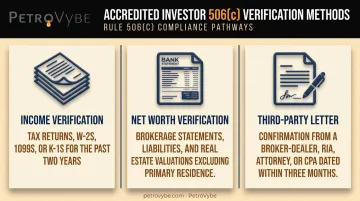
PetroVybe requires the third option exclusively for PetroVybe ONE. Before accepting any investment, the company mandates:
- A signed letter from a CPA, tax attorney, or licensed financial advisor
- Confirmation dated within the prior three months
- No self-certification or internal shortcuts
That single requirement does two things: it satisfies the SEC's 506(c) verification standard, and it gives both sides a documented record if questions ever arise later.
Frequently Asked Questions
What is the best platform for accredited investors?
There isn't a single "best" platform — it depends on your offering type. Private credit marketplaces, pre-IPO platforms, and direct issuer sites each serve different deal structures and investor bases.
How much money do I need to be an accredited investor?
You need a net worth over $1 million (excluding your primary residence), or income over $200,000 individually or $300,000 jointly for two consecutive years with reasonable expectation of the same going forward.
What should you never tell investors?
Avoid guaranteed returns, unverifiable performance claims, omitted risk disclosures, or misrepresented deal terms. All of these can trigger securities fraud claims regardless of intent.
How do you verify someone is an accredited investor?
Through income documentation (tax returns, W-2s), net worth documentation (bank and brokerage statements), or a third-party letter from a CPA, attorney, or registered advisor confirming their status.
Can I publicly advertise to find accredited investors?
Only under Rule 506(c), and only if you verify every single purchaser's accredited status through documented, reasonable steps. Rule 506(b) prohibits public advertising entirely.
What's the difference between Rule 506(b) and 506(c) for finding investors?
506(b) allows self-certification but bans general solicitation, limiting you to private, relationship-based outreach. 506(c) permits broad advertising but requires mandatory, verified proof of accreditation for every investor.