
That combination has a lot of savers asking the same question: what should I actually put my money into instead?
The FDIC's national average for a 12-month CD sat at just 1.68% in July 2026, while CPI-U inflation ran 3.5% over the same period. Do that math and the average CD holder lost purchasing power before taxes even entered the picture.
This guide walks through low-risk liquid options, tax-advantaged fixed income, and growth-oriented alternatives, so you can match a strategy to your actual goals instead of defaulting to whatever your bank is advertising this month.
Key Takeaways
- CDs trade liquidity and tax efficiency for a guaranteed rate that often trails inflation
- Alternatives span three tiers: liquid low-risk accounts, tax-advantaged bonds, and growth-oriented assets
- Your ideal choice depends on liquidity needs, tax bracket, and risk tolerance, not just APY
- Accredited investors gain access to added tax-deduction strategies, including private natural gas development
Why Look Beyond CDs?
CD interest is taxed as ordinary income at the federal level, and often at the state and local level too, depending on where you live. A high earner in the 32% federal bracket loses nearly a third of every dollar of CD interest before it hits their account.
There's no capital gains treatment, no exemption, just a straight tax bill.
Then there's inflation. Top-tier CD offers have reached 4.35% APY according to NerdWallet's rate tracker, but that's the best of the best. Most depositors are earning far closer to the national average, which barely keeps pace with a 3.5% inflation rate before tax is even applied.
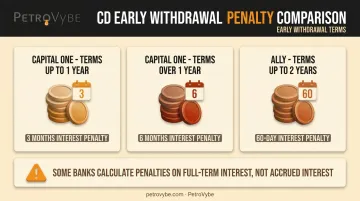
Early withdrawal penalties compound the problem, and they aren't standardized across the industry:
- Capital One charges three months of interest on terms up to a year, six months on longer terms
- Ally applies a 60-day penalty on terms up to two years
- Some institutions calculate penalties on the full term's interest, not just what's accrued
If your emergency fund shifts, or a better opportunity comes along, that penalty locks up your capital right when you need flexibility most.
The Renewal Trap
Here's something banks don't advertise: when a CD matures, it often auto-renews into whatever promotional rate is current, not the rate you originally locked in. Investors who aren't paying close attention can find themselves earning a fraction of what they signed up for, with another penalty waiting if they want out.
Low-Risk, Liquid CD Alternatives
If safety and access to cash matter most, several options beat a standard CD without asking you to accept meaningfully more risk.
High-yield savings accounts (HYSAs) currently lead the pack, with Forbright Bank listed at 4.15% APY as of July 2026. These accounts are FDIC-insured up to $250,000 per depositor, per bank, per ownership category, and funds remain accessible, though some banks still cap monthly transactions.
Money market accounts (MMAs) blend savings with checking features. Zynlo Bank's 3.90% APY offer requires no minimum deposit, and MMAs typically include debit card or check-writing access. They're FDIC-insured just like HYSAs, though some carry minimum balance requirements to earn the top rate.
Money market funds work differently. These are brokerage-based investments in short-term securities, covered by SIPC rather than FDIC insurance. Vanguard's money market funds carry expense ratios between 0.07% and 0.12%, and yields tend to run slightly higher than bank products since there's no branch overhead to fund.
Treasury bills and notes offer something unique: interest that's exempt from state and local tax. Rates as of July 24, 2026 ranged from 3.77% on 4-week bills to 4.69% on 10-year notes. One catch: securities purchased through TreasuryDirect must stay in the account for 45 days before you can sell or transfer them.
Brokered CDs sidestep early withdrawal penalties entirely. Instead of paying a fee to exit early, you sell the CD on the secondary market. That flexibility comes with a trade-off: you might sell for more or less than face value, depending on how rates have moved since purchase.
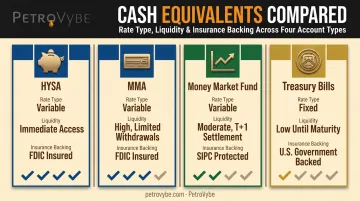
Quick Comparison
| Account Type | Rate Type | Liquidity | Insurance |
|---|---|---|---|
| HYSA | Variable | High, some transaction limits | FDIC |
| MMA | Variable | High, check/debit access | FDIC |
| Money market fund | Variable | High, brokerage settlement | SIPC |
| Treasury bills | Fixed at purchase | 45-day TreasuryDirect hold | U.S. government backing |
The pattern here: HYSAs and MMAs win on simplicity and insurance, while Treasuries add a tax break that bank accounts can't match.
Tax-Advantaged Fixed-Income Alternatives
For investors in higher tax brackets, the after-tax return matters more than the sticker rate. This is where CDs really start to lag.
Municipal bonds often pay interest exempt from federal tax, and sometimes state and local tax too if you buy bonds issued in your home state. The S&P Municipal Bond High Yield Index showed a 5.84% yield to maturity in July 2026. Run that through the tax-equivalent yield formula:
Tax-equivalent yield = tax-exempt yield ÷ (1 − marginal tax rate)
For an investor in the 37% federal bracket, a 5.84% muni yield equates to a 9.27% taxable yield. No CD on the market comes close to that on an after-tax basis.
U.S. Savings Bonds offer a different kind of tax advantage: deferral. Series I bonds issued between May and October 2026 carry a 4.26% composite rate, adjusted for inflation twice a year, while Series EE bonds earn a flat 2.40% but guarantee doubling in value after 20 years.
Both let you skip paying tax until redemption, and both are exempt from state and local income tax. Purchase limits cap at $10,000 per person, per bond type, per year.
Defined maturity bond funds, like Invesco's BulletShares or iShares' iBonds, hold diversified bond portfolios tied to a specific maturity year. You get CD-like predictability with daily trading liquidity, though NAV can fluctuate before the fund's target date arrives.
Choosing between these options really comes down to your bracket:
- High earners benefit most from municipal bonds' federal exemption
- Moderate earners may find savings bonds' state and local tax exemption sufficient
- Anyone prioritizing deferral over immediate income should look at savings bonds
The trade-off across this entire category: better tax treatment than CDs, but modest interest rate risk if you need to sell before maturity.
Higher-Growth and Alternative Investment Options
Once liquidity and tax efficiency are covered, some investors want a portion of their portfolio working harder. This is where CDs simply aren't built to compete.
Dividend-paying stocks combine regular income with the potential for share-price appreciation. You're accepting more volatility, but historically, dividend growers have outpaced inflation over long holding periods.
ETFs offer low-cost diversification across sectors, asset classes, or entire markets, with liquidity similar to buying an individual stock. They're a straightforward way to build exposure without picking individual winners.
Real estate, through REITs or crowdfunding platforms, gives you an inflation-resistant, income-generating asset class. It's typically less liquid than public securities, though publicly traded REITs do trade daily.
Private Natural Gas Development
There's a category most CD alternative guides skip entirely: private energy development, available to accredited investors seeking both tax efficiency and above-market return potential.
Here's the mechanism: intangible drilling cost (IDC) deductions let qualifying investors write off a substantial share of their investment against active income, including W-2 wages and capital gains, not just passive income. That's a meaningful difference from CD interest, which is fully taxable with no offsetting deduction available.
PetroVybe structures its ONE program around exactly this model. The company develops natural gas projects across roughly 58,000 acres in Lavaca County, South Texas, and the Gulf Coast Basin, backed by around 400 producing wells and 57-plus planned new wells. A few specifics stand out:
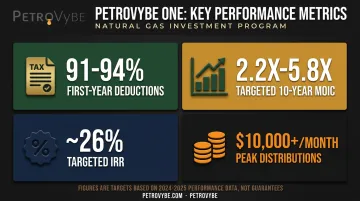
- First-year deductions: ran 91-94% against active income for recent partners, based on the company's own 2024 and 2025 performance data
- Targeted 10-year MOIC: roughly 2.2x to 5.8x, with a targeted IRR near 26%
- AI-driven demand: production is tied to rising electricity demand from AI data centers, since natural gas already supplies close to 42% of U.S. grid power, according to U.S. Energy Information Administration data
- Distributions: structured as passive income, projected to peak above $10,000 per month during peak production
This isn't a cash-equivalent. It requires a minimum $100,000 commitment, accredited investor status, and a hold period of roughly 2-3 years before first distributions, with the broader thesis built around a 10-year horizon.
But for investors looking to offset a heavy tax year while building a long-term, tangible asset position, it's a different tool than anything in the CD or bond world.
These growth and alternative options carry real risk and reduced liquidity. They belong as a slice of a diversified portfolio, not a wholesale replacement for the cash reserves a CD or HYSA is meant to protect.
How to Choose the Right CD Alternative for You
Three factors should drive your decision, not the headline rate:
- Liquidity needs: How soon might you need this money? Emergency funds and near-term goals belong in HYSAs or MMAs, not anything with a hold period.
- Tax bracket: Higher earners get more mileage from municipal bonds, Treasuries, or deduction-driven vehicles like private energy development than from taxable CD interest.
- Risk tolerance: How much price movement or illiquidity can you stomach in exchange for higher potential returns?
A simple framework:
- Short-term goals and emergency funds → HYSAs, MMAs
- Medium-term, tax-conscious savings → Treasuries, municipal bonds, savings bonds
- Long-term wealth building → Dividend stocks, ETFs, real estate, or private development opportunities
Before committing significant capital, especially into accredited-investor vehicles with longer holding periods, talk to a financial or tax advisor. The right mix looks different depending on your income, timeline, and how much of your portfolio is already tied up in cash-equivalents.
Frequently Asked Questions
What to invest in instead of CDs?
Options range from HYSAs and money market accounts for liquidity, to Treasuries and municipal bonds for tax efficiency, to dividend stocks, ETFs, real estate, and private energy development for higher growth potential. The right pick depends on your timeline and tax situation.
How much will a $10,000 3-month CD earn in 2026?
Using the FDIC's national 3-month CD average of 1.15%, a simple-interest calculation gives you $10,000 × 0.0115 × (3/12) = $28.75. Actual results vary by bank since compounding methods differ.
Is a CD alternative riskier than a CD?
It depends on which one. HYSAs and Treasuries carry similarly low risk to CDs, while growth-oriented options like stocks or private development investments carry more risk in exchange for higher potential returns.
What's the difference between a money market account and a money market fund?
Money market accounts are FDIC-insured bank products, while money market funds are SIPC-covered investment products typically bought through a brokerage. SIPC protects against custodial failure, not market losses.
Can I get tax benefits with CD alternatives?
Yes. Municipal bonds, Treasuries, and savings bonds offer various tax exemptions or deferrals, while private oil and gas development investments can offer substantial deductions against active income, including W-2 wages.
How do I decide which alternative fits my investment goals?
Weigh your timeline, tax bracket, and risk tolerance before moving money out of CDs. A financial advisor can help match the right vehicle, especially before committing to less liquid, higher-return alternatives.