

Confusing the two matters. It affects what you pay in fees, how much risk you're actually taking on, how quickly you can get your money back, and whether you even qualify to invest in the first place. A retail investor cannot simply "choose" a hedge fund the way they'd pick a mutual fund.
Beyond these two paths, a growing number of accredited investors are also looking at direct alternative investments, such as private natural gas development, for tax efficiency and passive income. We'll cover that option too.
Key Takeaways
- Asset management targets relative returns, diversification, and capital preservation for all clients
- Hedge funds chase absolute returns through leverage, restricted to accredited investors only
- Fee models diverge sharply: AUM-based fees for asset managers versus "two-and-twenty" for hedge funds
- No single winner: fit depends on risk tolerance, liquidity needs, and accreditation status
- Direct alternative investments open a third path: tangible assets plus tax advantages
Asset Management vs Hedge Fund: Quick Comparison
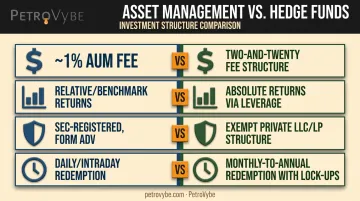
Comparing these two vehicles across four dimensions clarifies how they differ in practice: cost, risk approach, regulation, and liquidity.
Fees & Cost Structure
Asset Management: Fees are typically charged as a percentage of assets under management. Financial-adviser fees typically sit around 1% of managed assets, aligning manager compensation with client portfolio growth.
Hedge Funds: The classic model is "two-and-twenty" — a 1-2% annual management fee plus 20% of profits. The SEC describes this structure as standard, though newer fund launches have trended lower, with recent industry data showing average fees closer to 1.3% management and roughly 18% incentive.
Risk & Return Approach
Asset Management: Pursues relative returns, benchmarked against market indices, with an emphasis on long-term, risk-adjusted growth over chasing every market swing.
Hedge Funds: Pursues absolute returns regardless of market direction, using leverage, derivatives, and short positions. Leverage amplifies gains, but it amplifies losses just as fast.
Regulation & Investor Access
Asset managers register with the SEC and file Form ADV, a publicly available disclosure covering fees, conflicts, and business practices. This makes them accessible to retail and institutional clients alike.
Hedge funds operate under lighter regulation, typically as private LLCs or LPs exempt from registered-company status. They can't market broadly to the public under Rule 506(b), and participation requires accredited investor status: net worth over $1 million (excluding primary residence) or income above $200,000 individually ($300,000 jointly) for two consecutive years.
Liquidity & Transparency
| Factor | Asset Management | Hedge Funds |
|---|---|---|
| Redemption | Daily (mutual funds) or intraday (ETFs) | Monthly, quarterly, or annual windows |
| Lock-up periods | Rare | Often one year or more |
| Reporting | Standardized (prospectus, Form N-PORT) | Limited, manager discretion on valuation |
What Is Asset Management?
Asset management is the professional oversight of a client's portfolio, spanning stocks, bonds, real estate, and ETFs, with the goal of maximizing risk-adjusted returns over time.
Core Benefits and Structures
The value proposition centers on three things:
- Diversification across asset classes to reduce concentration risk
- Professional rebalancing that keeps allocations aligned with goals as markets shift
- Fee alignment, since AUM-based pricing means the manager benefits when the portfolio grows
Asset management shows up in several forms: mutual funds, ETFs, separately managed accounts, and registered investment advisor (RIA) relationships. Each offers a different balance of customization, cost, and control, but all share the same regulatory backbone.
Use Cases and Scale
Asset management dominates retirement accounts, institutional pension management, and diversified long-horizon portfolios. Pension funds, university endowments, and mass affluent individuals are the classic client base — investors who need steady growth over decades rather than a quick win.
The scale here is enormous. Global asset-management AUM reached an all-time high of $135 trillion in 2024, according to McKinsey, with organic growth accelerating to 3.7%. That's the traditional backbone of most people's retirement and institutional investing.
What Is a Hedge Fund?
A hedge fund is a pooled investment vehicle, structured as an LLC or LP, that uses aggressive strategies to chase absolute returns. Participation is restricted to accredited investors, and the barrier to entry is intentional.
Core Benefits and Strategy Types
Hedge funds use leverage, derivatives, and short-selling to generate alpha regardless of which direction markets move. For high-net-worth investors, this can provide genuine diversification against traditional stock-and-bond portfolios.
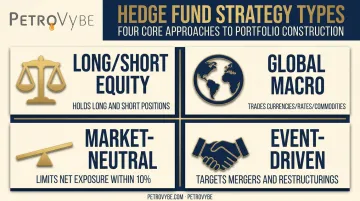
Four main strategy types dominate the space:
| Strategy | What it does |
|---|---|
| Long/short equity | Holds long and short equity positions, profiting from stock selection rather than market direction |
| Global macro | Trades currencies, rates, and commodities based on macroeconomic forecasts |
| Market-neutral | Limits net market exposure (often to within 10%) while exploiting pricing gaps |
| Event-driven | Targets mergers, restructurings, and other corporate special situations |
Use Cases and Industry Scale
Hedge funds typically sit in the "alternative allocation" sleeve of an institutional or high-net-worth portfolio, alongside traditional stocks and bonds. They tend to work best in volatile markets or for investors specifically seeking non-correlated returns rather than another equity-tracking vehicle.
That non-correlated appeal helps explain the industry's rapid expansion. HFR reported global hedge-fund capital surged past $5.15 trillion at year-end 2025, following a record $642.8 billion increase during the year alone. This growth confirms hedge funds have moved firmly into mainstream institutional portfolios.
Asset Management vs Hedge Fund: Which Is Better for You?
Key Decision Factors
Weigh these before choosing either path:
- Risk tolerance: Can you stomach leveraged strategies and potential drawdowns, or do you want steadier, benchmark-relative performance?
- Liquidity needs: Do you need same-day access to capital, or can it sit locked up for a year or more?
- Investment horizon: Are you investing for decades or looking for shorter-term positioning?
- Fee sensitivity: A 2-and-20 structure eats into returns differently than a flat AUM fee.
- Accreditation status: This alone rules hedge funds out for most retail investors.
Choose asset management if capital preservation and steady long-term growth are your priority. Choose hedge funds if you're accredited and comfortable trading liquidity and higher fees for potentially higher, less market-correlated returns.
Considering Direct Alternative Investments
Here's what both paths share: they remain tied to public market volatility, and neither offers much in the way of tax efficiency compared to owning a hard asset directly.
That's where direct alternative investments come in. For accredited investors, private oil and natural gas development offers tangible assets, passive income, and substantial upfront tax deductions against active income, something neither traditional asset management nor hedge funds typically provide.
PetroVybe is one example of this model. The Texas-based natural gas developer, operating in Lavaca County within the Gulf Coast Basin, gives accredited investors direct entry-point access to development assets rather than shares in an already-matured pipeline company.
Its structure is built around Intangible Drilling Cost (IDC) deductions, which (unlike real estate losses) can offset active income including W-2 earnings and capital gains. PetroVybe partners received a 91% deduction against active income in 2024 and 94% in 2025.
The company also targets a 10-year MOIC of roughly 2.2x to 5.8x and an IRR near 26%, positioned around the thesis that AI-driven data centers will keep pushing electricity and natural gas demand higher. Compare this direct energy allocation against your existing asset management or hedge fund exposure if diversification and tax efficiency matter to you.

Conclusion
There's no single winner between asset management and hedge funds. The right fit comes down to your risk appetite, liquidity needs, and whether you meet accreditation thresholds. Many investors end up blending both strategies rather than choosing one.
If tax efficiency and passive income matter to you, consider PetroVybe's natural gas development partnerships alongside your AM and hedge fund allocations. These accredited-investor deals combine tangible-asset ownership with tax advantages neither option offers alone.
Frequently Asked Questions
Are hedge funds considered asset management?
Technically yes — hedge funds fall under the broader asset management industry. But their strategies, fee structures, and investor restrictions set them apart enough that most professionals treat them as a distinct category.
What are the 4 types of hedge funds?
The primary strategy categories are long/short equity, global macro, market-neutral, and event-driven. Each targets returns through a different mechanism, from stock selection to macroeconomic forecasting.
Can you move between a career in asset management and hedge funds?
Yes, professionals move between the two sectors frequently. Core skills like financial modeling, research, and portfolio construction transfer directly between roles.
What is the difference between hedge funds, private equity, and asset management?
Hedge funds trade liquid market strategies, private equity takes direct ownership stakes in private companies over multi-year holds, and asset management oversees diversified portfolios for a broad client base.
How much money do I need to invest in a hedge fund versus an asset management firm?
Hedge funds require accredited investor status and often six-figure minimums or more. Asset management services accommodate a much wider range of investment sizes, including small retirement accounts.
Are there alternatives to hedge funds and asset management for accredited investors?
Direct alternative investments, such as PetroVybe's private natural gas development program, offer tangible assets and substantial tax deductions against active income, benefits not typically available through traditional fund structures.