
Most business owners and investors understand their individual assets well. Fewer step back to examine how those assets are organized together. That gap — between owning good assets and structuring them well — is often the difference between average returns and exceptional ones.
This guide defines asset structure, breaks down its core components, connects it directly to Return on Assets (ROA), and outlines concrete strategies for optimizing it. That includes diversifying into alternative, tax-advantaged assets that many traditional portfolios overlook entirely.
Key Takeaways
- Asset structure categorizes total assets into current, fixed, financial, and intangible types.
- A well-optimized structure improves ROA by keeping capital from sitting idle.
- No universal "correct" mix exists; industry, business model, and goals shape allocation.
- Diversifying into tangible, alternative assets boosts structure and tax efficiency.
What Is Asset Structure?
Asset structure refers to the organization and percentage distribution of a company's or investor's total asset base across major categories. It's typically visualized on the balance sheet, where the fundamental equation reads: Assets = Liabilities + Owners' Equity.
Asset structure lives specifically on the "Assets" side of that equation. This is a distinct concept from capital structure, which describes how those assets are financed through debt and equity.
Asset Structure vs. Capital Structure
Think of it this way: capital structure answers where the money came from. Asset structure answers what the money became. A company might finance its operations with 60% debt and 40% equity (capital structure), then deploy that capital into a mix of real estate, equipment, cash reserves, and financial holdings (asset structure).
One distinction matters here: the everyday sense of "asset" (anything of value, including people, reputation, or relationships) differs from formal balance-sheet assets that carry a recorded book value. This guide focuses on the latter, since those are the holdings that show up in performance metrics.
Every asset on the books needs to earn its place. A mismatched structure (too much cash sitting idle, too much capital tied up in slow-moving inventory, or too little diversification into higher-yield categories) can erode both business performance and personal wealth-building potential.
Asset structure applies at two levels: the corporate/balance-sheet level, where a company organizes its total assets, and the personal/portfolio level, where an individual investor organizes their net worth.
Accredited investors increasingly think about their net worth the way a company thinks about its balance sheet, weighing each holding on its own merits. This guide addresses both levels of that thinking.
Core Components of Asset Structure
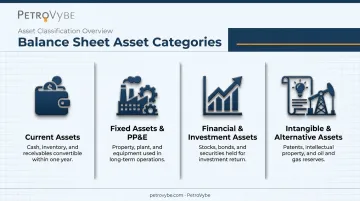
Most asset structures break down into four broad categories, each carrying different risk, liquidity, and return characteristics.
Current Assets
Current assets — cash, inventory, and accounts receivable — are short-term holdings expected to convert to cash within a year. They provide the liquidity a business or individual needs to cover near-term obligations.
- Cash and equivalents: immediate liquidity, but typically the lowest-yielding category
- Inventory: ties up capital until it sells
- Accounts receivable: revenue already earned but not yet collected
Too little liquidity creates operational risk. Too much sitting in cash means missed opportunity for higher returns elsewhere.
Fixed Assets (Property, Plant & Equipment)
Fixed assets, or PP&E, are long-term holdings like real estate, machinery, and equipment. They're expected to generate value over multiple years, not months.
Depreciation affects both the income statement and the asset base over time: as equipment ages, its book value declines even if its operational usefulness hasn't. This is why capital-intensive industries need to actively manage their fixed asset schedules rather than let them passively erode.
Financial and Investment Assets
Financial assets (stocks, bonds, and long-term investments) are holdings valued by market price rather than depreciation schedules. Firms and individuals use these to supplement income beyond their core business or job.
For companies, this might mean holding marketable securities as a treasury management strategy. For individuals, it's typically the traditional brokerage account or retirement portfolio.
Intangible and Alternative Assets
Intangible assets, including patents, trademarks, and brand equity, carry real economic value without physical form. Many investors are now adding alternative real assets to this mix as well, including private equity, commodities, and natural resource development, for diversification and inflation protection. Direct oil and gas partnerships, the kind PetroVybe structures for accredited investors, fall squarely within this category of tangible alternative assets.
This shift isn't a fringe trend. According to a 2023 report from Cerulli Associates, U.S. high-net-worth clients with at least $5 million in investable assets averaged 9.1% in alternatives that year, with advisors projecting growth to 9.6% by 2024. That's a meaningful reallocation away from the traditional stock-bond-real estate template.
Asset Structure and Return on Assets (ROA)
ROA is the central metric connecting asset structure decisions to actual performance. The formula is straightforward:
ROA = Net Income ÷ Average Total Assets
This measures how effectively a company's asset base generates profit (CFI, 2025). A business with $2 million in net income and $20 million in assets has a 10% ROA — a much stronger showing than one earning the same profit off $40 million in assets.
The Finance and Accounting View
Under this lens, each asset category becomes its own mini-portfolio to optimize using category-specific methods:
- PP&E: managed through depreciation schedules and utilization rates
- Inventory: managed through turnover ratios
- Receivables: managed through days-sales-outstanding targets
- Financial assets: managed through allocation and rebalancing strategy
Industry structure varies enormously. Capital-intensive sectors like manufacturing and oil and gas development carry heavy PP&E loads, often posting modest, single-digit ROA figures because so much capital sits in physical plant, equipment, and wells.
Technology and insurance firms, by contrast, hold mostly intangible or financial assets. Those categories require less balance-sheet weight to generate revenue, so their measured returns per dollar of assets often look stronger.
The Strategic Approach
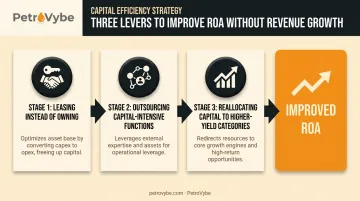
Rather than passively accumulating assets, smart firms and investors intentionally shape their asset structure to match business model, competitive intensity, and economic conditions. One of the most underused levers here: **reducing an oversized or underperforming asset base**.
This can happen through:
- Leasing instead of owning equipment or facilities to reduce fixed asset weight
- Outsourcing functions that require heavy capital investment
- Reallocating capital from low-yield categories (excess cash, slow inventory) into higher-yield ones
Each of these can improve ROA without touching the numerator at all: no revenue growth required, just a leaner, better-organized denominator.
Factors That Shape an Optimal Asset Structure
There's no universal template. The right mix depends on a handful of moving pieces.
Market conditions shift which categories offer the best risk-adjusted returns at any given moment. The Federal Reserve has noted that higher-than-anticipated long-term rates, especially alongside persistent inflation, can pressure asset prices and increase unrealized losses on fixed-rate holdings (Federal Reserve, 2025).
Low-rate environments push the opposite way, often nudging long-horizon investors toward less-liquid assets in search of yield.
Industry standards and business size set baseline needs. A service business needs far fewer fixed assets than a manufacturer running production lines. A solo consultant's balance sheet looks nothing like a logistics company's.
Financial goals should ultimately drive the decision:
- Growth-focused investors may tolerate more illiquid, higher-return positions
- Stability-focused investors weight toward liquidity and lower volatility
- Tax-conscious investors prioritize categories offering deductions or deferral
- Income-focused investors prioritize consistent cash flow over appreciation
Copying a generic template instead of anchoring to your own goals is the most common asset structure mistake investors make.
Strategies to Optimize Asset Structure for Better Returns
Once you understand the components and what drives them, optimization becomes a matter of deliberate reallocation.
Diversify across tangible and intangible assets. Concentration risk (too much weight in one category) smooths out when spread across categories that don't move in lockstep through market cycles.
Reassess your current-to-fixed asset balance regularly. Enough liquidity to run operations, but not so much that capital sits idle instead of funding long-term growth. This isn't a one-time exercise; it shifts as conditions change.
Look beyond stocks, bonds, and real estate. For accredited investors, optimizing personal asset structure increasingly means adding direct-access alternative assets that offer both appreciation potential and tax efficiency, categories that traditional portfolios rarely touch.
Where Natural Gas Development Fits In
Natural gas and oil development investments are one example of a tangible, cash-flow-generating alternative asset class capable of meaningfully improving an investor's overall asset structure. PetroVybe, which develops natural gas liquid assets in Lavaca County and the broader Gulf Coast Basin, structures its PetroVybe ONE partnership around this exact idea.
Here's how the mechanics work for accredited investors:
- Upfront tax efficiency: PetroVybe partners received a 94% tax deduction against active income in 2024 and 91% in 2025, driven by Intangible Drilling Costs (IDCs) that offset W-2 wages and capital gains, not just passive income
- Long-term cash flow: monthly passive distributions are projected to peak above $10,000 during the production phase, following an initial multi-year development period
- Return targets: a 10-year MOIC window of roughly 2.2x to 5.8x and an IRR target near 26%, though all projections carry commodity price and operational risk
- Tangible backing: a $48 million proved reserves valuation, engineered by a licensed third-party firm, anchors the asset rather than leaving it purely speculative
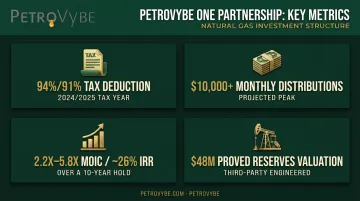
This kind of structure adds a category most portfolios lack entirely: a tangible, income-producing asset with an upfront tax offset baked in.
**Work with a licensed advisor** before reallocating. Any restructuring, whether into oil and gas development, private equity, or another alternative category, should align with your overall financial goals, tax situation, and risk tolerance. A CPA or financial advisor can confirm the numbers work for your specific circumstances before capital moves.
Frequently Asked Questions
What is an asset structure?
Asset structure is the distribution of a business's or individual's total asset base across categories like current, fixed, financial, and intangible assets. It shapes how effectively that asset base generates returns.
What is the difference between asset structure and capital structure?
Asset structure refers to what a company or investor owns — the asset side of the balance sheet. Capital structure refers to how those assets are financed, through a mix of debt and equity.
How does asset structure affect Return on Assets (ROA)?
ROA measures profit generated relative to total assets. A well-optimized structure with fewer idle or underperforming assets directly improves this ratio, since the denominator shrinks or works harder.
What factors should determine my ideal asset structure?
Industry norms, business size, current market conditions, and personal financial goals (growth, stability, or tax efficiency) should all guide your ideal mix. There's no single correct template.
Can individual investors apply asset structure principles to their personal portfolios?
Yes. Investors can think of their net worth like a balance sheet, deliberately diversifying across categories including alternative, tax-advantaged options rather than defaulting to stocks and bonds alone.
How can alternative assets like natural gas development improve my asset structure?
Tangible, income-producing alternative assets add diversification, inflation protection, and tax efficiency that traditional stock, bond, and real estate structures often lack. They can also deliver monthly passive income and meaningful tax deductions, generating cash flow uncorrelated with public markets.