

But here's the problem: many people journal gratitude lists, repeat affirmations every morning, and still feel financially stuck. That's because belief work without strategic action rarely moves the needle on your bank balance.
This guide breaks down what wealth consciousness actually means, how to identify and rewire limiting money beliefs, daily practices that build the mindset, and — critically — how to turn that mindset into tangible, tax-efficient wealth-building strategies.
Key Takeaways
- Wealth consciousness reflects subconscious beliefs about money and self-worth, not just "positive thinking"
- Family conditioning creates most limiting money beliefs, which you can identify and reframe
- Daily mindfulness and gratitude practices shift scarcity thinking toward abundance
- Mindset only works alongside real financial structure: budgeting, diversification, and tax strategy
What Is Wealth Consciousness?
Wealth consciousness is the subconscious belief system that determines what you feel you deserve financially. It operates mostly below conscious awareness, quietly shaping the financial decisions you make every single day.
Research on daily behavior supports this idea, though not in the exaggerated way it's often presented online. A 2025 study from the University of South Carolina found that 66% of daily behaviors were habitually initiated, meaning they ran on autopilot rather than deliberate thought.
The same study found 76% of behavior was still intentional, with significant overlap between habit and intention. In other words, your subconscious patterns and conscious choices aren't opposites. They work together, which is exactly why untangling old money habits takes deliberate effort.
Wealth consciousness isn't only about dollar amounts. It includes:
- Your sense of self-worth and what you believe you're "allowed" to have
- Beliefs about what success requires (struggle, luck, connections, talent)
- Unspoken attitudes toward wealthy people (admiration, suspicion, resentment)
Why Mindset Precedes Money
Your financial life follows a chain: thoughts create feelings, feelings drive actions, and actions produce results. A scarcity mindset can quietly sabotage that chain in ways that feel logical at the time.
Consider someone who avoids a smart investment opportunity because "it feels too risky," underprices their services because they don't feel worthy of charging more, or overspends to self-soothe after a stressful week. None of these decisions feel like mindset problems in the moment. They feel like practical choices.
This connects to what's sometimes called an "invisible floor and ceiling" on income. It's a popular coaching metaphor, not a scientific finding, but it holds up anecdotally.
Many professionals plateau at a specific income level for years, then suddenly break through after doing internal belief work, raising rates, or asking for the promotion they'd been avoiding. The ceiling wasn't external. It was self-imposed.
There's also real evidence that financial strain itself narrows cognitive bandwidth. Research published by the American Psychological Association found that sugarcane farmers performed the equivalent of 10 IQ points lower on cognitive tasks before harvest, when money was tight. Their performance rebounded after harvest, when cash was flowing again.
Scarcity isn't a character flaw. It's a bandwidth constraint that makes clear financial decision-making harder.

Uncovering and Rewiring Limiting Money Beliefs
Most people carry a handful of limiting beliefs about money that they've never consciously examined. Common ones include:
- "Money is the root of all evil"
- "I'll never have enough, no matter what I do"
- "Wealthy people got there by being unethical"
- "Money only comes from struggle and sacrifice"
- "It's greedy to want more than I need"
These beliefs rarely arrive through conscious decision. They're absorbed during childhood, from watching how parents talked about money, argued over bills, or reacted to wealthy relatives. Cultural narratives reinforce them further, whether through religious messaging, media portrayals, or community norms around what's "appropriate" to want.
Auditing Your Own Money Story
Once you can trace a belief back to its origin, the next step is examining your own money story directly. Grab a journal and get specific. This isn't a one-time exercise — revisit it every few months as your financial life evolves.
- Write down your top 3 money beliefs. What do you actually believe, deep down, about wealth and your relationship to it?
- Trace each one to its source. Who said it, modeled it, or reacted in a way that taught you this lesson?
- Ask the reframe question. What would my life look like without this belief holding me back?
Reframing Scarcity Into Abundance
Reframing takes a limiting belief and flips it into something empowering, without pretending the old belief never existed.
- "Money is hard to get" becomes "money flows to me as I create value"
- "I don't deserve wealth" becomes "I am worthy of the results my work produces"
- "Rich people are greedy" becomes "wealth gives me more capacity to help others"
Intellectual agreement with a new statement isn't enough. Reframing sticks when you repeat it consistently and actually feel it, not just recite it while thinking the opposite underneath.
Daily Practices to Cultivate a Wealth-Conscious Mindset
Building wealth consciousness is less about one big breakthrough and more about small, repeated practices that compound over time.
Mindfulness and Presence
Grounding practices like meditation, deep breathing, or a mindful walk reduce the anxious, worry-based thinking that clouds financial decisions. When you're calm, you make clearer choices about spending, saving, and investing instead of reactive ones.
Gratitude Journaling
Write down 3-5 things you're grateful for every day, specifically related to money and resources you already have. This practice trains your attention toward abundance instead of lack, building a genuine felt sense of "enough" over time.
Visualization and Affirmations
Picture specific financial goals as already achieved, not as distant hopes. Pair that visualization with affirmations like "I am a magnet for abundance." Repetition reinforces new belief patterns, though it works best alongside the practical steps covered later in this guide.
Thinking Bigger and Asking for More
Many people unconsciously "ask small." Common patterns include:
- Negotiating less than the market actually supports
- Pricing services below competitive rates
- Setting financial goals that feel safe rather than ambitious
Audit your own standards regularly. A self-imposed deserve-level ceiling can be raised through deliberate practice and evidence of your own growing capability.

Balancing Abundance Mindset With Financial Consciousness
Abundance mindset is expansive and intuitive, while financial consciousness is structured and strategic. Neither one works well without the other.
An abundance mindset without financial structure often leads to overextension: taking on debt for "opportunities," overspending because "money will come," or investing without a plan.
Research backs this up. A study published by the National Bureau of Economic Research found that people with a high propensity to plan had 2.5 to 3 times the net worth of low-propensity planners. Mindset alone tends to plateau without that structural discipline.
Quick self-assessment:
Rate yourself 1-10 on each:
- Abundance mindset: How expansive is your thinking about what's possible financially?
- Financial consciousness: How structured is your actual planning, budgeting, and investing?
Whichever score is lower, that's where your next month of focused effort should go.
From Mindset to Money: Turning Wealth Consciousness Into Tangible Wealth
Wealth consciousness that stays purely internal never becomes wealth. At some point, belief work has to mature into action: budgeting consistently, saving with purpose, and diversifying beyond the traditional stock-bond-real estate trio most portfolios default to.
For high-income earners and accredited investors, this is where mindset meets measurable results. Aligning abundance thinking with tax-efficient strategies, particularly deductions that offset active income like W-2 wages and capital gains, is where the internal work becomes external proof.
This is the space PetroVybe operates in. As a Texas-based natural gas development company, PetroVybe gives accredited investors direct equity participation in upstream energy projects located in Lavaca County and the broader Gulf Coast Basin. Rather than buying into a mature, already-peaked public energy stock, partners take a direct position in early-stage development, where:
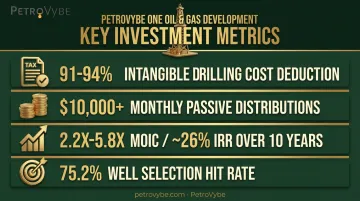
- Intangible Drilling Cost deductions delivered a 91-94% deduction against active income for 2024 and 2025 partners
- Monthly passive distributions are projected to peak above $10,000 during production, on a $100,000 unit investment
- The 10-year target window projects a MOIC of roughly 2.2x-5.8x and an IRR near 26%
- The company's Chief Geophysicist brings a 75.2% career hit rate on well selection, well above the sub-40% industry average
PetroVybe frames its work through a lens of biblical stewardship. That shapes how it treats partner capital: third-party engineering validation, transparent reporting, and a long-term hold structure rather than speculative short-term plays.
For investors who've already done the internal belief work, that's a values-driven fit built on structure and diligence, not guesswork.
Lasting wealth requires both mindset and strategy working together: internal belief work paired with concrete, well-researched financial decisions. That might mean diversifying into tax-advantaged energy partnerships or scheduling a discovery call to see if a structure like PetroVybe ONE fits your goals.
Frequently Asked Questions
What are the 9 words that attract wealth?
Florence Scovel Shinn's actual 1928 prosperity text states, "I am an irresistible magnet for all that belongs to me by Divine Right" — longer than the popularized nine-word version. No verified original source establishes a canonical nine-word phrase, despite its popularity in manifestation circles.
What are the 5 habits that make you rich?
Financial-literacy sources consistently point to five recurring habits: consistent saving and investing, disciplined budgeting, active debt management, ongoing financial education, and regular goal review. No single validated study confirms this exact list, but the pattern holds across research.
What are the 8 stages of wealth?
The most commonly cited eight-stage model, from a Forbes editorial by CFP David Rae, progresses from emergency-fund stability through growing security, independence, and eventually financial abundance. No single version is universally authoritative.
What color attracts wealth?
Green, gold, and purple are traditionally associated with prosperity in feng shui and color psychology. These are cultural and symbolic associations, not demonstrated financial effects.
How long does it take to shift your money mindset?
Habit-formation research shows real behavior change typically takes anywhere from 59 to 154 days on average, with wide individual variation. No study has measured a specific timeline for a complete "money mindset shift."
Can wealth consciousness alone make you rich without taking action?
No. Mindset shapes attention, confidence, and the opportunities you notice, but it must be paired with strategic financial decisions, like budgeting, saving, and diversified investing, to produce measurable wealth.