

Here's the problem. Once the paychecks stop, so does the built-in safety net. No more automatic direct deposits, no employer benefits cushioning a bad month, no bonus to cover a surprise expense. Just you, your savings, and whatever income streams you've set up.
More than half of Americans (51%) say it's somewhat or very likely they'll outlive their savings, according to Northwestern Mutual's 2025 Planning & Progress Study. That fear doesn't come from nowhere.
This guide breaks down what retirement cash flow actually means, how to build a real plan around it, the withdrawal rate "rules" everyone talks about (including the 7% rule and the $1,000-a-month shortcut), and how to diversify your income so it doesn't buckle under inflation or a bad market year.
Key Takeaways
- Cash flow determines whether you can sustain your lifestyle, not your total net worth
- A documented cash flow plan surfaces income gaps before they become emergencies
- Withdrawal benchmarks—4%, 7%, or a flat $1,000 a month—are starting points, not guarantees
- Non-correlated, tax-advantaged income sources help retirement cash flow keep pace with inflation
What Is Retirement Cash Flow?
Retirement cash flow is simple in concept: it's the net movement of money in versus money out, tracked monthly or annually. It replaces the paycheck you no longer get.
Money typically flows in from several places:
- Social Security benefits
- Pension payments (if you have one)
- Taxable brokerage accounts
- Tax-deferred accounts like 401(k)s and traditional IRAs
- Roth IRAs
- Annuities
- Rental income
- Part-time or consulting work
Each of these has different tax treatment, and that matters more than most people realize when it's time to actually withdraw the money.
Why Cash Flow Beats Net Worth as a Metric
A $2 million portfolio sounds great until you realize most of it sits in a house, a tax-deferred 401(k) you can't touch efficiently, or illiquid investments. That's how someone becomes "asset rich, cash poor." Net worth measures what you own. Cash flow measures what you can actually spend without wrecking your plan.
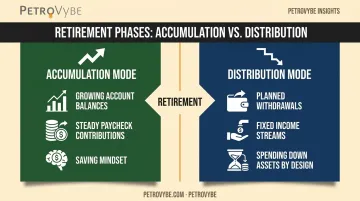
This is also a psychological shift, not just a math problem. During your working years, you're in accumulation mode — watching balances climb feels good. Retirement flips that script.
You're now in distribution mode, where account balances decline every month even when the plan is working exactly as designed. That can feel unsettling. Knowing your cash flow numbers cold is the antidote to that anxiety. When you can see the plan is sound, a shrinking balance stops feeling like a crisis.
How to Build a Retirement Cash Flow Plan
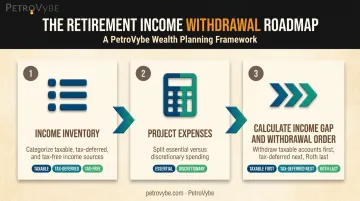
A cash flow plan is a living document with three core steps, not a one-page spreadsheet you build once and forget.
Step 1: Take Inventory of Your Income Sources
List every income stream you have or expect, and tag each one by tax treatment:
- Taxable: brokerage account dividends, interest, rental income
- Tax-deferred: 401(k), traditional IRA (taxed on withdrawal)
- Tax-free: Roth IRA, certain municipal bond interest
This categorization matters because of timing rules. Social Security can be claimed anywhere from age 62 to 70, and claiming early permanently reduces your benefit by roughly 30% compared to waiting until full retirement age. Delay past full retirement age, and you earn credits worth about 8% per year, up to 124% of your full benefit at age 70.
Required Minimum Distributions (RMDs) add another wrinkle. The current RMD age is 73, rising to 75 for those turning 74 after 2032. Miss these dates and the IRS penalties are steep, so this milestone needs to sit right next to Social Security on your timeline.
Step 2: Project Essential vs. Discretionary Expenses
Split your spending into two buckets:
- Essential: housing, healthcare, food, transportation, insurance
- Discretionary: travel, entertainment, gifts, hobbies
Two costs get underestimated constantly: healthcare and long-term care.
Fidelity estimates a 65-year-old retiring in 2025 may need $172,500 in after-tax savings just for healthcare throughout retirement (roughly $345,000 for a couple). That figure covers Medicare premiums and cost-sharing, but it doesn't include long-term care.
Long-term care costs even more. CareScout's 2025 survey puts the national median for assisted living at $6,200/month, and a private nursing home room at $355/day, which adds up to nearly $130,000 a year.
Spending in retirement also isn't flat. Researcher David Blanchett identified what's now called the "retirement spending smile": a U-shaped curve where spending is higher in active early years, dips in the middle, then climbs again later due to healthcare and long-term care needs.
Step 3: Calculate Your Income Gap and Withdrawal Order
Subtract guaranteed income (Social Security, pensions, annuities) from total expenses. Whatever's left is your income gap — the amount that has to come from savings every year.
A common tax-efficient withdrawal sequence looks like this:
- Taxable brokerage accounts first: lower tax impact, preserves tax-deferred growth
- Tax-deferred accounts next: while managing RMD timing
- Roth accounts last: tax-free growth continues as long as possible
Revisit this every year. Tax law changes, inflation shifts, health changes, and life happens. A plan built in 2023 shouldn't be running unchanged in 2027.
Retirement Withdrawal Rate Rules and Strategies
Withdrawal rate rules give retirees a starting point. None of them are gospel.
The 4% rule. Financial planner William Bengen introduced this in his 1994 paper testing historical market returns back to 1926. Withdraw 4% of your portfolio in year one, adjust for inflation annually, and the strategy historically survived at least 30 years.
Morningstar's 2025 research puts the more current safe starting rate closer to 3.9% for a 90% success probability over 30 years. Flexible strategies, like guardrails or constant-percentage withdrawals, can push starting rates up to 5.1%-5.7%.
The 7% rule. This is a much more aggressive benchmark you'll hear in retirement planning circles. There's no rigorous academic backing for it the way there is for the 4% rule. It carries meaningfully higher sequence-of-returns risk, meaning a bad market early in retirement could drain your portfolio far faster than planned.
This approach might make sense for retirees with:
- A shorter time horizon and fewer years of withdrawals ahead
- A large asset cushion beyond core retirement needs
- Substantial guaranteed income from pensions or annuities
For most people, it's a risk, not a strategy.
The $1,000-a-month rule. This shortcut estimates you need roughly $240,000 saved for every $1,000/month of desired income, assuming a 5% withdrawal rate and 5% annual return.
It's quick napkin math for a first pass. According to Kiplinger's breakdown of the rule, it doesn't account for inflation, taxes, or how long you'll live. Use it to sanity-check a number, not to build your entire plan.
The three-bucket strategy. Many retirees use this to manage timing risk:
| Bucket | Purpose | Time Horizon |
|---|---|---|
| Bucket 1 | Cash and liquid assets | 1-2 years of spending |
| Bucket 2 | High-quality fixed income | Years 3-10 |
| Bucket 3 | Long-term growth assets | 10+ years |
The point is simple: never be forced to sell growth assets during a downturn just to cover this month's bills.
There's no universal safe withdrawal rate. It depends on your portfolio mix, life expectancy, spending flexibility, and how much guaranteed income you already have.

Diversify Your Retirement Cash Flow Beyond Stocks and Bonds
Most retirement portfolios lean heavily on stocks and bonds. That works fine until inflation eats into purchasing power over a 20-30 year retirement, or a market downturn hits right as withdrawals begin.
Consider this: $1 in 2005 retained only about 61% of its purchasing power by 2025, based on Bureau of Labor Statistics CPI data. Stretch that back 30 years, and a fixed dollar keeps less than half its original value. Retirees relying solely on fixed-income assets are fighting that math the entire time they're drawing down.
This is why many high-net-worth retirees look at non-correlated, cash-flow-generating alternatives:
- Real estate
- Private credit
- Direct energy development
Direct natural gas development is one of these alternatives, and it's the space PetroVybe operates in. PetroVybe structures accredited investor partnerships in natural gas and NGL projects in Lavaca County, Texas — Gulf Coast Basin territory with established pipeline and processing infrastructure already in place.
Two features make this relevant for retirees managing cash flow and taxes:
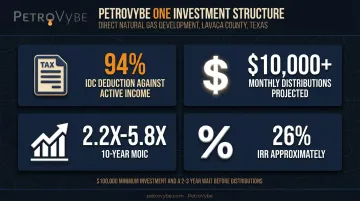
- IDC deductions apply against active income, including W-2 earnings and capital gains, not just passive income. PetroVybe partners realized a 94% deduction against active income in 2024.
- Passive monthly distributions are projected to peak above $10,000/month during production, targeting a 10-year MOIC of roughly 2.2x-5.8x and an IRR near 26%.
That's meaningfully different from real estate deductions, which are typically restricted to offsetting passive income unless you qualify as a real estate professional.
This isn't a fit for everyone. It requires accredited investor status, a $100,000 minimum, and a 2-3 year wait before distributions typically begin. It's built for retirees with low near-term cash needs, moderate risk tolerance, and existing wealth who want a slice of income that doesn't move in lockstep with the stock market.
Common Retirement Cash Flow Mistakes to Avoid
Even solid plans fail when a few predictable mistakes creep in.
- Underestimating healthcare and long-term care costs. Nursing care can run $130,000+ per year, so build in a buffer even if you never use it.
- Ignoring tax-efficient withdrawal order. Pulling from the wrong account first can trigger unnecessary taxes and shrink your net cash flow.
- Treating the plan as a one-time exercise. Tax law, inflation, and your health all shift over time, so plans need annual updates.
The fix for all three is the same: review your numbers at least once a year, and don't wait for a crisis to do it.
Frequently Asked Questions
What is retirement cash flow?
Retirement cash flow is the balance between your guaranteed and variable income streams and your living expenses. It's what replaces your paycheck once you stop working full-time.
What is the 7% rule in retirement?
The 7% rule suggests withdrawing 7% of your retirement portfolio annually, well above the traditional 4% benchmark. It carries higher sequence-of-returns risk and a greater chance of depleting your portfolio too early.
What is the $1,000-a-month rule for retirees?
It's a rule of thumb estimating that roughly $240,000 in savings can safely generate $1,000 a month in retirement income. It's a quick planning shortcut, not a personalized strategy.
How is the 7% rule different from the traditional 4% rule?
The 4% rule is conservative and built for a 30-year retirement horizon with historical market data behind it. The 7% rule trades that safety margin for higher income, which only makes sense with a shorter timeline or larger asset cushion.
How can retirees increase their cash flow without taking on excessive risk?
Diversify into non-correlated, income-generating assets like real estate or direct energy investments, and use a tax-efficient withdrawal sequence. Both moves boost net cash flow without simply increasing portfolio risk.
How often should I review my retirement cash flow plan?
At least once a year, plus additional check-ins after major life events, tax law changes, or significant market swings. A plan that isn't revisited regularly stops reflecting your actual situation.