Here's the pain point: most business owners know a mortgage or business loan produces some deduction. Few understand how the mechanics actually work, and even fewer realize that certain alternative investments — like direct working interests in oil and gas development — can generate deductions many times larger than a typical loan.
This guide covers:
- The interest tax shield formula and how to calculate it yourself
- A step-by-step worked example with real numbers
- How the shield shows up in WACC, DCF, and LBO models
- How accredited investors use a related strategy — Intangible Drilling Cost deductions — to offset active income at scale
Key Takeaways
- Interest expense reduces taxable income, saving Interest Expense × Tax Rate in taxes
- The shield only has value when EBIT exceeds interest payments; no profit means no benefit
- IRC 163(j) caps deductible interest, and the calculation method shifted again for 2025
- Oil & gas IDC deductions give accredited investors a far larger write-off against active income
What Is an Interest Tax Shield?
An interest tax shield is the reduction in taxable income (and the resulting drop in tax liability) that happens because interest expense on debt is deductible. Pay interest on a loan, and the IRS lets you subtract that expense before calculating what you owe.
This is why finance people say debt is "cheaper" than equity. Dividends paid to shareholders come out of after-tax profit; interest paid to lenders comes out before taxes are calculated.
A company weighing $10 million in new debt against $10 million in new equity will find the debt route shrinks its tax bill in a way equity never does. That's a major reason companies lean on leverage at all.
The shield only works if there's profit to shield. A business with EBIT lower than its interest payments gets no benefit from the deduction: you can't reduce taxable income below zero and get cash back. Startups burning capital and companies in a down year often learn this the hard way: the deduction is real, but worthless without taxable income to offset it.
Who Can Use It
The concept applies broadly:
- Corporations issuing bonds or taking out loans
- Individuals paying mortgage interest on a primary residence
- Accredited investors using specialized deductions like Intangible Drilling Costs in oil and gas development (more on this below)
The Deduction Isn't Unlimited
Deduction rules vary by country and are frequently capped. In the U.S., IRC Section 163(j) limits how much business interest a company can deduct. Under current IRS guidance, deductible business interest generally cannot exceed business-interest income plus 30% of adjusted taxable income, plus any floor-plan financing interest.
That 30% baseline has shifted definitions more than once since 2018. It was EBITDA-like through 2021, tightened to an EBIT-like measure from 2022 through 2024, and reverted to an EBITDA-like calculation for tax years beginning after December 31, 2024. Translation: highly leveraged companies may not get to deduct every dollar of interest they pay.
Interest Tax Shield Formula & Calculator: Step-by-Step Calculation
The core formula is simple:
Interest Tax Shield = Interest Expense x Tax Rate
- Interest Expense — the dollar amount of interest paid on debt during the period
- Tax Rate — the marginal rate that applies to the entity's next dollar of income (corporate rate for a business, personal bracket for an individual)
A Worked Example
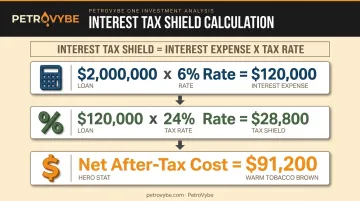
Say a mid-size manufacturing company carries $2 million in term debt at a 6% interest rate.
- Interest Expense = $2,000,000 x 6% = $120,000
- Tax Rate = 24% (combined federal and state marginal rate)
- Interest Tax Shield = $120,000 x 24% = $28,800
That $28,800 is real money the company doesn't send to the IRS, purely because it carries debt. The net after-tax cost of that $120,000 interest expense drops to $91,200 ($120,000 - $28,800).
A basic interest tax shield calculator automates this exact math, using just two inputs: interest expense (or loan amount and rate) and your marginal or corporate tax rate. It returns two outputs: dollar tax savings and effective after-tax interest cost.
After-Tax Cost of Debt & Real-World Adjustments
The same logic drives a formula used constantly in business valuation:
After-Tax Cost of Debt = Pre-Tax Cost of Debt x (1 – Tax Rate)
Using the example above: 6% x (1 – 0.24) = 4.56%. This effective rate, not the stated interest rate, flows into a company's Weighted Average Cost of Capital. Higher tax rates make debt financing look relatively more attractive in valuation models as a result.
As the IRS notes, the Tax Cuts and Jobs Act reduced the federal corporate rate to a flat 21%, a rate many models still use as a default assumption.
Before trusting any calculator output, adjust for:
- Marginal personal bracket vs. corporate rate — individuals and businesses face different schedules
- State taxes — can meaningfully raise your effective rate
- 163(j) phase-in limits — larger, highly leveraged businesses may not get to deduct 100% of interest paid
Common Examples of Tax Shields
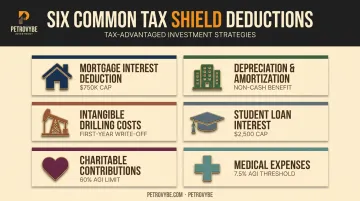
Interest isn't the only deduction that shields income from taxes. Several others show up constantly in personal and business tax planning:
- Mortgage interest deduction — interest on qualifying home loans, capped at $750,000 of acquisition debt for loans originated after December 15, 2017 (pre-2017 loans keep a $1 million cap)
- Depreciation and amortization — a non-cash deduction that spreads an asset's cost over its useful life
- Intangible drilling costs (IDC) — oil and gas developers can deduct a large share of drilling and completion costs in the first year, often against active income rather than passive income alone
- Student loan interest — up to $2,500 deductible, phasing out at higher income levels
- Charitable contributions — cash gifts to qualifying public charities can generally be deducted up to 60% of AGI
- Medical expenses — deductible only to the extent they exceed 7.5% of AGI
Depreciation deserves special attention. It's the largest non-cash tax shield most real estate investors and capital-intensive businesses use. A rental property owner, for example, can deduct a portion of the building's value every year without spending a dime. Accelerated depreciation strategies, like cost segregation studies, can front-load much of that benefit into the early years of ownership.
Every one of these deductions has its own caps, phase-outs, and eligibility rules that shift from year to year. Verify current IRS thresholds before relying on any of these figures for your own return.
Interest Tax Shield in Corporate Valuation, WACC & LBO Models
Finance professionals don't just calculate the tax shield as a standalone number. They build it directly into how companies get valued.
Embedded in WACC
The Weighted Average Cost of Capital formula already accounts for the interest tax shield through its after-tax cost of debt component:
WACC = (E/(D+E) x Cost of Equity) + (D/(D+E) x Pre-Tax Cost of Debt x (1 – Tax Rate))
Because the debt portion is multiplied by (1 – Tax Rate), higher leverage combined with a higher tax rate can lower a company's overall WACC.
In a discounted cash flow model, that lower discount rate increases the present value of future cash flows. That's precisely why debt financing looks cheaper than equity in the math.
For readers building their own models: in an Unlevered Free Cash Flow (UFCF) analysis, don't add the interest tax shield as a separate line item in the cash flows. Its benefit is already captured in the after-tax cost of debt baked into WACC.
Double-counting it (once in the cash flow, again in the discount rate) inflates the valuation.
Role in LBO Models
In a leveraged buyout, the interest tax shield reduces the effective cost of acquisition debt, modestly improving IRR over the holding period. Don't overweight this effect, though.
Purchase price, exit multiple, and revenue growth assumptions typically swing LBO returns far more than the tax shield ever will. A firm obsessing over shield optimization while ignoring entry-multiple discipline is solving the wrong problem.
Oil & Gas IDC Deductions: How Investors Access an Outsized Tax Shield
Most investors think of tax shields in terms of a mortgage or business loan. Few know about a deduction that can dwarf both: Intangible Drilling Costs (IDCs) in oil and gas development.
IDCs cover the non-salvageable costs of drilling a well — survey work, ground preparation, wages, fuel, geology and engineering services, drilling and fracing services, and equipment rentals like drill bits. Under current U.S. tax law, these costs can generally be deducted in the year they're incurred rather than capitalized and recovered over years.
Why This Beats a Standard Interest Shield
A mortgage or business-loan interest deduction only offsets income up to the interest paid — usually a modest fraction of the total loan. IDC deductions work differently:
- They typically represent 60-80% of total invested capital in a new drilling project
- A $100,000 investment can generate a $60,000-$80,000 first-year deduction
- Because investors hold a direct working interest rather than a passive security, the deduction escapes passive-loss restrictions entirely. It can offset W-2 wages, business income, and capital gains, not just passive investment income
That last point is the real differentiator. Real estate depreciation, by contrast, is generally trapped against passive income unless you qualify as a real estate professional.
PetroVybe's Track Record
We've seen this play out directly through PetroVybe ONE, our natural gas development partnership in South Texas and the Gulf Coast Basin. Partners who joined in 2024 and 2025 achieved total tax deductions of 91-94% against active income, with roughly 70% of that deduction typically available in the first year alone.

Combining the deduction with a direct working interest also builds long-term value: PetroVybe targets a 10-year MOIC of roughly 2.2x-5.8x and a ~26% target IRR, meaning the tax benefit is a starting point, not the whole return.
Who Qualifies
This strategy isn't for everyone. It's generally limited to:
- Accredited investors under SEC rules (net worth over $1 million excluding primary residence, or income over $200,000 individually/$300,000 jointly)
- Investors with $100,000+ in liquidity to commit
- Partners willing to hold an illiquid position through the multi-year development and production cycle
Before committing capital for tax reasons alone, confirm the operator provides independent third-party engineering validation of reserves. PetroVybe's projects carry a $48 million proved-reserves valuation certified by a licensed third-party engineering firm — the kind of verification that should be non-negotiable before any IDC-focused investment.
If reducing this year's tax bill while building a long-term equity position in natural gas development sounds relevant to your portfolio, explore PetroVybe's current South Texas and Gulf Coast Basin projects to see if it fits.
Risks & Limitations of Relying on Tax Shields
A tax shield is only as good as the profit behind it. A few limitations apply across every version of this strategy:
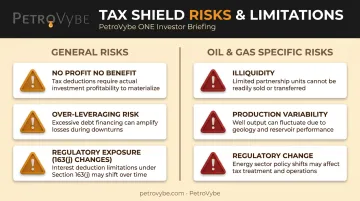
- No profit, no benefit: if EBIT is negative or too thin to absorb the deduction, the tax shield produces zero cash savings despite existing on paper.
- Over-leveraging risk: chasing tax savings by piling on debt raises real interest costs, and statutory caps like the 163(j) limitation can shrink the deduction's value in heavily leveraged deals.
- Regulatory exposure. Deduction rules change. The 163(j) calculation method has already shifted twice since 2018.
Specific to Oil & Gas and Alternative Investments
Individual and alternative investments carry their own risk profile:
- Illiquidity: capital is typically locked up for years and isn't available for quick withdrawal
- Production variability: wells don't produce at a fixed rate, and output naturally declines over time and can vary from projections
- Regulatory change: proposals to alter IDC expensing rules have surfaced in Congress and Treasury, though none have been enacted as of this writing
None of this means the strategy is unsound. It means due diligence matters. Verify the operator's track record, insist on third-party reserve engineering — the same standard PetroVybe applies to its own projects — and never invest primarily because of the tax benefit alone.
Frequently Asked Questions
How does an interest tax shield work?
Interest expense reduces taxable income before taxes are calculated, so the resulting tax savings equal the interest expense multiplied by your applicable tax rate. It only has value if you have enough taxable profit to offset.
What are some common examples of tax shields?
Beyond business interest, common examples include mortgage interest, depreciation, student loan interest, and charitable donations. Each carries its own caps and eligibility rules that change periodically.
What are the risks of a tax shield?
The main risks are over-leveraging to chase deductions and losing the benefit if profitability drops. Changing limits like the 163(j) cap can also shrink the deduction, and alternative investments add illiquidity and production variability on top of that.
What is the formula to calculate an interest tax shield?
Interest Tax Shield = Interest Expense x Tax Rate. Multiply the interest you actually paid by your marginal or corporate tax rate to get your dollar savings.
Is a tax shield the same as tax savings?
Not quite. A tax shield reduces your taxable income; the tax savings are the actual dollar reduction in tax liability that results. They're closely related but not identical concepts.
Can individual investors use interest tax shield strategies, or is this only for corporations?
Individuals can, through mortgage interest and other deductions. Accredited investors can go further with oil and gas IDC investments, which can offset up to 100% of an investor's active income tax liability over the life of the deal.