

Introduction
Taxes are likely the single biggest expense you'll pay over your lifetime, larger than your mortgage, your car payments, or your kids' tuition combined. Yet most people spend more hours planning a weekend getaway than they do planning how to keep more of what they earn.
That gap is exactly what Tom Wheelwright, CPA and longtime Rich Dad Advisor, set out to close with Tax-Free Wealth: How to Build Massive Wealth by Permanently Lowering Your Taxes. First published in 2012 and updated through multiple editions since, the book reframes the tax code as a map that most people were never taught to read.
This summary breaks down Wheelwright's core arguments and his Cashflow Quadrant framework. It also covers the strategies he repeats most often, including his case for oil and gas as one of the most overlooked tax-advantaged asset classes available to everyday investors.
Key Takeaways
- Tax law rewards investing, entrepreneurship, and energy production, not just earning income
- Business owners and investors access more deductions than employees or the self-employed
- Depreciation, income-splitting, and oil & gas deductions are the book's core wealth tools
- Tax planning works best as a daily habit with a qualified advisor, not an annual scramble
- The book is a starting point—high earners still need personalized guidance to execute it
About the Book: Tax-Free Wealth Overview
The current 3rd edition, published by Rich Dad Library in January 2024, holds a 4.7/5 rating from roughly 4,250 reviewers on Amazon, a strong showing for a personal finance title. It carries a foreword from Robert Kiyosaki, placing it firmly within the broader Rich Dad series alongside titles like Rich Dad Poor Dad.
Structurally, the book moves in two broad halves:
- The first half lays out foundational tax law principles: why the code exists, how governments use it, and the mindset shift required to benefit from it
- The second half gets tactical, covering entity structuring, estate planning, and specific investment categories like real estate and oil & gas
Beyond that structure, Wheelwright's own background explains why the material lands so clearly. His stated mission is to "make taxes fun, easy, and understandable," and his career backs that up: he spent years running professional training for thousands of CPAs inside Ernst & Young's National Tax Department, then served as an adjunct professor at Arizona State University for 14 years.
He later founded WealthAbility, his own tax advisory firm. That combination of Big Four training and classroom teaching shows up in how the book explains complex rules without drowning readers in jargon.
The Foundational Principle: Why the Tax Code Works in Your Favor
Wheelwright builds the entire book on two ideas: what's yours is yours, and the tax code is structured to help you pay less tax, not more. He treats these not as loopholes to exploit but as the system working exactly as designed.
To back this up, he leans on a famous line from Judge Learned Hand's 1934 opinion in Helvering v. Gregory, where the court wrote that anyone may arrange their affairs so their taxes are as low as possible, adding that "there is not even a patriotic duty to increase one's taxes." Wheelwright uses this quote as philosophical cover for aggressive, legal tax planning.
The court in that same case, however, still rejected the taxpayer's specific transaction. The quote supports legitimate planning, not sham deals.
Beyond the legal argument, a deeper question remains: why does the government build in all these breaks? Wheelwright's answer: incentive, not generosity. Congress uses the tax code as a stimulus tool, rewarding:
- Job creation through business deductions
- Housing development through real estate depreciation
- Energy production through drilling cost write-offs
He also stresses that net profit, not gross income, is what actually gets taxed. That means nearly every daily decision, from how you structure a purchase to which entity holds an asset, eventually shows up on your tax bill.
Wheelwright offers one final warning: most taxpayers get bad advice not because their advisor is dishonest. Instead, that advisor is often intimidated by the code's complexity or too risk-averse to advocate aggressively on a client's behalf.
The Cashflow Quadrant: Why Investors and Business Owners Pay Less
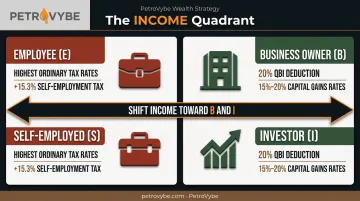
Wheelwright borrows Robert Kiyosaki's Cashflow Quadrant to explain why identical income can be taxed at wildly different rates depending on how it's earned.
Employees (E) and Self-Employed (S): The Highest Taxed Groups
Wage earners and self-employed individuals trade time directly for money, and the tax code treats that trade harshly. Self-employed workers pay a 15.3% self-employment tax on top of ordinary income tax, covering Social Security and Medicare. Employees get taxed on gross wages before most expenses ever enter the picture, leaving them with the fewest deductions of any quadrant.
Business Owners (B) and Investors (I): The Tax-Advantaged Groups
Business owners and investors earn through equity and assets rather than direct labor, which means they get to subtract expenses before arriving at taxable income.
The gap is real: qualified business owners can deduct up to 20% of qualified business income through the QBI deduction, while long-term capital gains for most investors top out at 15-20%, well below the top ordinary income brackets employees face.
Wheelwright organizes income into five distinct "buckets," each taxed on its own set of rules:
- Earned income: wages, self-employment
- Ordinary/retirement income: 401(k) withdrawals, pensions
- Investment income: capital gains, dividends
- Gift/inheritance income
- Passive income: rental, royalty, and business income you don't actively manage
Passive income offers the most planning flexibility, which is exactly why the book spends so much time on real estate and oil & gas. Direct investment structures, like the oil and gas development partnerships PetroVybe offers, sit squarely in this bucket, often generating deductions against active W-2 income in the same tax year. Wheelwright's central takeaway lands here: successful taxpayers don't necessarily earn more. They change which quadrant and which bucket their income falls into.
Top Wealth-Building Strategies From the Book
Real Estate: Depreciation and 1031 Exchanges
Depreciation is Wheelwright's favorite example of a non-cash deduction that still produces real tax savings. The IRS lets investors depreciate residential rental property over 27.5 years and commercial property over 39 years, per Publication 946.
Here's a simplified version of his math: say you buy a rental property for $500,000, with $400,000 allocated to the building (land isn't depreciable). Divide $400,000 by 27.5 years, and you get roughly $14,545 in annual depreciation. That deduction can offset rental cash flow on paper, even while the property generates positive income in your bank account.
For gains on sale, Wheelwright points to 1031 like-kind exchanges, which let investors roll proceeds into a new property and push the capital gains tax down the road indefinitely. One caveat the IRS is clear about: this is tax-deferred, not tax-free, and since 2018, the exchange only applies to real property held for business or investment use.
Family and Estate Income-Splitting
A recurring strategy in the book involves forming an LLC or family partnership to shift income toward lower-bracket family members, parents, adult children, even minors in some structures. Because tax brackets are progressive, moving income to a relative in a lower bracket can reduce the family's combined tax bill.
A few guardrails matter here:
- The annual gift tax exclusion sits at $19,000 per recipient for 2025
- The kiddie tax kicks in once a child's unearned income exceeds $2,700, taxing the excess at the parent's rate
- Family partnership allocations can't disproportionately favor a donee over the donor's own capital contribution
On estate planning, Wheelwright treats trusts and wills as complementary tools rather than either/or choices. Trusts help avoid probate and let you maintain control over how assets are distributed. Wills handle guardianship decisions for minor children and direct the distribution of anything not already titled into a trust.
Oil & Gas: The Book's Most Overlooked Tax-Advantaged Asset Class
This is where Wheelwright's argument gets sharpest. He specifically flags oil and gas as one of the only asset classes exempt from the passive loss limitation rules that restrict real estate deductions for most investors.
Under Section 469(c)(3) of the tax code, a working interest in an oil or gas property isn't treated as a passive activity as long as the investor's liability isn't limited. That distinction means those deductions can offset active income like W-2 wages and capital gains, not just passive income.
Two mechanisms drive this benefit:
- Intangible drilling costs (IDCs), which cover labor, fuel, and site preparation, can be deducted in the year they're incurred rather than capitalized
- A depletion allowance lets producers deduct a percentage of gross income from the well as reserves are extracted, subject to statutory limits under Section 613A
This is precisely the "change your facts" strategy Wheelwright describes throughout the book: restructure how you earn income, not how much you earn, to access a different set of tax rules. Companies like PetroVybe apply this exact provision, offering accredited investors direct partnership units in natural gas development projects in Lavaca County, Texas.
IDC deductions on projects like these typically run 60-80% of invested capital, taken in the year the investment is made, directly against active income including W-2 earnings and capital gains. It's a concrete, real-world version of the tax mechanics Wheelwright spends an entire chapter explaining.

Is Tax-Free Wealth Worth Reading?
Reviewers generally praise the book for taking thousands of pages of tax law and turning them into a digestible, motivating introduction. For business owners and investors who've never thought seriously about proactive tax planning, it reframes the entire subject from a compliance chore into a wealth-building lever.
The criticism is consistent too: some readers find the strategies too generic. Book summary service Shortform notes the tactics can be complex, often favoring taxpayers who already have resources to deploy.
Physician-focused reviewers agree, noting these strategies suit business owners far more than W-2 employees who've maxed out standard retirement accounts.
My take: treat this book as a mindset shift, not a how-to manual. It's excellent at explaining why the code favors certain behaviors.
Actually executing these strategies takes real expertise. Consider what's involved:
- Oil & gas IDC deductions offsetting up to 100% of active income, including W-2 earnings
- Family partnerships structured for asset protection and estate planning
- 1031 exchanges deferring capital gains on real estate
Each needs a qualified CPA or an established partner like PetroVybe, which structures IDC deductions directly against investors' active income.
Frequently Asked Questions
What are the key takeaways from Tax-Free Wealth?
The book argues the tax code rewards specific economic behaviors rather than punishing income. It uses Kiyosaki's Cashflow Quadrant to show why business owners and investors access more deductions. Real estate and oil & gas emerge as the book's top tax-advantaged asset classes.
Is Tax-Free Wealth worth reading?
Yes, as a beginner's introduction to proactive tax strategy. Some content is generic and best suited to business owners and investors rather than W-2 employees, so pair it with professional tax guidance if you're in a high bracket.
Can I give my kids $100,000 tax-free?
Not directly in one year. The annual gift tax exclusion is $19,000 per recipient in 2025, though family LLC and partnership structures the book discusses can shift income over time. A tax advisor should structure any gifting strategy to stay compliant.
What are the four types of earners in the Cashflow Quadrant?
Employee, Self-Employed, Business Owner, and Investor. Business Owners and Investors are taxed more favorably because they earn through equity and assets, allowing deductions before arriving at taxable income.
Does Tax-Free Wealth cover oil and gas investments?
Yes. The book dedicates attention to oil and gas, highlighting intangible drilling cost deductions and depletion allowances as benefits unavailable to most other asset classes, including real estate. These same mechanics power PetroVybe's natural gas partnerships, where 2024 investors claimed 91-94% deductions against active income.
Who is Tom Wheelwright?
Tom Wheelwright is a CPA, Rich Dad Advisor, and founder of WealthAbility. He spent years training CPAs at Ernst & Young and teaching at Arizona State University before authoring several books in Robert Kiyosaki's Rich Dad series.