

A Family Limited Partnership (FLP) is one of the tools that tries to solve both problems at once. It's become one of the most widely used estate and wealth-transfer structures among high-net-worth families, largely because it lets parents gift wealth while still running the show.
This article breaks down how FLPs actually work, the real benefits and drawbacks, and how to figure out whether one fits your family's broader tax and wealth strategy.
Key Takeaways
- FLPs let families pool assets while a general partner retains centralized control
- Valuation discounts on gifted LP interests can meaningfully cut gift and estate taxes
- Benefits like asset protection and succession planning carry real costs and control trade-offs
- Careful drafting and consistent compliance are essential to survive IRS scrutiny
What Is a Family Limited Partnership and How Does It Work?
An FLP is a limited partnership formed by family members to jointly own and manage assets, such as an operating business, a real estate portfolio, or an investment account.
There's no separate federal statute defining an "FLP" specifically. It's simply a state-law limited partnership used within a family, generally requiring at least one general partner and one limited partner.
In a typical setup, parents contribute assets to the partnership in exchange for two things:
- A small general partnership (GP) interest — often just 1-2% — which retains full management control
- A large limited partnership (LP) interest, which is gradually gifted or sold to children over time
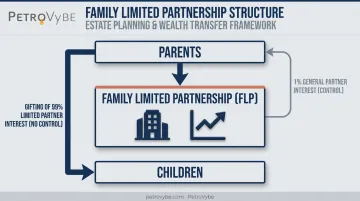
General Partners vs. Limited Partners
The GP and LP roles aren't interchangeable, and the distinction matters a lot for both control and liability.
General partners manage daily operations, control distributions, and make investment decisions. In exchange for that authority, they carry unlimited personal liability for partnership debts and obligations.
Limited partners are passive investors. They have no say in management, their liability is capped at their investment, and they typically can't sell or transfer their interest without restrictions written into the partnership agreement.
Common Assets Held in an FLP
FLPs work best with actively managed or income-producing assets, not personal-use property. Typical holdings include:
- Operating businesses (family companies, professional practices)
- Investment real estate portfolios
- Securities and brokerage accounts
- Direct interests in alternative assets, such as energy or natural resource development projects
Key Benefits of a Family Limited Partnership
Facilitates Multigenerational Wealth Transfer
Instead of gifting assets directly, parents gift LP interests. This lets wealth move to children gradually, year after year, while the parent stays in the driver's seat as general partner. The business or portfolio keeps running exactly as it would have without the gift.
Valuation Discounts Reduce Gift and Estate Tax Cost
This is the feature most families are actually chasing. Because LP interests come with no management rights and no easy resale market, appraisers can apply two types of discounts when valuing a gifted interest:
- Lack-of-control discount: the interest is worth less because the holder can't direct partnership decisions
- Lack-of-marketability discount: the interest is worth less because there's no ready buyer for a restricted, privately-held stake
Estate planning sources commonly reference discounts in the 30-60% range, though the actual number is fact-specific and must be supported by a qualified appraisal, not treated as a fixed IRS rule.
For 2025, the annual gift tax exclusion is $19,000 per donee, meaning a couple can gift $38,000 worth of discounted LP interests to each child, every year, tax-free.
Asset Protection from Creditors and Litigation
FLPs offer a layer of protection through the charging order mechanism. Under statutes like Virginia's, a creditor pursuing a judgment against an individual partner can only obtain a lien on that partner's distributions — they can't seize partnership assets directly or force liquidation. This protects against a partner's personal creditors, not creditors of the partnership itself, and the exact scope varies by state.
Tax-Efficient Income Splitting
As a pass-through entity, an FLP doesn't pay tax at the entity level. Income flows to each partner's individual return via Schedule K-1, taxed at that partner's own rate. Shifting income to family members in lower brackets can reduce the family's overall tax bill.
One catch: the kiddie tax limits this strategy for minors. For 2024, unearned income above $2,600 for a covered child gets taxed at the parent's rate, not the child's, so income splitting works better for adult children than young kids.
Flexible Management and Succession Planning
The partnership agreement is where succession actually gets built. Senior family members can retain decision-making authority while slowly training heirs for leadership roles, adjusting responsibilities as the next generation demonstrates readiness.
Simplifies Multi-State Property and Avoids Ancillary Probate
If a family owns real estate in three different states, dying with title in each name individually usually triggers separate probate proceedings in each state. Transfer that property into an FLP, and the decedent instead owns a single intangible partnership interest — probated only in their home state. The underlying real estate doesn't need to go through ancillary probate at all.
Drawbacks and Risks of a Family Limited Partnership
High Setup and Ongoing Administrative Costs
FLPs aren't a set-it-and-forget-it document like a simple will. Drafting a compliant partnership agreement, obtaining qualified appraisals, and maintaining formalities requires:
- Estate planning attorneys for entity structure and agreement drafting
- Valuation professionals for defensible appraisals
- CPAs for Form 1065 filings, K-1s, and capital account tracking
That's a meaningfully higher price tag than simpler estate tools.
Loss of Control for Limited Partners
Children receiving LP interests can't compel distributions, can't participate in management, and often can't easily liquidate their stake. For a family member who actually needs cash, this illiquidity can become a real source of frustration.
Unlimited Liability for General Partners
The general partner — usually a parent — remains personally liable for partnership debts unless the GP role is held by a corporation or LLC instead of an individual. Skipping this step exposes personal assets to business risk.
IRS Scrutiny and Risk of Disallowed Discounts
The IRS pays close attention to FLPs that look like they exist purely for tax savings rather than legitimate business purposes. In Estate of Strangi, the Fifth Circuit upheld inclusion of the FLP's assets in the taxable estate. The decedent had transferred nearly all his assets to the partnership, which then paid his personal expenses, with no substantial nontax purpose behind the arrangement.
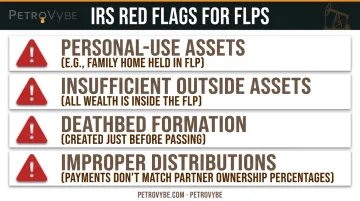
Common red flags that invite challenges include:
- Personal-use assets (like a residence) held inside the FLP
- Insufficient assets retained outside the partnership
- Deathbed formation, done too close to the person's passing
- Distributions that don't match ownership percentages
Potential for Family Conflict
Shared decision-making sounds great on paper. In practice, disagreements over distribution timing, management choices, or who gets to lead next can strain family relationships for years.
Family Limited Partnership vs. Other Estate Planning Tools
Trusts and FLPs solve overlapping problems but work differently. A trust is run by a trustee for beneficiaries under fixed instructions — the beneficiaries typically aren't involved in day-to-day decisions. An FLP, by contrast, allows active family participation in managing a business or investment portfolio.
| Feature | FLP | Trust |
|---|---|---|
| Best for | Actively managed businesses, real estate, portfolios | Passive wealth distribution, minor beneficiaries |
| Control retained by | General partner | Trustee (per trust terms) |
| Family involvement | Active (as partners) | Passive (as beneficiaries) |
Many high-net-worth families don't pick one or the other; they use both. A common strategy is gifting FLP interests into a Grantor Retained Annuity Trust (GRAT), layering the FLP's valuation discount with the GRAT's own transfer-tax mechanics. This isn't a guaranteed "double discount," but it's a recognized way to stack estate planning tools when structured correctly.
Is a Family Limited Partnership Right for Your Family?
Before setting one up, work through these questions with your advisors:
- Are you comfortable losing some liquidity? Limited partners can't force distributions, so cash flow needs matter.
- Do you understand the valuation discount rules? These require defensible appraisals, not guesswork.
- Does this fit your family's dynamics? Shared management can strain relationships if roles aren't clearly defined upfront.
Given the complexity of IRS rules around retained control and valuation, this isn't a DIY project. Work with a qualified estate planning attorney and tax advisor before establishing an FLP.
Some families weigh these questions alongside other tax-advantaged strategies. PetroVybe's natural gas development projects in Texas are one example accredited investors sometimes discuss with their advisors as a complement to (not a replacement for) FLP planning.
Frequently Asked Questions
What is a family limited partnership used for?
FLPs pool family assets like businesses or real estate under centralized management, letting parents transfer wealth to children gradually at a reduced gift and estate tax cost.
What is the downside of a family limited partnership?
Setup and ongoing costs are significant, limited partners lose control over distributions and management, and the IRS scrutinizes FLPs lacking legitimate business purposes.
How is a family limited partnership taxed?
FLPs are pass-through entities, so income is taxed at each partner's individual rate via Schedule K-1. Gifted interests may qualify for valuation discounts and the annual gift tax exclusion ($19,000 per donee in 2025).
How many people do you need to set up an FLP?
You need at least two related family members: one general partner to manage the entity and at least one limited partner holding an economic interest.
Is it expensive to run a family limited partnership?
Yes, relative to simpler estate tools. Ongoing legal, tax, and appraisal support is needed to maintain compliance and defend valuation positions if challenged.
What assets can you put into a family limited partnership?
Common contributions include operating businesses, investment real estate, securities portfolios, and other actively managed investment assets. Personal-use property, like a family home, adds unnecessary IRS risk.