

This scenario plays out at small businesses across the country every week. Profit and cash are not the same thing, and confusing the two is how healthy-looking companies end up insolvent.
The data backs this up. In the Federal Reserve's 2024 Small Business Credit Survey, 56% of employer firms reported difficulty paying operating expenses, and 51% cited uneven cash flows. This isn't a fringe problem. It's the default experience for more than half of small business owners.
This guide breaks down why cash crises happen, the warning signs that show up weeks before a real shortfall, and the monitoring practices that keep a business solvent long enough to grow.
Key Takeaways
- Cash flow monitoring tracks money in and out in real time, not just monthly
- Most crises trace back to slow-paying customers, poor forecasting, or overspending
- Warning signs appear weeks in advance, including rising DSO and credit line reliance
- Prevention requires real-time dashboards, automated alerts, and rolling forecasts
- Once cash flow stabilizes, surplus reserves can work harder in tax-advantaged assets
Common Causes of Cash Flow Problems
Cash flow monitoring means systematically tracking and analyzing what's coming in and going out so you always know your true liquidity position. When businesses skip this, cash crises rarely stem from one dramatic event. They build from a handful of recurring, preventable issues.
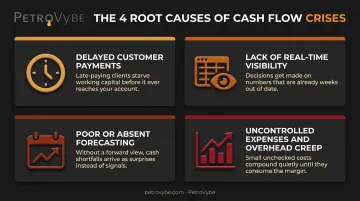
Delayed Customer Payments
Slow-paying clients create a timing mismatch. You've earned the revenue, but the cash hasn't landed yet.
A common scenario: you invoice on net-60 terms while your own vendor bills are due in 30 days. That 30-day gap has to be financed by something, usually your reserves or a credit line.
Older survey data from Forbes found 31% of small business owners waited more than 30 days for payment, with average outstanding receivables reaching $53,399 (Forbes). Even if your numbers look different today, the pattern holds: receivables gaps compound fast.
Lack of Real-Time Visibility
Manual spreadsheets and monthly bank reconciliations delay awareness of a shrinking cash position. By the time you notice, you're already behind.
The typical failure point: a founder discovers a shortfall only when a payment bounces. At that stage, you're reacting to a crisis instead of managing one.
Poor or Absent Cash Flow Forecasting
Without a rolling forecast, businesses can't anticipate seasonal dips or large upcoming outflows. SCORE notes that some seasonal businesses generate up to 70% of annual revenue in just a few months (SCORE) — meaning a strong quarter can mask a slow one just months away.
A seasonal business that overspends during its peak, without planning for the off-season, often gets caught off guard when revenue drops but overhead doesn't.
Uncontrolled Expenses and Overhead Creep
Rising operating costs, forgotten subscriptions, and expansion spending outpace revenue growth before anyone notices. The Federal Reserve's Small Business Credit Survey found 75% of employer firms cited rising costs for goods, services, or wages as a top pressure point.
Watch for:
- Rapid hiring ahead of confirmed revenue
- Inventory buildup without a sales commitment
- Software subscriptions no one reviews or cancels
- Office or facility expansion tied to optimism, not contracts
What Happens If Cash Flow Monitoring Is Ignored
The consequences escalate in a predictable order. First, you dip into a credit line to cover routine expenses. Then vendor payments slip. Eventually, payroll becomes uncertain, and you're negotiating with suppliers on worse terms than before.
CB Insights found that 70% of 431 VC-backed companies that shut down since 2023 ran out of capital, compared to 43% that cited poor product-market fit (CB Insights). This sample covers VC-backed startups specifically, not all small businesses, and companies could cite multiple causes.
Still, the pattern holds: weak demand hurts revenue, but poor monitoring is what lets the resulting cash drain go unnoticed until it's too late.
A business can be profitable on paper and still fail. Cash is what actually pays the bills.
Warning Signs You're About to Experience a Cash Flow Crisis
These indicators typically show up weeks before a full-blown shortfall. Catch them early, and you have options. Miss them, and you're forced into reactive decisions.
- Growing dependence on a credit line or overdraft just to cover routine operating expenses, not one-time emergencies
- Consistently low cash balances right before payroll or major vendor due dates, month after month
- A widening gap between DSO and DPO — meaning it's taking longer to collect from customers than the time you have to pay your own bills
On the DSO side, Investopedia notes that a DSO below 45 days is generally considered healthy, though the right number varies by business (Investopedia). Track the trend over time rather than fixating on one benchmark.
How to Prevent Cash Flow Problems: Best Practices
Prevention works best as a repeatable system, run continuously whether things feel fine or not.
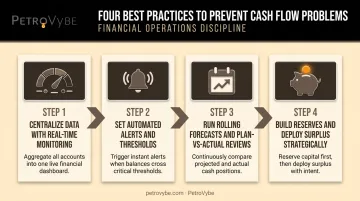
Centralize Data with Real-Time Monitoring Tools
Connect your bank accounts, payment platforms, and accounting software into one dashboard. This gives you a live view of your cash position instead of a snapshot from three weeks ago.
Doing so directly blocks the "lack of visibility" problem by replacing manual reconciliation with continuous tracking. Set this up from day one of operations, not after a scare forces your hand.
Set Automated Alerts and Thresholds
Configure rules that flag unusual transactions or balances dropping below a set minimum. This catches problems within days instead of at month-end, when it's often too late to course-correct cheaply.
Implement alerts alongside your monitoring dashboard so both work together, not as separate tools you check on different schedules.
Run Rolling Forecasts and Plan-vs-Actual Reviews
Compare projected inflows and outflows against actuals on a regular cadence to catch forecasting drift early. That directly counters poor forecasting and seasonal surprises.
At minimum, review monthly. High-transaction-volume businesses should review weekly. The AICPA recommends a rolling 13-week cash flow cycle updated weekly for near-term liquidity, paired with a 12-month view for seasonality planning.
Build Reserves and Put Surplus Cash to Work Strategically
Set aside a portion of profits, commonly 3-6 months of operating expenses, into a dedicated reserve account. That buffer absorbs the timing mismatches described earlier.
Once the reserve is secured and stable, some owners explore deploying surplus cash into diversified, tax-advantaged assets outside the business. Accredited investors with $100k+ in liquidity, for example, sometimes consider options like PetroVybe's natural gas development projects in South Texas for passive income disconnected from their own company's cash cycle.
Only pursue outside opportunities after core operating cash flow is predictable — don't chase them while your own AR and payroll timing are still shaky.
Tips for Long-Term Cash Flow Control
Sustained control comes down to consistency, not clever tools.
- Set a fixed review cadence (daily for high-volume businesses, weekly or monthly for others) and stick to it even when things look fine
- Train whoever owns AP/AR (bookkeeper, controller, or founder) on the same monitoring rules and reporting format
- Document your invoicing, collections, and approval processes so monitoring doesn't live in one person's head
- Use software or AI-driven categorization to reduce manual error as your transaction volume grows
A bookkeeper who records transactions accurately is essential, but that's different from someone actively monitoring thresholds and forecasting variance. Know which role is covering which task.
Conclusion
Cash flow crises rarely come from one bad month. They build up from unmonitored gaps that compound quietly until they can't be ignored anymore.
Consistent monitoring, disciplined reserves, and rolling forecasts turn cash flow from a source of anxiety into a tool you actually manage. Once your operating cash position is stable and predictable, the conversation shifts from survival to growth.
For business owners who've reached that stable point, PetroVybe's CFO Clayton Riddle is available through the PetroVybe team to discuss how surplus capital can be positioned in oil and gas development investments for tax-advantaged, passive income. Riddle is a financial strategist and petroleum engineer who led a 9x year-over-year EBITDAX increase in a prior oil and gas turnaround.
Frequently Asked Questions
What is cash flow monitoring?
Cash flow monitoring is the ongoing tracking and analysis of a business's cash inflows and outflows to maintain liquidity. It ensures you always know whether you can meet upcoming obligations before they're due.
Do bookkeepers monitor cash flow?
Bookkeepers typically record and reconcile transactions, including accounts payable and receivable. Active monitoring, such as alerts and forecasting, usually falls to a controller, CFO, or the owner depending on business size.
What are the best practices for cash flow monitoring?
Best practices include real-time dashboards connecting your bank and accounting data, automated alerts for low balances, rolling forecasts, and regular plan-vs-actual reviews.
How often should a business monitor its cash flow?
High-transaction businesses should review cash flow daily. Smaller, stable businesses can typically review weekly or monthly without missing early warning signs.
What's the difference between cash flow monitoring and forecasting?
Monitoring tracks what has happened and what's happening right now with your cash position. Forecasting predicts future cash positions based on expected inflows and outflows.
What tools can help small businesses monitor cash flow?
Cloud accounting software with bank integrations, real-time dashboards, and automated alert systems are the most common solutions. Many also offer digital invoicing to speed up collections.