The problem is that most people don't know how that number gets calculated, or why it sometimes shrinks. Many investors treat a stated yield as guaranteed income, then get surprised when a fund cuts its payout or when a "distribution" turns out to be partly their own capital coming back to them.
This guide breaks down what a distribution actually is, the mechanics behind how funds calculate and pay them, and where you'll encounter them across asset classes, including private oil and gas development programs.
Key Takeaways
- Distributions pay out income, capital gains, or capital returns without a sale
- Per-unit payout equals net distributable income divided by outstanding units
- Tax treatment depends entirely on the distribution's source, not its size
- Public funds follow NAV rules; private placements follow a negotiated waterfall
- Payouts range from monthly to annual and can be reinvested to compound
What Is a Distribution?
A distribution is the transfer of cash or additional units from a fund, account, or company to an investor, representing that investor's share of generated profit. It's the mechanism that lets someone collect ongoing income from an asset they still own, rather than forcing them to sell a piece of it every time they want cash.
That last point matters. A distribution is not the same thing as a capital gain you realize by selling shares above what you paid. It's also broader than a dividend. A dividend is one type of distribution, specifically one paid from a corporation's earnings and profits, while a distribution can come from several sources entirely.
Three Sources of Distributable Profit
Every distribution traces back to one of three origins, and the tax treatment changes with each:
- Investment income — dividends from stocks or interest from bonds held in the portfolio
- Realized capital gains — profit from the fund selling an underlying asset, passed through to investors
- Return of capital (ROC) — money paid back that represents the investor's own original investment, not profit
This distinction isn't just accounting trivia. Ordinary and qualified dividends get reported differently on Form 1099-DIV. Capital gain distributions are generally taxed as long-term gains no matter how long you held the fund. Return of capital typically isn't taxed at all until it reduces your cost basis to zero.
Why the Calculation Method Depends on Fund Type
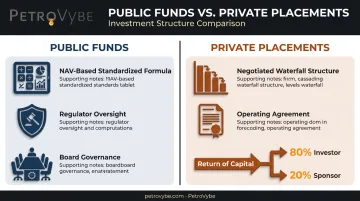
Publicly traded funds use standardized, NAV-based formulas that regulators and fund boards oversee. Private placements, including real estate syndications and oil and gas development programs, work differently. These structures typically follow a negotiated waterfall spelled out in the operating agreement, which determines exactly how cash gets split between the sponsor and investor partners before a dollar goes out the door. In one of PetroVybe's oil and gas partnerships, for instance, the waterfall might return investor capital first before splitting remaining profit 80/20 between investors and the sponsor.
How Does a Fund Distribution Work?
A distribution moves through a defined sequence: income gets generated, expenses get subtracted, a per-unit amount gets calculated, and cash finally reaches the investor. Understanding each stage is how you judge whether a fund's payout is actually sustainable.
Initiation: How Distributable Income Is Generated
The process starts when underlying assets produce income. This might be dividends from portfolio stocks, interest accruing on bonds, rental checks landing in a REIT's account, or oil and gas revenue from wells that are actively producing.
Some of this income generation is continuous, like interest accrual or ongoing production. Other income is event-driven, tied to a specific asset sale or exit event.
Here's the bottleneck most investors miss: income has to exceed operating expenses and reserves before it becomes "distributable." A fund can generate strong revenue and still pay out very little if expenses, debt service, or reserve requirements eat into it first.
Core Operation: Calculating the Distribution Amount
The basic math is straightforward:
Net distributable income ÷ total outstanding units = distribution per unit
A simplified example: a fund generates $500,000 in net income after expenses and reserves in a quarter, and it has 1,000,000 outstanding units. That's a $0.50 per-unit distribution for the period.
Several variables push that number up or down:
- Management fees deducted before income is deemed distributable
- Held-back reserves for maintenance, taxes, or future capital needs
- Ownership splits in private placements, defined by the deal's waterfall structure
That last point is where private oil and gas partnerships differ meaningfully from public funds. PetroVybe's development projects, for example, use an 80/20 profit split favoring investors once distributable income is determined.
That split sits on top of a compound capital structure: every dollar of investor equity is designed to unlock roughly five dollars of total project capital through staggered equity, credit facilities, and reinvested cash flow.
What makes a distribution sustainable? Watch for a healthy coverage ratio, meaning income comfortably exceeds what's being paid out. FINRA specifically flags repeated return of capital, managed payout policies disconnected from actual income, and heavy leverage as warning signs that a distribution rate may not hold up over time.
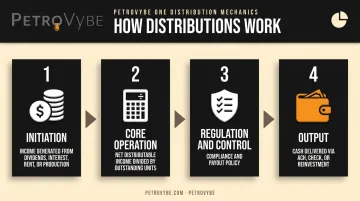
Regulation and Control: Compliance and Payout Policy
Payout policy depends on what kind of fund you're dealing with. Publicly registered funds, known as Regulated Investment Companies (RICs), must distribute at least 90% of their investment company taxable income annually to maintain their tax status under Section 852.
A separate excise tax rule under Section 4982 pushes many funds toward distributing closer to 98% of ordinary income to avoid a 4% penalty.
Private placement sponsors, by contrast, set their own schedule and terms within the operating agreement. There's no regulator-mandated cadence.
FINRA requires that communications about these private programs disclose one important fact: distributions are not guaranteed and can be modified at the sponsor's discretion. Fund managers monitor cash flow against reserve requirements before authorizing each payout cycle.
A missed or reduced distribution often signals financial strain before anything else does, and it can create tax complications if a distribution is declared on paper but never actually paid.
Output: How Investors Actually Receive the Payout
Once approved, a distribution reaches investors through one of three methods:
- Direct deposit or ACH — cash lands in a linked bank account
- Physical check — mailed for accounts not set up for electronic transfer
- Automatic reinvestment (DRIP) — cash buys additional units instead of paying out
Reinvested distributions compound over time. Vanguard's own hypothetical illustration shows a $10,000 investment earning 6% annually generates $600 in year one. Reinvest that amount instead of withdrawing it, and year two's earnings grow to $636 since the base itself has grown.
Over 20 years, the reinvested version can produce roughly $22,000 in cumulative earnings versus about $12,000 if the annual amount is withdrawn instead.
Working the math backward: if you want $1,000 a month ($12,000 a year) in distributions, the principal you need depends heavily on the yield. At a 4% yield, that's $300,000. At a 1% yield, you'd need $1.2 million. Yield assumptions matter as much as the dollar target itself.
Where Are Fund Distributions Used?
Distributions show up across nearly every income-generating investment structure, though frequency and yield vary widely by vehicle.
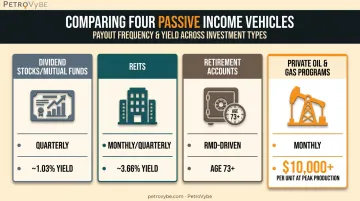
Public dividend stocks and mutual funds:
- Typically quarterly, often auto-reinvested inside brokerage accounts
- Distribution size tracks net asset value changes and underlying earnings
- The S&P 500's dividend yield sat at 1.03% as of June 30, 2026, according to Nareit's REIT Industry Financial Snapshot
REITs and real estate syndications:
- Monthly or quarterly cash-flow distributions sourced from rental income
- Listed equity REITs are required to distribute at least 90% of taxable income annually
- The same Nareit data put the FTSE Nareit All Equity REIT yield at 3.66%, roughly 3.5 times the S&P 500's yield over the same period
Retirement accounts:
- Distributions here are largely mandatory once you hit a certain age, not performance-driven
- Traditional IRA owners generally must begin Required Minimum Distributions at age 73, per current IRS guidance, with the amount calculated from the prior year-end balance and an IRS life-expectancy factor
- Roth IRA owners face no lifetime RMD requirement
Private natural gas and oil development programs:
- Direct working-interest programs generate periodic cash distributions from produced natural gas liquids revenue
- PetroVybe's South Texas and Gulf Coast Basin projects, for instance, target Monthly Passive Distributions exceeding $10,000 per unit during peak production, under the 80/20 split described earlier
- These programs often pair cash flow with substantial tax deductions. PetroVybe partners saw 91-94% deductions against active income in 2024-2025 via IDC elections under Section 263(c)
- Unlike passive real estate losses, a qualifying working interest held without limited liability protection escapes passive activity loss limits, so the deduction can offset W-2 wages and capital gains directly
Conclusion
Strip away the jargon and a distribution is just generated income minus expenses, divided across ownership units, and delivered on whatever schedule the fund's structure and compliance rules allow. That's true whether you're holding a dividend stock, a REIT, or a unit in a private oil and gas partnership.
Understanding that mechanism changes how you evaluate any stated yield. A high number backed by thin coverage or return of capital isn't the same as one backed by real, sustainable production income.
Whether your goal is quarterly brokerage income, monthly REIT cash flow, or the tax-efficient payout structure of a private program like PetroVybe ONE, the question stays the same: where does this income actually come from? What happens to your payout if that source slows down?
Frequently Asked Questions
What is an investment distribution?
A distribution is a payment of income, capital gains, or return of capital from a fund or investment to its investors, paid on a set schedule. It lets investors collect returns without selling their underlying position.
What is a good investment distribution?
A good distribution is backed by sustainable underlying income, meaning a healthy coverage ratio, rather than borrowed funds or asset sales propping up the number. Reasonable yield expectations vary by asset class, so compare like with like.
Are investment distributions considered income?
Tax treatment depends entirely on the distribution type. Ordinary and qualified dividends are taxable income, capital gain distributions get capital gains treatment, and return of capital generally isn't taxed until it exceeds your cost basis.
How much does it take to make $1,000 a month in dividends?
At a 4% yield, you'd need roughly $300,000 in principal to generate $1,000 monthly. At a 1% yield, similar to the broad S&P 500, that figure jumps to about $1.2 million, so the yield assumption changes everything.
How often are distributions paid out to investors?
Frequency depends on the fund type. Money market and bond funds often pay monthly, dividend stocks and many REITs pay quarterly, and private placements sometimes follow custom schedules set by the sponsor's operating agreement.
Can investors choose to reinvest their distributions instead of taking cash?
Yes, through a Dividend Reinvestment Plan (DRIP), which automatically uses cash distributions to buy additional whole or fractional units. Reinvested distributions add to your position and can generate their own future payouts, compounding returns over time.