

Building a cash flow forecast sounds simple: list what's coming in, list what's going out, see what's left. But the accuracy of that number depends entirely on your method, your time horizon, and the quality of the inputs feeding it. A forecast built on optimistic guesses can be more dangerous than no forecast at all.
This guide walks through the exact steps to build one that holds up, the variables that quietly wreck accuracy, the mistakes to avoid, and how a forecast that keeps showing surplus cash can point toward smarter, tax-efficient ways to grow that money.
Key Takeaways
- A cash flow forecast projects future inflows and outflows to reveal your cash position.
- Match your time horizon (short, medium, long, or rolling) to your liquidity needs.
- Five core steps build any forecast, from setting the period to calculating final balances.
- Accuracy depends on quality data, realistic assumptions, and regular comparisons to actuals.
- Consistent cash surplus signals it's time to explore tax-efficient uses for that capital.
How to Create a Cash Flow Forecast (Step-by-Step)
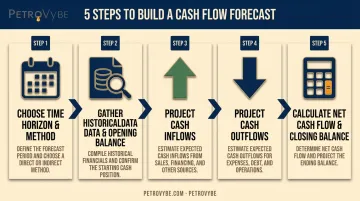
Step 1: Choose Your Time Horizon and Forecasting Method
Start by deciding what you need to know:
- Short-term (daily/weekly): For managing payroll and immediate liquidity over the next 4 to 6 weeks.
- Medium-term (13-week/monthly): For operational planning and financing decisions within the coming quarter.
- Long-term (annual+): For capital investments, debt strategy, and where to deploy excess cash.
Then pick your method. The direct method tracks actual cash receipts and disbursements line by line, best for short-term accuracy.
The indirect method adjusts projected income statements and balance sheets, better suited to longer-range planning where transaction-level detail simply doesn't exist yet.
Step 2: Gather Historical Financial Data and Set the Opening Balance
Pull real numbers from your bank accounts, accounting software, income statements, and balance sheets. Look for patterns: how long invoices typically sit before customers pay, which expenses spike seasonally, when loan payments hit.
Then confirm your actual current cash balance, verified against your bank statement, as day one of the forecast. An estimated starting figure undermines everything built on top of it.
Step 3: Project Cash Inflows
List every expected receipt by category and the date it's expected to land in the account, not when you invoice it:
- Sales and cash receipts
- Accounts receivable collections
- Loan proceeds or lines of credit drawn
- Tax refunds
- Asset sales
Use your historical accounts receivable pattern to time when invoiced revenue actually becomes cash. If 60% of your invoices pay within 30 days and 30% take 60, build that lag into the model rather than assuming full collection on schedule.
Step 4: Project Cash Outflows
Map out payments by category and the date they'll actually leave your account:
- Payroll and payroll taxes
- Rent and lease payments
- Supplier and vendor payments
- Loan and debt service payments
- Taxes and capital expenditures
Account for your real accounts payable terms. If you pay suppliers net-30 but your forecast assumes cash leaves at time of purchase, you'll show a shortage that doesn't exist, or worse, miss a real one.
Step 5: Calculate Net Cash Flow, Closing Balance and Set a Review Cadence
Two formulas do the heavy lifting:
- Net Cash Flow = Total Inflows − Total Outflows
- Closing Balance = Opening Balance + Net Cash Flow
Roll each period's closing balance into the next period's opening balance, then set a cadence to revisit the numbers: weekly for short-term forecasts, monthly for medium- and long-term ones. A forecast you never update is just a document. One you review regularly is a management tool.
Key Variables That Affect Cash Flow Forecast Accuracy
Two businesses can plug numbers into the same spreadsheet template and land on wildly different forecasts. The gap almost always comes down to how these four variables get handled.
Time Horizon Selected
The further out you forecast, the less certain the data gets. A one-week forecast draws from contracted, near-certain cash movements. A twelve-month forecast draws from budgets, historical averages, and assumptions.
Why it matters: A shaky 12-month projection carries far more decision-making risk than a near-certain one-week number. Impact on accuracy: Treat short-term forecasts as precise decision-making tools. Treat long-term forecasts as directional guidance, not gospel.
Direct vs. Indirect Method Choice
Each method sources its numbers differently: direct forecasting tracks actual transactions, while indirect forecasting adjusts projected financial statements.
Why it matters: The data source determines how granular, and how current, your forecast can be. Impact on accuracy: Direct forecasting suits daily liquidity tracking. Indirect forecasting suits budgeting and strategic, multi-month planning.
Data Quality and Source Reliability
A forecast is only as good as what feeds it. Manual entry and disconnected accounting systems raise the risk of outdated or simply wrong figures.
Why it matters: Errors can hide when overestimated and underestimated flows offset each other in the total. Impact on accuracy: EY's research found that only 28% of companies' cash forecasts land within 10% of their annual free cash flow targets, compared with 80% of revenue guidance hitting that same accuracy bar. Companies with strong processes, however, can reach an estimated 90% quarterly accuracy against enterprise cash flow targets, per EY.
Payment Terms, Collection Patterns and Seasonality
Customers and vendors rarely pay exactly on the terms stated on the invoice.
Why it matters: Real-world collection lag and seasonal swings differ from stated terms. Impact on accuracy: Ignoring these patterns causes a forecast to misstate not whether cash arrives, but when. A retailer booking December sales as December cash, when a chunk of it actually settles in January card processing, will misjudge liquidity at exactly the wrong moment.
Common Mistakes to Avoid When Building a Cash Flow Forecast
Even a well-structured forecast can mislead you if it rests on the wrong assumptions. Three mistakes show up again and again:
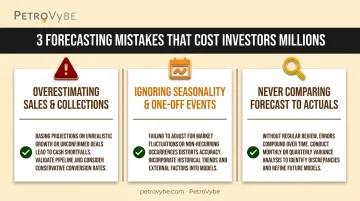
- Overestimating sales and collections. Using best-case revenue projections instead of realistic, historically grounded figures. If customers have historically paid in 45 days, don't forecast 30.
- Ignoring seasonality and one-off events. Building a flat, average-based forecast that leaves no buffer for slow months, surprise repairs, or a customer who pays late every single quarter.
- Never comparing forecast to actuals. Building the model once and shelving it means you never learn where assumptions went wrong or how to improve the process.
Fix these three habits and your forecast becomes a genuine decision-making tool, not a hopeful guess dressed up in a spreadsheet.
When You Need a Cash Flow Forecast (and Which Type Fits)
Different situations call for different forecast types. Match the horizon to the decision you're actually making.
| Horizon | Best For | Update Frequency |
|---|---|---|
| Short-term (daily/weekly) | Payroll, supplier payments, day-to-day liquidity | Daily to weekly |
| Medium-term (13-week rolling) | Operational planning, financing decisions this quarter | Weekly |
| Long-term (12+ months) | Capital investments, debt strategy, deploying excess cash | Monthly |
The 13-week rolling forecast stands apart from the rest. J.P. Morgan calls it the "standard 13-week forecast" because it balances week-by-week granularity with a three-month planning window.
If you're managing tight liquidity, loan covenants, or lender conversations, this model fits best. It updates weekly, so the picture never goes stale.
From Cash Flow Surplus to Long-Term Wealth Building
A forecast's job isn't only to flag shortfalls. Run one consistently and you'll notice the opposite problem too: recurring stretches where cash sits well above what operations actually need.
For high-income earners and business owners, that idle surplus often becomes a tax problem in its own right. Cash parked in a low-yield account still gets taxed on any interest earned, and it does nothing to offset the bill on your W-2 income or capital gains.
This is where some accredited investors look beyond the operating account. PetroVybe, a Texas-based natural gas development company, works with accredited investors holding $100,000 or more in surplus liquidity who want to convert idle cash into both upfront tax relief and long-term income.
How it works in practice:
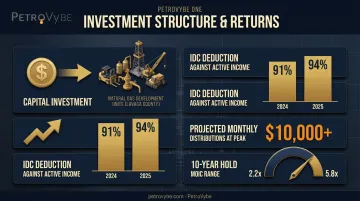
- Capital goes into natural gas development partnership units (PetroVybe ONE) tied to projects in Lavaca County, part of the Gulf Coast Basin.
- Intangible Drilling Cost (IDC) deductions let investors apply most of the write-off against active income, including W-2 wages and capital gains, unlike most real estate deductions.
- PetroVybe partners who invested in 2024 received a 91% deduction against active income; 2025 partners received 94%, based on the company's reported K-1 results.
- Wells are projected to generate monthly distributions exceeding $10,000 at peak production, over a 10-year hold with a MOIC of roughly 2.2x-5.8x.
A structure like this isn't for everyone. It's built specifically for accredited investors seeking diversification beyond stocks, bonds, and real estate, and it's not a substitute for keeping adequate operating cash reserves on hand. The forecast comes first. What you do with the surplus it reveals comes second.
Frequently Asked Questions
What is a cash flow forecast?
A cash flow forecast projects your expected cash inflows and outflows over a set period, showing your projected cash position and flagging liquidity needs before they become problems.
What is a 3-way cash flow forecast?
A 3-way forecast links the income statement, balance sheet, and cash flow statement into one integrated model, so changes in one statement flow through the others for a complete financial picture.
What is a 13-week cash flow forecast and why is it so widely used?
It's the standard medium-term rolling model in treasury management, tracking weekly cash detail across a full quarter. Businesses favor it because it balances detailed visibility with a practical planning window.
How often should I update my cash flow forecast?
Update short-term forecasts daily or weekly, since near-term numbers change fast. Medium- and long-term forecasts typically need only a monthly review to stay useful.
What's the difference between a cash flow forecast and a budget?
A budget sets planned revenue and expense targets for a period. A forecast tracks the actual timing of cash movements, showing when money will really hit or leave your account.
What should I do if my forecast shows a consistent cash surplus?
First, confirm your operating reserve is fully funded for slow periods or emergencies. After that, consider tax-advantaged options, such as direct energy investment partnerships, that generate passive income while offsetting your active income tax liability.