

Introduction
Saving used to be enough. Not anymore.
The top 1% of earners pay an average federal income tax rate of 26.1%, nearly double the 14.5% rate paid by the average taxpayer, according to Tax Foundation's analysis of the latest IRS data. Layer on inflation, and every dollar you save has to work harder just to hold its value.
Yet many high-earning professionals have done everything "right." A 401(k) here, a brokerage account there, a life insurance policy bought a decade ago. Ask how these pieces connect to a specific goal, though, and the answer is often silence.
That gap is what wealth planning fills. This guide walks through a practical four-step framework: clarifying your goals, building a portfolio that actually serves them, cutting your tax bill legally and meaningfully, and protecting what you build.
Key Takeaways
- Wealth planning ties your goals to cash flow, investments, taxes, estate, and insurance decisions
- Specific, time-bound goals should drive every dollar you invest, not vague saving habits
- Diversification now extends beyond stocks and bonds into alternative, tax-advantaged assets for accredited investors
- Direct participation strategies, like energy development deductions, can offset active income and raise after-tax returns
- Your plan is a living document. Revisit it as life and tax law change
What Is Wealth Planning, and Why Does Goal Alignment Matter?
Wealth planning isn't the same as picking good investments. It's the process of integrating your cash flow, investment strategy, tax planning, estate documents, insurance coverage, and legacy goals into one coordinated roadmap. Portfolio management is one piece of that puzzle. Wealth planning is the puzzle itself.
Done well, it delivers what a spreadsheet alone can't:
- Clarity on which goals matter most, and in what order
- Confidence that today's decisions support tomorrow's outcomes
- A measurable path to track progress and course-correct
Most people are missing this entirely. Only 36% of Americans have determined their financial goals and documented them in a formal plan, according to Charles Schwab's 2024 Modern Wealth Survey. The remaining 64% have vague, undocumented intentions or no plan at all.
That gap gets more expensive the more you earn. A high-income professional without a written plan tends to accumulate assets reactively, a stock tip here, a rental property there, rather than building deliberately toward a specific number and date.
The accounts might grow, but growth without direction still isn't progress toward a goal.
Step 1: Clarify Your Short- and Long-Term Financial Goals
Set Goals You Can Actually Measure
Vague goals like "save more" don't drive decisions. SMART goals do:
- Specific: Name the exact outcome
- Measurable: Attach a number to it
- Achievable: Grounded in your real income and savings rate
- Relevant: Tied to what you actually want
- Time-bound: Has a deadline attached
A SMART goal reads like this: "Generate $150,000 in passive income by age 55." That single sentence tells you how much capital you need, what return you're targeting, and how many years you have.
Organize Goals by Time Horizon
Break every goal into one of three buckets:
- Short-term (1-3 years): Emergency fund, high-interest debt payoff, home down payment
- Mid-term (3-10 years): Education funding, seeding a business, major renovations
- Long-term (10+ years): Retirement, wealth transfer, legacy giving
Money you'll need in 18 months shouldn't sit in volatile assets. Money you won't touch for 20 years can absorb more risk in exchange for growth.
Know Your Financial Independence Number
This is the amount of passive income, or invested assets, required to cover your lifestyle without a paycheck. If your household spends $120,000 a year and you plan to draw 4% annually from your portfolio, you'd need roughly $3 million invested. That number becomes the reference point for every allocation decision that follows.
Revisit Goals as Life Changes
Goals shift with life stage, so your plan should shift with them:
- Early career: Build cash reserves and start retirement contributions.
- Peak earning years: Max out tax-advantaged accounts and explore alternatives, such as direct energy investment partnerships, for diversification and tax efficiency.
- Pre-retirement: Shift your allocation toward capital preservation.
- Retirement: Manage distributions and turn attention to legacy planning.
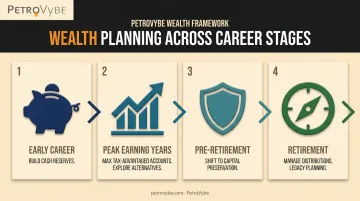
A plan built in your 30s won't fit your needs in your 50s.
Step 2: Build a Diversified Portfolio Aligned to Your Goals
Beyond Stocks, Bonds, and Real Estate
Traditional diversification spreads risk across equities, fixed income, and real property. That's still the foundation, but concentration risk creeps in when too much of your net worth sits in one asset class, or one company's stock through employer equity.
Goal-based investing takes this further: match each investment's risk and liquidity profile to the specific goal it's funding. Your emergency fund doesn't belong in private equity, and your 20-year legacy goal probably shouldn't sit entirely in a savings account.
The Growing Role of Alternative Assets
Accredited investors have been shifting into alternatives. Average allocation among high-net-worth clients with at least $5 million in investable assets reached 9.1% in 2023, according to a 2023 Cerulli Associates survey on high-net-worth investor allocations.
Advisors expect that figure to climb to 9.6% within two years, and roughly half of surveyed firms plan to increase private-equity allocations over that window.
Alternative investments such as private equity, real assets, and direct energy positions tend to move independently of public market swings. That lower correlation matters most when stocks and bonds fall together, which happens more often than most portfolios are built to handle.
Tangible, Cash-Flow Assets as an Inflation Buffer
Real assets with genuine cash-flow generation are worth a closer look here. This is where PetroVybe enters the conversation. PetroVybe develops natural gas liquids projects in South Texas and the Gulf Coast Basin, positioning the assets to help fuel the electricity demand driven by AI data center growth.
Unlike a stock position, a direct working interest in natural gas development generates monthly production income tied to a physical, depleting resource, not a company's earnings multiple. For accredited investors already loaded up on public equities, that's a different risk driver.

Due Diligence Still Comes First
Any alternative allocation, energy included, demands scrutiny before you commit capital. Look for:
- Third-party engineering validation of reserves, not just operator projections
- Track record of the technical team behind location and development decisions
- Transparency in reporting and ongoing partner communication
PetroVybe's projects carry a $48 million third-party engineered proved reserves valuation, and the company's lead geophysicist has posted a 75.2% career hit rate on well-location selection over 48 years, nearly double the industry peer average of under 40%. That's the kind of verifiable track record due diligence should uncover, whichever sponsor you're evaluating.
Step 3: Maximize Tax-Efficient Wealth-Building Strategies
Start With the Fundamentals
Before advanced strategies, get the basics right:
- Tax-advantaged accounts: 401(k)s, IRAs, and HSAs shelter growth from annual taxation
- Tax-loss harvesting: Up to $3,000 in excess losses can offset ordinary income annually, with the remainder carried forward
- Holding periods: Assets held longer than a year qualify for lower long-term capital gains rates instead of ordinary-income rates
Asset location matters too. Place tax-inefficient holdings, like bonds generating regular interest, inside tax-advantaged accounts. Keep tax-efficient assets, like index funds, in taxable brokerage accounts.
The Problem With Conventional Shelters
Asset location and holding periods help at the margins, but they don't solve a bigger structural issue. Here's the limitation most high W-2 earners run into: most standard tax shelters only offset passive income. If your income comes primarily from a salary or capital gains, a passive real estate loss often can't touch it, unless you qualify as a real estate professional, which most full-time executives don't. This is where conventional planning stalls, and where a narrow provision in the tax code opens a different path.
The IDC Deduction: A Different Category
Intangible Drilling Costs, authorized under Section 263(c) of the tax code, work differently. When a working interest in an oil or gas well is held directly, without limited liability, the resulting deduction is treated as nonpassive, meaning it isn't boxed in by the same passive-loss rules that limit most real estate deductions.
PetroVybe's investment structure runs on this provision. Investors receive a K-1 as limited partners, and the IDC deduction flows through to offset active income, including W-2 wages and capital gains. In practice, PetroVybe partners realized a 94% deduction against active income in 2024 and a 91% deduction in 2025.
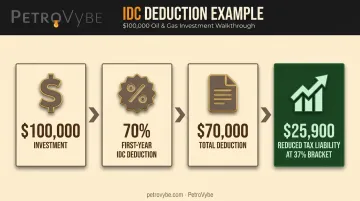
Illustrative example: A $100,000 investment generating a 70% first-year IDC deduction produces $70,000 in deductions. For someone in the top 37% federal bracket, that translates to roughly $25,900 in reduced tax liability in year one, before any production income even arrives.
That said, IDC deductions carry an alternative minimum tax preference above certain thresholds, and basis and at-risk limits apply before passive-loss rules come into play at all.
Talk to a qualified tax or financial advisor before implementing any direct participation program. These structures involve real capital risk, illiquidity, and technical rules a generalist advisor may not have encountered before.
Step 4: Protect and Adapt Your Plan Over Time
Estate Planning and Insurance
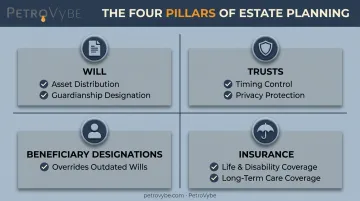
A wealth plan without estate documents is unfinished. At minimum, review:
- A will, directing asset distribution and naming guardians for minor children
- Trusts, for control over timing, privacy, and tax efficiency in wealth transfer
- Beneficiary designations, on retirement accounts and life insurance, which override your will if left outdated
- Life, disability, and long-term care insurance, protecting your family's cash flow if something happens to you
More than half of American adults have no estate-planning document of any kind. That gap turns even a well-built investment plan into a legal mess for heirs. An outdated beneficiary form or a missing will can undo years of disciplined investing in a single probate proceeding.
Revisit Your Plan Regularly
Wealth plans aren't "set it and forget it." Certain events should trigger an immediate review:
- Marriage, divorce, or a new child, which changes your beneficiaries and dependents
- A new job, promotion, or business sale, which shifts your income and tax bracket
- Major market shifts affecting your portfolio's risk exposure
- Tax law changes, which happen more often than most people track
- Approaching retirement, typically 5-10 years out
Beyond these triggers, schedule a standing review with a financial and tax professional at least once a year, twice if your income or assets are complex. Markets shift, tax brackets shift, and a plan you don't revisit falls out of date fast.
Frequently Asked Questions
What is the best wealth building strategy?
There isn't one single best strategy. Sustainable wealth building combines clear goal-setting, diversified investments including alternatives, tax efficiency, and consistent long-term discipline.
What is the average net worth of a 65-year-old couple?
According to the Federal Reserve's 2022 Survey of Consumer Finances, households aged 65-74 had a median net worth of $409,900 and a mean of $1,794,600. Homeownership and retirement savings drive wide variance around these figures.
How much money do I need to start wealth planning?
Basic wealth planning benefits anyone at any income level. Formal strategies involving accredited investor opportunities, like direct energy development, typically require $100,000 or more in investable liquidity.
What's the difference between wealth planning and wealth management?
Wealth planning is the holistic roadmap covering goals, taxes, and estate strategy. Wealth management typically refers to the ongoing, day-to-day management of the investment portfolio within that plan.
How often should I update my wealth plan?
Review your plan at least annually, plus immediately after major life events, tax law changes, or significant shifts in income.
Are alternative investments like oil and gas a good way to diversify for tax purposes?
For accredited investors, direct energy development can offer portfolio diversification and substantial tax deductions against active income. Pair it with thorough due diligence and professional tax guidance before committing capital.