That confusion is understandable. The term gets used three different ways: the geological journey from formation to combustion, the classification system for gas types, or the daily commercial cycle that schedules pipeline deliveries. Each matters for a different reason.
This guide covers all three. You'll learn how natural gas forms and moves through the energy system, the four main types you'll encounter in the field, how long U.S. reserves are projected to last, and why any of this matters if you're considering a position in the industry.
Key Takeaways
- Natural gas moves through five stages: formation, extraction, processing, transportation, and consumption
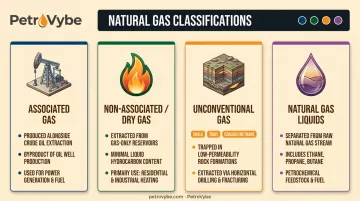
- Four classifications exist: associated, non-associated, unconventional, and natural gas liquids (NGLs)
- U.S. proved reserves stood at 583.9 Tcf at year-end 2024.
- AI data center demand could add 3-6 Bcf/d of new gas consumption by 2030.
What Is the Natural Gas Cycle?
The natural gas cycle describes the resource's complete journey: formation deep underground, extraction through drilling, processing to remove impurities, transportation via pipeline, and final combustion. Each stage creates distinct opportunities and risks. Understanding where value gets created, and where it gets consumed, helps clarify why timing matters so much in this industry.
Formation: Millions of Years in the Making
Natural gas forms in two ways. Biogenic gas comes from microorganisms breaking down organic matter at relatively low temperatures, often in shallow sediments. Thermogenic gas forms when buried organic material sits under intense heat and pressure over geologic time. This process produces most of the world's natural gas supply.
Once generated, gas doesn't stay put. It migrates through fractures and porous rock until it either escapes to the surface or gets trapped by an impermeable cap rock. That trapping process creates a reservoir: the target every drilling operation is searching for.
Shale gas works differently. It often stays locked in the low-permeability source rock itself, which is exactly why unconventional extraction methods had to be invented.
Extraction & Production
Modern gas extraction relies on two core techniques working together:
- Horizontal drilling: the well goes vertical, then turns to run laterally through the producing formation, exposing far more rock to the wellbore than a vertical well ever could
- Hydraulic fracturing: water, sand, and additives are pumped in under pressure to crack the rock and hold those fractures open so gas can flow
By 2016, hydraulically fractured horizontal wells accounted for 69% of new U.S. oil and gas wells and 83% of total drilled footage. This combination is now the industry standard.
The drilling technique doesn't separate a profitable well from a dry hole. The geology behind the decision to drill there does, and that's where operator expertise creates real separation.
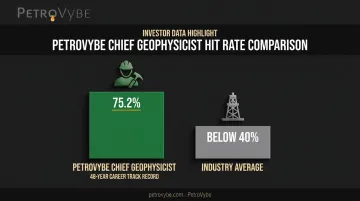
PetroVybe's Chief Geophysicist, Michael Stamatedes, has posted a 75.2% career hit rate on profitable well locations across 48 years, including a tenure as a Geology leader at ExxonMobil. Industry peers typically hover below 40%. That gap compounds directly into decline curve accuracy and, ultimately, investor returns.
Processing, Transportation & Storage
Raw gas coming out of the ground isn't ready for the pipeline. Processing removes water, carbon dioxide, and hydrogen sulfide, then separates out natural gas liquids through fractionation based on boiling point.
From there, gas enters a delivery network of roughly 3 million miles of pipeline connecting production areas to storage and end users. Underground storage (depleted fields, aquifers, salt caverns) plays a critical seasonal role:
- Operators typically inject gas April 1 through October 31
- They withdraw during November 1 through March 31 to meet winter heating demand
This storage cycle is what keeps pipeline pressure stable and prevents shortages during cold snaps.
Consumption & the Cycle's Continuation
Gas ultimately reaches three major end uses: residential heating, industrial processes, and power generation. Power generation is the fastest-growing category, and it's the one driving renewed interest in the sector right now.
As older wells decline, and every well does decline, new drilling and reinvestment keep production flowing. That reinvestment loop is the actual engine of the natural gas cycle: a continuously renewing system where today's consumption funds tomorrow's development, rather than a straight line from formation to consumption.
The Four Types of Natural Gas Explained
Classification depends on where and how the gas is found. That distinction affects extraction cost, processing requirements, and market value . The differences matter well beyond academic interest.
Associated Natural Gas
Associated gas is found alongside crude oil deposits and gets captured as a byproduct of oil production. It's typically separated at the wellhead. Because it rides along with oil drilling economics, associated gas supply often moves with oil prices rather than gas-specific demand.
Non-Associated (Dry) Natural Gas
Non-associated gas comes from reservoirs that don't produce significant crude oil. Once liquefiable hydrocarbons and nonhydrocarbon gases are stripped out, what's left is often called "dry gas," primarily methane. It's the form most familiar to consumers through home heating and stoves.
Unconventional Natural Gas
Unconventional gas includes three main sources, each requiring specialized extraction:
- Shale gas: trapped in low-permeability shale formations, requiring horizontal drilling and fracturing
- Tight gas: held in low-permeability sandstone or carbonate rock
- Coalbed methane: extracted from coal seams
Shale gas has become the dominant source of U.S. supply. According to U.S. Energy Information Administration data, shale wells produced 35,109,495 MMcf out of 45,867,761 MMcf in total U.S. gross gas withdrawals in 2024, a 76.55% share. That's a massive shift from where the industry stood two decades ago.
Natural Gas Liquids (NGLs)
NGLs (ethane, propane, butane, and pentane) are liquid hydrocarbons separated out during processing rather than a separate geological source. They matter because of economics: liquids command premium pricing relative to production cost, delivering higher margins than standard dry gas. That's a core reason PetroVybe's development strategy leans toward liquids-rich production rather than dry gas alone.
How Long Will Natural Gas Last? Reserves, Longevity & the Production Cycle
"Proved reserves" are volumes that geological and engineering data show, with reasonable certainty, can be recovered under current economic and operating conditions. U.S. proved natural gas reserves stood at 583.9 Tcf at year-end 2024, down 3% from 603.6 Tcf the year before, according to the EIA.
That dip doesn't signal a shrinking resource base — reserve figures fluctuate year to year based on drilling activity, pricing, and technology. Here's the misconception worth clearing up: reserves are not a fixed, depleting number. They're recalculated constantly as exploration expands and extraction technology improves.
- Horizontal drilling, 3D seismic imaging, and better completion techniques have unlocked gas once considered inaccessible
- U.S. proved reserves rose in nearly every year after 2000 as these tools matured
- Individual wells still follow a decline curve (production drops over time), but workovers, recompletions, and reinvestment can extend a field's productive life well past initial projections
That last point is central to how disciplined operators compound value from legacy assets rather than chasing new acreage every year.
Demand Is Reshaping the Supply Conversation
The other side of the reserves equation is demand, and it's shifting fast. McKinsey projects U.S. data center electricity use climbing from 147 TWh in 2023 to 606 TWh by 2030. S&P Global estimates that growth could add 3-6 Bcf/d of additional natural gas demand by 2030, assuming roughly half of new generation capacity runs on gas.
These are scenarios, not locked-in contracts. But they add real urgency to a supply conversation that used to move at a much slower pace.
The Natural Gas Market & Operational Cycle
Beyond geology, there's a daily commercial cycle that keeps physical gas flowing from producer to end user. FERC Order 809 governs this through five scheduled nomination windows each gas day, starting at 9:00 a.m. Central Time:
| Cycle | Nomination Deadline | Flow Effective |
|---|---|---|
| Timely | 1:00 p.m. (prior day) | 9:00 a.m. next day |
| Evening | 6:00 p.m. (prior day) | 9:00 a.m. next day |
| Intraday 1 | 10:00 a.m. | 2:00 p.m. |
| Intraday 2 | 2:30 p.m. | 6:00 p.m. |
| Intraday 3 | 7:00 p.m. | 10:00 p.m. |
This system exists to keep producers, pipelines, and utilities synchronized so power plants get gas exactly when they need it.
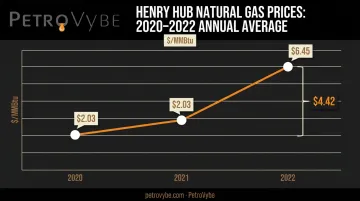
Pricing follows a different pattern entirely, with sharp year-over-year swings. EIA's Henry Hub annual averages ranged from just $2.03 per MMBtu in 2020 to $6.45 in 2022, a spread of $4.42 driven by weather swings, storage levels, and shifting supply-demand balances. That volatility rewards operators with strong well economics, including low breakeven costs and consistent output, over those betting on favorable pricing swings.
Why the Natural Gas Cycle Matters for Investors
Value in the natural gas cycle concentrates early — at the development stage, before gas ever reaches a pipeline. Buying downstream, closer to consumption, means paying a premium for an asset that's already been de-risked by someone else.
The IDC Tax Advantage at the Development Stage
The development stage also carries a tax advantage most investors overlook: intangible drilling cost (IDC) deductions. Under IRC 263(c), a working interest holder can elect to deduct qualifying drilling costs, including wages, fuel, hauling, and supplies, in the year they're incurred.
Unlike most passive investments, this deduction can offset active income, including W-2 earnings and capital gains, when the interest is held directly or through an entity that doesn't limit liability.
PetroVybe structures its development projects around exactly this stage of the cycle. Consider the numbers:
- Up to 100% total tax deduction over the life of an investment, combining IDC, depletion, and depreciation
- 2024 partners realized a 94% deduction against active income; 2025 partners saw 91%
- A $100,000 investment typically generates a $60,000-$80,000 first-year deduction through IDC alone
Where PetroVybe Sits in the Cycle
This deduction offers a direct offset against W-2 income, not a passive real estate depreciation schedule. It's available because the investment sits at the development stage, the point in the cycle where PetroVybe's team works to reduce dry-hole risk before capital gets deployed.
Chief Geophysicist Michael Stamatedes brings a 75.2% well-selection track record to that risk-reduction process, applied directly across PetroVybe's own development projects.
Those projects sit in South Texas and the Gulf Coast Basin, built around a straightforward premise: today's gas fuels the AI-driven electricity surge, while disciplined development builds long-term legacy wealth for accredited investor partners over a projected 10-year hold. That's a direct position at the exact point in the cycle where value gets created.
Frequently Asked Questions
What is the cycle of natural gas?
It's the resource's journey from formation and extraction through processing, transportation, and combustion. This cycle repeats continuously as older wells decline and new ones get developed.
How long is natural gas expected to last?
Reserves are measured using a reserves-to-production framework rather than a fixed countdown. U.S. proved reserves stood at 583.9 Tcf at year-end 2024, and estimates typically grow as drilling technology and exploration advance.
What are the four types of natural gas?
Natural gas comes in four types:
- Associated gas: found alongside crude oil
- Non-associated (dry) gas: comes from gas-only reservoirs
- Unconventional gas: includes shale, tight gas, and coalbed methane
- NGLs: liquid hydrocarbons like ethane and propane separated during processing
Is natural gas a renewable or nonrenewable resource?
Natural gas is a nonrenewable fossil fuel formed over millions of years through the decomposition of organic matter under heat and pressure. It burns cleaner than coal, producing roughly half the CO2 per unit of energy.
How is natural gas formed?
Organic matter decomposes under heat and pressure over geologic time, producing either biogenic gas from microbial activity or thermogenic gas from deeper thermal processes. The gas then migrates until it's trapped beneath impermeable cap rock.
What's the difference between natural gas and natural gas liquids (NGLs)?
Dry gas is mostly methane, used directly as fuel for heating and power. NGLs (ethane, propane, butane, and pentane) are liquid hydrocarbons separated during processing and used in fuels, heating, and petrochemical manufacturing.