

Introduction
Most people run their financial lives through separate silos. A broker manages the portfolio. A CPA handles taxes each April. An insurance agent sells a policy once and disappears.
None of them talk to each other, and that gap costs money.
High earners feel this the most. Rising tax burdens and stubborn inflation have made a portfolio-only approach feel incomplete. In fact, 53% of households say having a comprehensive financial plan is important to their financial confidence, according to Cerulli Associates research on financial planning.
That's the case for holistic wealth planning. This guide breaks down what it actually means, the six pillars that hold it together, and where alternative assets, including tax-advantaged energy investments, can fill gaps that stocks and bonds alone can't.
Key Takeaways
- Holistic wealth planning unites investments, taxes, retirement, and estate strategy into one cohesive plan
- A complete strategy rests on six pillars: cash flow, investments, tax planning, retirement, estate, and risk management
- Alternative assets like energy development boost tax efficiency and hedge inflation
- Your plan isn't static — revisit it as income, tax law, and life circumstances shift
What Is Holistic Wealth Planning?
Holistic wealth planning starts from a different place than traditional financial planning. Instead of asking "what should I do with this money," it asks "what is this money supposed to accomplish in my life?" Then it works backward from there.
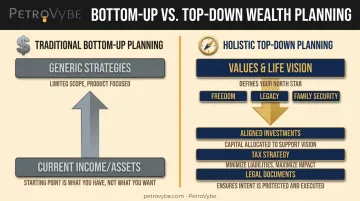
Traditional bottom-up planning starts with your current income or investable assets and builds strategies around them. Holistic, top-down planning starts with your values and life vision (freedom, legacy, family security) and aligns your investments, tax strategy, and legal documents to serve that vision.
Comprehensive vs. Holistic: What's the Real Difference?
People use these terms interchangeably, but they're not quite the same:
Comprehensive planning covers every financial area, including investments, insurance, taxes, retirement, and estate planning. Holistic planning does that too, but also weaves in your personal goals, lifestyle priorities, and legacy intentions.
Think of comprehensive as the checklist and holistic as the reason the checklist exists.
That distinction matters because holistic planning is never static. A business sale, a marriage, an inheritance, or a new tax law can throw an otherwise sound plan out of alignment overnight. That's why it requires ongoing revisits, not a one-time setup.
Holistic planning matters most for people whose financial lives have real complexity:
- High-income W-2 earners facing steep marginal tax brackets
- Business owners with concentrated equity in one asset
- Investors realizing capital gains from a sale, exit, or liquidity event
For these groups, the cost of siloed advice isn't hypothetical. It shows up every April as a bigger tax bill than necessary.
The Core Pillars of a Complete Wealth Strategy
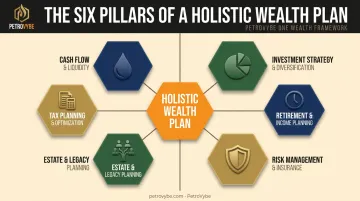
A holistic plan spans six interconnected pillars, each influencing the others.
Cash Flow & Liquidity Management
Before any long-term strategy matters, you need enough accessible cash to fund near-term goals, such as a home purchase, tuition, or a business investment, without derailing your wealth-building timeline. Locking every dollar into illiquid investments defeats the purpose of a coordinated plan.
Investment Strategy & Diversification
Your investment mix should match your risk tolerance and time horizon, not just chase returns. That mix now often includes assets beyond the public markets.
There's a real gap between how institutions and individuals allocate here. Global institutions held roughly 20% of their portfolios in alternative assets in 2023. Individual investors trail far behind: high-net-worth individuals with $1 million to $5 million in assets held just 1% in alternatives in 2024, according to CAIA Association research on private wealth allocation. That gap represents an opportunity most individual investors haven't tapped yet.
Tax Planning & Optimization
This pillar goes beyond filing a return once a year. It's a multi-year strategy involving:
- Timing capital gains and losses strategically
- Tax-loss harvesting within taxable accounts
- Maximizing tax-advantaged retirement accounts
High-income earners are increasingly looking further, toward active-income tax deduction strategies that go beyond standard deferral tools. Direct investments in oil and gas development, for example, can qualify for intangible drilling cost (IDC) deductions against W-2 income and capital gains, not just passive income, an advantage we'll cover next.
Retirement & Income Planning
The goal here is durable passive income that doesn't collapse when the market dips or inflation spikes. That means building multiple income streams, not relying solely on a 401(k) balance and hoping the withdrawal math works out.
Estate & Legacy Planning
Wills, trusts, and wealth transfer strategies exist to minimize estate tax exposure and make sure assets pass to the next generation smoothly, not through a drawn-out probate fight.
Risk Management & Insurance
Life, disability, and long-term care insurance protect everything else you've built. One health event without proper coverage can undo decades of disciplined planning.
Where Alternative Investments Fit In Your Holistic Wealth Strategy
A complete strategy doesn't stop at public stocks and bonds. Accredited investors are adding private and real-asset investments, including real estate, private equity, and energy, specifically to reduce correlation with public markets and hedge against inflation.
Accredited status itself has a defined bar: income over $200,000 individually (($300,000 with a spouse) for two consecutive years, or net worth over $1 million excluding your primary residence, per the SEC's official accredited investor criteria. Meeting that threshold opens doors that most retail investors never see.
The Tax Angle: Intangible Drilling Costs
Within the tax planning pillar, one alternative asset class stands out: direct oil and gas working interests. They're among the few investment vehicles offering Intangible Drilling Cost (IDC) deductions that apply against active income — meaning W-2 wages and capital gains, not just passive income like most real estate deductions.
This is where PetroVybe puts this deduction to work. It's a Texas-based natural gas development company giving accredited investors direct access to NGL and gas development projects in Lavaca County and the Gulf Coast Basin. Structurally, it works like this:
- Minimum investment: $100,000 per unit
- 91% to 94% first-year tax deduction against active income delivered to partners in 2024 and 2025, respectively
- Deductions can be taken fully in year one or spread over five years
- 10-year target MOIC window of roughly 2.2x to 5.8x, with a targeted IRR near 26%
- Monthly passive distributions projected to exceed $10,000 during peak production
It Also Supports the Retirement Pillar
Because these distributions are passive and tied to a tangible, producing asset, this type of investment also strengthens the retirement/income pillar. It generates cash flow without requiring day-to-day management from the investor, which is exactly the durability that pillar calls for.
One caution worth repeating: direct energy development deductions shouldn't be a standalone decision. Evaluate them alongside a CPA or advisor as one coordinated piece of your broader plan. Ask specifically how the IDC deduction interacts with your current tax bracket and any passive-loss carryforwards before committing capital.
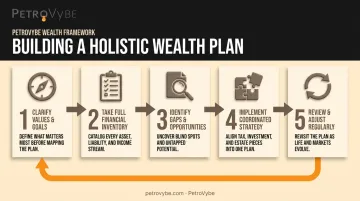
How to Build Your Holistic Wealth Plan in 5 Steps
Step 1: Clarify Your Values and Goals
Before selecting a single financial product, document what wealth is actually supposed to accomplish for you. Freedom to leave a job? Generational security? A legacy gift? This shapes everything downstream.
Step 2: Take Full Inventory of Your Financial Picture
Gather:
- Income sources and tax returns
- Assets and liabilities
- Insurance policies
- Estate documents (wills, trusts, beneficiary designations)
This inventory is the foundation everything else gets built on.
Step 3: Identify Gaps and Opportunities
Work with a CPA or advisor to uncover tax inefficiencies, insurance gaps, and overconcentration in traditional public market assets. This often reveals tax-advantaged alternatives such as direct oil and gas partnerships offering IDC deductions. Most gaps hide in plain sight until someone looks at the full picture at once.
Step 4: Implement a Coordinated Strategy
Bring your investment manager, CPA, estate attorney, and any alternative investment sponsors, such as PetroVybe's oil and gas development partnerships, together into one integrated action plan. Each professional should know what the others are doing, not operate in isolation.
Step 5: Review and Adjust Regularly
Revisit the plan at least annually, or immediately after a major life event or tax law change, such as evolving deduction rules for alternative investments. A plan built for 2023 income levels may be badly misaligned by 2026.
Common Mistakes to Avoid When Building a Holistic Wealth Strategy
Even well-intentioned investors fall into these traps:
- Treating taxes, investments, and insurance as separate decisions. They're one interconnected system; optimizing one in isolation can hurt another.
- Staying overconcentrated in stocks and bonds. Skipping tax-advantaged alternatives, such as direct oil and gas partnerships offering intangible drilling cost (IDC) deductions, leaves diversification and tax savings on the table.
- Not updating the plan after major changes. A business sale or new tax bracket without a plan update means yesterday's strategy running on autopilot.
Frequently Asked Questions
What is holistic wealth planning?
It's an integrated approach that combines investments, taxes, estate planning, and retirement strategy into one coordinated plan aligned with your personal goals, not a collection of separate financial decisions.
Is $200,000 enough to work with a financial advisor?
Yes, many advisors work with clients at this level, though minimums vary by firm. Accredited investor status depends on income or net worth thresholds, not simply how much liquidity you have on hand.
What is the difference between comprehensive and holistic financial planning?
Comprehensive planning covers every financial area, from taxes to insurance to retirement. Holistic planning does the same but also weaves in your personal values, lifestyle, and legacy goals.
How often should I review my holistic wealth plan?
At least once a year, and immediately after major life events like a business sale, marriage, or inheritance, or after significant tax law changes.
Are alternative investments only for the ultra-wealthy?
No. Accredited investor status requires $200,000+ in annual income or $1 million+ in net worth, which is a meaningful bar, but well below ultra-wealthy. Many qualifying professionals and business owners can add alternatives for diversification.
How can energy or natural gas investments provide tax benefits in a wealth plan?
Direct oil and gas working interests offer Intangible Drilling Cost (IDC) deductions that can offset active income, including W-2 wages and capital gains. That's a distinct advantage over most passive real estate deductions, which typically can't touch active income.