
Introduction
Open any financial news site and you'll hear "sector," "industry," and "asset class" tossed around like they mean the same thing. They don't, and mixing them up can leave you with a portfolio that's riskier than you think.
An investment sector is a classification that groups companies engaged in similar economic activities, making it possible to compare performance and manage risk across the market.
This guide covers the 11 official GICS sectors, how they differ from broader asset classes, and how investors use sector data to build a diversified strategy.
We'll also look at how a sector like Energy extends well beyond publicly traded stocks, into private, direct development opportunities available to accredited investors.
Key Takeaways
- Investment sectors group companies by business activity, simplifying performance comparisons and risk analysis
- The Global Industry Classification Standard (GICS) organizes public markets into 11 official sectors
- Concentrating in one sector can boost returns, but increases volatility versus a diversified portfolio
- Energy sector exposure extends beyond stocks and ETFs: private partnerships add tax and income benefits public markets don't offer
What Is an Investment Sector?
An investment sector groups companies or assets that share similar economic activities. Analysts use these groupings to track trends, compare company performance against peers, and construct portfolios that spread risk across different parts of the economy.
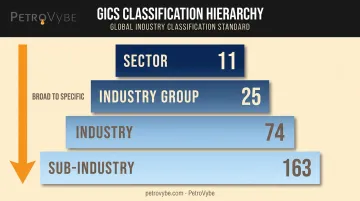
The most widely used framework is the Global Industry Classification Standard (GICS), jointly developed by MSCI and S&P Dow Jones Indices in 1999. GICS organizes the market into a four-tier hierarchy:
- Sector - the broadest classification (11 total)
- Industry Group - a narrower grouping within a sector (25 total)
- Industry - a more specific category (74 total)
- Sub-Industry - the most granular level (163 total)
Sector vs. Industry: A Concrete Example
Exxon and Chevron compete directly within the Energy industry. They don't compete with agricultural companies, even though economists might lump oil extraction and farming into the same broad "primary sector" category. That's the difference between economic sectors and financial market sectors.
Economic sectors (primary, secondary, tertiary, quaternary) describe how an economy produces value, from raw materials to services, while financial market sectors (GICS) describe how public companies are grouped for investment analysis.
Other classification systems exist too, though sector definitions can shift slightly depending on which provider you're using:
- ICB (FTSE Russell) uses similar logic with different category names
- TRBC (LSEG) offers a more granular hierarchy
- NAICS (U.S. Census Bureau) is a government statistics system, not an investment taxonomy
The 11 Stock Market Investment Sectors Explained
Under GICS, the public equity market splits into 11 sectors. Each one reacts differently to interest rates, consumer confidence, and where we sit in the economic cycle.
Here's a breakdown of what each sector covers and how it tends to behave:
| Sector | What It Covers | General Tendency |
|---|---|---|
| Communication Services | Telecom, media, interactive/social platforms | Sensitive to advertising and subscription cycles |
| Consumer Discretionary | Non-essential goods and services | Cyclical, rises and falls with consumer confidence |
| Consumer Staples | Food, household products | Defensive, holds up during downturns |
| Energy | Oil, gas, coal extraction and services | Sensitive to commodity prices and supply disruptions |
| Financials | Banks, insurers, asset managers | Reacts strongly to interest rate moves |
| Health Care | Pharma, biotech, providers | Defensive, but faces regulatory risk |
| Industrials | Capital goods, transportation, construction | Benefits from economic expansion |
| Information Technology | Software, hardware, semiconductors | Growth-oriented, rate-sensitive |
| Materials | Chemicals, metals, raw material processing | Tied closely to global demand |
| Real Estate | Mostly REITs | Highly sensitive to interest rate changes |
| Utilities | Electric, gas, water utilities | Defensive, but capital-intensive and rate-sensitive |
These behavioral labels describe historical tendencies, not guarantees. A sector's composition and the broader macro environment can change how it performs in any given cycle.
Public Energy stocks track commodity swings, while private upstream partnerships—like PetroVybe's natural gas projects in South Texas—carry a different risk and tax profile.
7 Common Types of Investments Beyond Stock Sectors
Sector classification applies almost exclusively to equities and equity funds. Bonds, cash, and alternatives sit outside the GICS framework entirely. Here's how the seven major investment categories break down:
- Stocks - Ownership stakes in individual companies
- Bonds - Debt instruments where you lend money in exchange for interest payments
- Mutual funds/ETFs - Pooled vehicles holding a basket of securities; ETFs trade throughout the day like stocks
- Real estate - Direct property ownership or REIT shares
- Commodities - Physical goods like oil, gold, or agricultural products
- Cash equivalents - Highly liquid, low-risk holdings such as money-market funds
- Alternative investments - Everything outside conventional stocks, bonds, and cash, including private equity and direct energy development
Note: Mutual funds and ETFs are wrappers, not asset classes themselves. Their underlying holdings determine what you're actually exposed to.
More investors are turning to alternatives, drawn by diversification and tax-efficiency benefits that public markets often can't offer. That shift is exactly why private energy development deserves a closer look, covered next.
How Investors Use Sector Classification
Sector data serves two practical purposes: timing portfolio allocations and managing risk exposure.
Sector Rotation
Sector rotation means shifting your portfolio weight based on where the economy sits in its cycle. Fidelity's analysis of market cycles from 1962 to 2020 found consistent patterns:
- Early expansion: Consumer Discretionary, Financials, Real Estate, Industrials, and Information Technology tend to lead
- Late cycle: Energy, Consumer Staples, Health Care, and Utilities often take over
- Recession: Consumer Staples, Utilities, and Health Care historically outperform
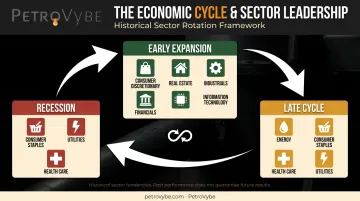
Fidelity is careful to note this framework is probabilistic. Cycles can skip phases entirely or retrace unexpectedly, so treat these patterns as tendencies rather than rules.
Diversification and Concentration Risk
While sector rotation focuses on timing, diversification tackles a different risk: concentration. Spreading investments across multiple sectors reduces your exposure to a downturn hitting just one part of the market. If your entire portfolio sits in one sector and that industry stumbles, you feel the full impact.
The flip side matters too. Narrowly focused sector funds tend to be more volatile than funds diversified across many sectors and companies, according to Fidelity's own portfolio research. That volatility can work in your favor during a rally, but it cuts both ways during a slump.
Why Energy Deserves a Place in a Diversified Sector Strategy
The Energy sector has always been cyclical, rising and falling with commodity prices and global supply disruptions. That's still true. But something new is layering on top of the old pattern: electricity demand is climbing fast, driven largely by AI infrastructure.
The International Energy Agency projects global data center electricity consumption will roughly double from 2024 levels to about 945 terawatt-hours by 2030, with AI-accelerated servers driving nearly half that increase. That's demand context, not a return forecast, but it's hard to ignore when thinking about where power needs to come from over the next decade.
Most investors gain Energy sector exposure through stocks or ETFs. That route offers liquidity, but it comes with tradeoffs:
- Limited access to early-stage development assets
- Fewer tax advantages compared to direct participation
- Exposure to whatever the fund manager chooses, not the specific projects you'd pick yourself
Private Development as an Alternative Path
This is where private oil and gas development partnerships come in. PetroVybe, for example, offers accredited investors direct participation in natural gas development projects across South Texas and the Gulf Coast Basin, with operations concentrated in Lavaca County.
Instead of buying shares in a diversified Energy ETF, investors take a direct limited partnership stake in specific drilling projects. That structure unlocks intangible drilling cost (IDC) tax deductions, which unlike most real estate deductions, apply against active income, including W-2 wages and capital gains, not just passive income.
PetroVybe's partners received a 94% deduction against active income in 2024 and 91% in 2025, according to company performance data. On a $100,000 investment, that translates to a first-year deduction in the range of $60,000 to $80,000.
What to Look For in Private Sector Opportunities
Direct energy investing carries real risk, so due diligence matters more than it does with a liquid ETF. PetroVybe's own model highlights the kind of factors worth checking:
- Third-party engineering validation - PetroVybe's proved reserves carry a $48 million valuation (PV-09), confirmed by an independent, licensed engineering firm rather than an internal estimate
- Experienced leadership - PetroVybe's Chief Geophysicist has a 48-year track record with a 75.2% well-success rate, well above the industry average below 40%
- Disclosed target returns - PetroVybe publishes a target 10-year MOIC of roughly 2.2x to 5.8x and a target IRR near 26%, with clear disclaimers that these figures depend on commodity pricing and execution

None of this replaces reading a full Private Placement Memorandum or speaking with a financial advisor. But these are the concrete markers that separate a credible private energy opportunity from a vague pitch deck.
Frequently Asked Questions
What are the 11 investment sectors?
The 11 GICS sectors are Communication Services, Consumer Discretionary, Consumer Staples, Energy, Financials, Health Care, Industrials, Information Technology, Materials, Real Estate, and Utilities.
What are the top 5 sectors to invest in?
No single "best" sector exists—it depends on the economic cycle and your goals. Technology, Health Care, Financials, Industrials, and Energy are frequently highlighted for growth, income, or diversification, but always check current conditions before allocating.
What are the 7 types of investments?
Stocks, bonds, mutual funds/ETFs, real estate, commodities, cash equivalents, and alternative investments cover the major categories investors typically consider.
What is the difference between a sector and an industry?
A sector is the broadest grouping under GICS. An industry sits two levels down, describing a narrower, more specific business activity within that sector.
Which sector performs best during an economic downturn?
Defensive sectors, particularly Utilities, Consumer Staples, and Health Care, have historically held up better than the broader market during recessions, though none are immune to losses.
How can I invest in a specific sector like energy?
You can buy sector ETFs, mutual funds, or individual stocks for liquid exposure. Accredited investors can also access private direct development partnerships, which offer tax-advantaged structures like IDC deductions unavailable through public markets.