
The Capital Cash Flow (CCF) method solves this problem differently. Instead of adjusting the discount rate for taxes, CCF builds the interest tax shield directly into the cash flow itself, then discounts everything at a single, unchanging rate.
CCF shows up constantly in leveraged buyout (LBO) valuations and highly leveraged private transactions, where debt levels move significantly over the investment horizon. Yet it's rarely taught alongside standard FCF/DCF training, leaving many analysts to default to the harder path even when a leveraged deal calls for something else.
This guide breaks down what CCF is, how to calculate it step-by-step, and how it stacks up against FCF/DCF, including how the logic applies to capital-intensive investments like oil and gas development.
Key Takeaways
- CCF equals Free Cash Flow plus the interest tax shield, not a discount-rate adjustment
- Discounting uses a constant pre-tax WACC, so shifting capital structures don't force annual rate recalculations
- This method fits LBOs, fixed-debt schedules, and deals where debt-to-value ratios move materially
- Applied correctly, CCF and FCF/WACC land on the same enterprise value, just via different paths
When to Use CCF and What You Need Before Calculating It
When CCF Fits Best
CCF earns its keep in one specific situation: debt that's fixed in dollar terms, or tied to a known repayment schedule, rather than pegged to a target percentage of value.
Picture a leveraged buyout. The sponsor borrows a set amount, then pays it down according to a fixed amortization schedule. As the company's value changes year to year, the debt-to-value ratio moves too, even though the actual debt balance follows a plan set at closing.
Standard FCF/WACC valuation struggles here. Since after-tax WACC depends on the debt-to-value ratio, and that ratio changes every year, the discount rate technically needs recalculating for every single period. That's tedious and error-prone.
CCF sidesteps that. Because it uses a constant pre-tax WACC (covered below), the shifting ratio doesn't force any rate changes.
One caveat: don't reach for CCF on stable, low-leverage companies where the debt-to-value ratio holds steady. FCF/WACC works fine there, and switching to CCF just adds complexity without a real gain.
What You Need Before Calculating CCF
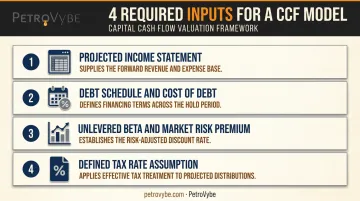
Before building a CCF model, gather four inputs:
- A projected income statement (EBIT or net income) plus depreciation, amortization, capex, and working capital changes, to build your cash flow base
- A debt schedule and cost of debt, since the interest tax shield depends on both the repayment plan and the rate charged
- Unlevered (asset) beta and market risk premium estimates, required to compute the pre-tax WACC that CCF uses as its discount rate
- A defined tax rate assumption, which directly sizes the interest tax shield added back into cash flow
Skip any one of these and the model breaks. Get the tax rate wrong, for instance, and the tax shield either overstates or understates CCF, throwing off the entire enterprise value calculation downstream.
How to Calculate the Capital Cash Flow Method (Step-by-Step)
CCF calculation follows a defined sequence, starting from either net income or EBIT. Skip the step where you add back the interest tax shield, and you've defeated the entire purpose of using CCF.
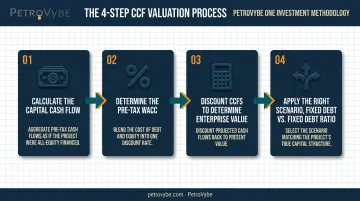
Step 1: Calculate the Capital Cash Flow
Two paths get you to the same number.
Net income path: Start with net income, which already has interest deducted. Add back depreciation and amortization, subtract capex and the change in net working capital, then add back cash interest paid. That last add-back turns FCF into CCF, restoring the cash interest that was already subtracted to arrive at net income.
EBIT path: Convert EBIT to EBIAT (earnings before interest, after taxes) using your tax rate. Layer in the same cash flow adjustments (D&A, capex, working capital) to get standard FCF. Then add the interest tax shield, cash interest multiplied by the tax rate, to reach CCF.
The most common setup error is forgetting that last add-back on the EBIT path. Skip it, and CCF collapses back into FCF, understating value and defeating the analysis.
Step 2: Determine the Pre-Tax WACC
CCF's discount rate comes from the asset's risk, not its financing. Under CAPM: pre-tax WACC equals the risk-free rate plus asset beta multiplied by the market risk premium.
Notice what's missing: no debt-to-equity weighting. Since asset beta reflects the operating risk of the underlying business, this rate holds steady even as the debt-to-value ratio shifts.
Compare that to the standard after-tax WACC used in FCF valuations, which blends the cost of debt and equity weighted by their respective proportions of capital. Change the leverage, and that blend changes too. This is CCF's core practical advantage in leveraged deals.
Step 3: Discount CCFs to Determine Enterprise Value
Discount each year's projected CCF at that same constant pre-tax WACC to arrive at enterprise value. From there, add redundant assets and subtract outstanding debt to reach equity value.
Here's a built-in sanity check: the CCF-derived enterprise value should match the FCF-derived value when you feed both models identical underlying assumptions. If the numbers diverge materially, look for inconsistent tax, leverage, or terminal-value assumptions before trusting either output.
Step 4: Apply the Right Scenario, Fixed Debt vs. Fixed Debt Ratio
Two scenarios call for different handling, and mixing them up causes real errors.
- Fixed debt: Total debt stays constant in dollar terms, or follows a set repayment schedule, while the debt-to-value ratio drifts as project value changes. CCF's constant discount rate fits this scenario well.
- Fixed debt ratio: The debt-to-value ratio stays constant instead, so you re-estimate project value each year to find the matching debt level and tax shield. CCF still applies one constant rate, though the debt figures take more work to pin down.
Misidentify which scenario you're in, and you'll run into circular calculations, especially if you apply fixed-debt-ratio FCF/WACC assumptions to what's actually a fixed-dollar-debt deal.
Capital Cash Flow vs. Free Cash Flow (DCF): Key Differences
The two methods start from the same place, projected cash flow, but handle debt's tax benefit in opposite ways.
Discount rate: CCF uses a constant pre-tax WACC that doesn't change when leverage changes. FCF/DCF uses an after-tax WACC that must be recalculated whenever the capital structure shifts, since that rate blends the cost of debt and equity by their (changing) weights.
Where the tax shield lives: CCF bakes the interest tax shield directly into the cash flow numerator. FCF/DCF instead reflects it in the discount rate denominator, through the after-tax cost of debt. Either way, the investor captures the same tax advantage; the two methods just place it in a different part of the formula.
Why CapEx Still Gets Removed
Here's a point that trips people up: CapEx is deducted from FCF because it's cash reinvested into the business to sustain operations, not cash available to distribute to debt and equity holders.
CCF handles CapEx exactly the same way. The only difference between CCF and FCF is how the tax shield gets treated, not how CapEx gets treated. Both methods net out reinvestment identically.
Complexity in Changing Capital Structures
Take an LBO with debt declining from $500 million toward zero over five years. Under FCF/DCF, the debt-to-value ratio changes every year as debt gets paid down, technically requiring a new after-tax WACC calculation for each period.
Under CCF, one pre-tax WACC applies across the entire five-year forecast. The underlying economics don't change, but you avoid rebuilding the discount rate five separate times.
| Factor | Capital Cash Flow | FCF / DCF |
|---|---|---|
| Discount rate | Constant pre-tax WACC | After-tax WACC, recalculated as leverage changes |
| Tax shield location | Inside the cash flow | Inside the discount rate |
| Best-fit scenario | Fixed debt or shifting leverage (LBOs) | Stable, low-leverage companies |
| Calculation complexity | Lower for leveraged deals | Higher when capital structure moves yearly |
Applied correctly, both methods land on the same enterprise value. CCF simply provides a calculation shortcut for situations where recalculating WACC every year becomes more trouble than it's worth.
Where the Capital Cash Flow Method Is Used in Practice
Leveraged Buyouts, Private Equity, and Project Finance
CCF's home turf is the leveraged buyout. Debt levels decline predictably as sponsors pay down acquisition financing from operating cash flow, and the constant discount rate saves analysts from rebuilding WACC every forecast period.
The academic case for this is solid. Kaplan and Ruback studied 51 highly leveraged transactions completed between 1983 and 1989, comparing transaction prices to discounted projected cash flows. Their estimates landed within roughly 10% of actual transaction values on average, performing at least as well as comparable-company approaches.
CCF also fits private equity and project finance deals with front-loaded debt structures: think capital-intensive natural resource development, where financing is heaviest early and the asset's own cash flow retires the debt over time.
Oil and gas projects are a textbook example. Debt structures often shift as wells come online, produce, and generate cash that pays down financing. The debt-to-value ratio moves constantly, exactly the condition where CCF's approach earns its keep.
The Tax Shield Parallel in Natural Gas Development
There's a useful parallel here for accredited investors evaluating energy deals. PetroVybe structures its natural gas development projects around upfront Intangible Drilling Cost (IDC) deductions. These deductions let partners claim a substantial portion of drilling costs against active income in the same year they deploy capital.
That's conceptually the same move CCF makes: building the tax benefit directly into the cash flow picture rather than treating it as a separate adjustment. For investors evaluating tax-advantaged energy development opportunities, asking how a sponsor accounts for tax shields inside their projected returns is one way to gauge how rigorously the sponsor built the underlying model.

Best Practices for Applying CCF Effectively
A few habits separate a clean CCF model from a shaky one.
- Reconcile against FCF every time. Build both models under identical assumptions. Diverging enterprise values signal inconsistent tax, leverage, or terminal-value assumptions.
- Pick your calculation path deliberately. The EBIT path suits tax-shield visibility for reporting; the net income path works best when starting directly from financial statements.
- Confirm the debt scenario before you build anything. Fixed-dollar debt and fixed-debt-ratio deals require different treatment. Getting this wrong leads to misapplied CCF or circular calculations.
None of this requires advanced math. CCF's real difficulty is sequencing: knowing when to add the tax shield and which discount rate applies, not the arithmetic itself.
For investors evaluating capital-intensive projects, including energy development deals like PetroVybe's natural gas partnerships, this framework doubles as a due diligence lens. Ask sponsors how they account for tax shields in projected MOIC and IRR figures, and whether the capital structure stays fixed or shifts over the hold period.
PetroVybe's own model blends partner equity, credit facilities, and reinvested cash flow, with leverage ratios tracked across the ten-year hold. That's the kind of detail worth confirming before committing capital to any leveraged or tax-advantaged structure.
Frequently Asked Questions
What is the capital cash flow method?
CCF is a valuation approach that adds the interest tax shield directly to Free Cash Flow, then discounts the total at a constant pre-tax WACC instead of adjusting the discount rate for taxes.
How do you calculate capital cash flow?
Two paths lead to the same number: start with net income and add back cash interest, or convert EBIT to EBIAT and add the interest tax shield separately. Both should reconcile to the same figure.
What is the difference between the capital cash flow method and discounted cash flow (DCF)?
CCF places the tax shield inside the cash flow and uses a constant pre-tax discount rate. Standard FCF/DCF places the tax shield inside the discount rate, requiring recalculation whenever leverage changes.
Why is CapEx removed from free cash flow (FCF)?
CapEx represents cash reinvested to sustain operations, so it isn't available to distribute to debt or equity holders. CCF removes it the same way FCF does.
When should you use CCF instead of FCF?
Reach for CCF when debt is fixed in dollar terms or follows a set schedule, or when the debt-to-value ratio shifts materially, such as in leveraged buyouts.
Does the CCF method produce a different valuation than the FCF method?
No. When both methods use consistent tax, leverage, and terminal-value assumptions, they produce the same enterprise value. The difference is calculation convenience, not a different answer.