
Introduction
Say your business just spent $50,000 on new equipment. Does that cost hit your income statement today, or does it sit on your balance sheet and get recovered over years?
That single decision is the heart of asset capitalization, and it's one that small businesses and large corporations wrestle with constantly.
Get it wrong and you're not just making a bookkeeping error. You're distorting taxable income, skewing profitability metrics, and potentially violating GAAP.
This guide breaks down what capitalization means, how GAAP treats it, the three main types you'll encounter, and how to record the journal entries yourself. We'll also look at a case where the standard rules bend in favor of the taxpayer: oil and gas development, where certain drilling costs can be expensed immediately instead of capitalized.
Key Takeaways
- Capitalization records a cost as a long-term asset instead of expensing it immediately
- GAAP requires capitalization when a cost benefits the business beyond one period and meets a set dollar threshold
- Businesses recover capitalized costs over time through depreciation or amortization, not all at once
- Some industries, like oil and gas, expense certain costs immediately for major first-year tax advantages
What Does It Mean to Capitalize an Asset?
Capitalizing an asset means recording its cost as a long-term asset rather than a one-time expense. It shows up on the balance sheet, not the income statement, which ties directly to the accounting equation: Assets = Liabilities + Equity.
The logic behind this comes from the matching principle. Costs should be recognized in the same period as the revenue they help generate. A delivery truck doesn't just benefit this month. It helps generate revenue for years, so its cost gets spread across those years through depreciation.
Under current FASB guidance, an asset is defined as a company's present right to a future economic benefit. Simply spending money doesn't automatically create an asset. The purchase has to result in something that will keep delivering value.
Capitalization vs. Expensing: The Core Difference
The contrast is straightforward once you see it in action:
| Aspect | Expensing | Capitalizing |
|---|---|---|
| Income statement impact | Reduces net income immediately, in full, in the period the cost occurs | Spreads cost recognition over multiple periods |
| Balance sheet impact | No new asset recorded | Temporarily inflates total assets |
There's a balance sheet effect too. Capitalizing a cost temporarily inflates total assets, which can shift metrics like return on assets. That's exactly why consistent, defensible capitalization policies matter for investors and lenders reading your financials.
What Types of Assets Get Capitalized?
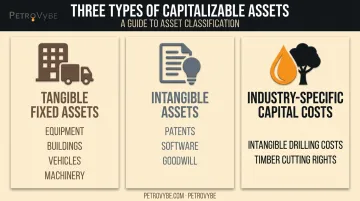
Not every purchase qualifies. Capitalizable costs generally fall into a few buckets:
- Tangible fixed assets: equipment, buildings, vehicles, machinery
- Intangible assets: patents, capitalized software development costs, goodwill
- Industry-specific capital costs: intangible drilling costs (IDCs) in oil and gas development, timber cutting rights in forestry
The common thread across these categories: the asset must have a useful life extending beyond one year. A $30 stapler doesn't qualify, no matter how long it lasts. A $50,000 CNC machine does.
GAAP Rules for Fixed Asset Capitalization
GAAP's core test is simple to state, harder to apply: a cost qualifies for capitalization when it provides future economic benefit beyond the current accounting period. Everything else flows from that test.
What counts as "capitalized cost"? It's not just the sticker price. Under GAAP, the full capitalized cost includes:
- Purchase price
- Shipping and delivery charges
- Installation costs
- Sales tax
- Testing costs required to get the asset ready for its intended use
Capitalization Thresholds
Every company sets its own dollar threshold, above which a purchase gets capitalized and below which it's simply expensed. Most businesses align this with IRS guidance rather than inventing a number from scratch.
The IRS de minimis safe harbor gives two thresholds:
| Business Type | Safe Harbor Threshold |
|---|---|
| Without an applicable financial statement (AFS) | $2,500 per invoice or item |
| With an AFS | $5,000 per invoice or item |
These thresholds took effect for tax years beginning on or after January 1, 2016. The IRS tangible property regulations FAQ confirms the election must be made annually by attaching a statement to a timely filed return. These are tax safe harbors, not mandatory GAAP book thresholds, but most companies use them as a practical benchmark anyway.
Capitalized Interest on Construction
When a company builds an asset for its own use, like a facility or a large piece of equipment, interest incurred during construction can be capitalized rather than expensed. Under ASC 835-20, capitalization begins once expenditures are being made, preparation activities are underway, and interest cost is actually being incurred. It ends when the asset is substantially complete and ready for use.
GAAP vs. IFRS: Where They Diverge
GAAP tends to be detailed and rules-based, with industry-specific guidance for nearly every scenario. IFRS relies on a broader principles-based test: whether future economic benefit is "probable."
Research and development costs show this divergence clearly. Under ASC 730, US GAAP generally requires R&D costs to be expensed as incurred, with a handful of narrow exceptions. IFRS's IAS 38 splits the difference: research costs get expensed, but development costs are capitalized once specific recognition criteria are met. Same underlying activity, two very different balance sheet outcomes.
The Three Types of Capitalization
Capitalization takes three distinct forms, depending on what you're capitalizing.
| Type | What It Covers | How It's Recognized |
|---|---|---|
| Fixed Asset Capitalization | Physical property, plant, and equipment purchased outright | Recorded at cost, depreciated over useful life |
| Leased Asset (ROU) Capitalization | Finance and operating leases | Recognized as right-of-use assets and lease liabilities under ASC 842 |
| Intangible/Capitalized Cost Capitalization | Capitalized interest, software development, certain acquisition costs | Recognized as an asset rather than expensed immediately |
Fixed asset capitalization is what most people picture: buying a building or a fleet of trucks and depreciating that cost over the years the asset is in service.
Leased asset capitalization changed with ASC 842. Both finance and operating leases must now be capitalized as right-of-use assets paired with corresponding lease liabilities. This was a major shift from the old rules, where operating leases stayed off-balance-sheet entirely.
Intangible and capitalized cost treatment covers the trickier category: costs that don't produce a physical asset but still meet the future-benefit test, like capitalized interest during construction, intangible drilling costs in oil and gas development, or qualifying software development spend.
The Accounting Entry for Asset Capitalization: Step-by-Step Example
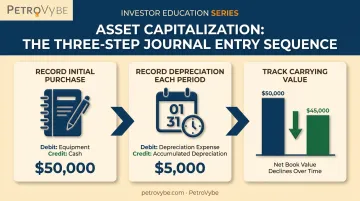
Let's walk through an actual entry. Say your business buys a $50,000 piece of equipment in cash.
Step 1: Record the initial purchase
Debit: Equipment (Asset)       $50,000
Credit: Cash                   $50,000
If purchased on credit instead, you'd credit Accounts Payable rather than Cash.
Step 2: Record depreciation each period
Assume a 10-year useful life with no salvage value, using straight-line depreciation:
Debit: Depreciation Expense    $5,000
Credit: Accumulated Depreciation $5,000
Step 3: Track carrying value
The equipment's book value is original cost minus accumulated depreciation. After year one, that's $50,000 - $5,000 = $45,000.
This carrying value keeps declining each year until it reaches salvage value (or zero) at the end of the asset's useful life. It's what shows up on the balance sheet, not the original purchase price.
Capitalize or Expense? A Quick Decision Checklist
Once you've capitalized an asset, the trickier question is often deciding whether a cost qualifies for capitalization in the first place. When you're unsure, run it through these three questions:
- Does the cost exceed your capitalization threshold? (Often $2,500 or $5,000, per IRS safe harbor)
- Will the asset be used for more than one year?
- Does it directly support ongoing operations?
If the answer to all three is yes, capitalize it.
Example: A $50,000 delivery truck gets capitalized and depreciated over its useful life. A $500 fuel purchase for that same truck gets expensed immediately, because fuel has no benefit beyond the current period.
Why Asset Capitalization Rules Matter for Oil & Gas Investors
Oil and gas development breaks the typical fixed-asset mold in a way that creates one of the more distinctive tax advantages available to accredited investors.
In a standard drilling project, costs split into two categories:
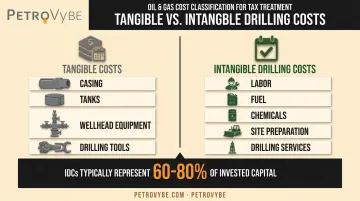
- Tangible drilling costs: casing, tanks, wellhead equipment, drilling tools. These have salvage value and must be capitalized, then recovered through depreciation
- Intangible Drilling Costs (IDCs): labor, fuel, chemicals, site preparation, drilling services. Despite the name, this is real spending; under IRC 263(c), operators can elect to deduct qualifying IDCs immediately instead of capitalizing them
The IRS Oil & Gas Audit Technique Guide confirms this election covers wages, fuel, repairs, drilling mud, site preparation, and similar costs, while explicitly excluding tangible, salvageable equipment.
Why This Creates a Rare Tax Advantage
Here's what makes IDCs unusual: for investors holding a direct working interest, these deductions aren't limited to passive income. They can offset active income, including W-2 wages and capital gains, according to IRS Publication 925 on passive activity rules.
That's a meaningful departure from real estate, where losses are generally trapped against passive income unless you qualify as a real estate professional.
This mechanism drives the substantial first-year deductions available through direct working-interest natural gas development projects like PetroVybe ONE, which operates in Lavaca County, Texas, and the broader Gulf Coast Basin.
IDCs typically represent 60% to 80% of invested capital in new drilling projects. Because they qualify as active-income deductions rather than passive ones, the tax impact can be substantial in year one.
Every investor's tax situation is different. Consult a qualified tax professional to confirm how capitalization and expensing elections apply to your specific circumstances before making any investment decision based on tax treatment.
Frequently Asked Questions
What is the accounting entry for asset capitalization?
You debit the relevant asset account and credit cash or accounts payable for the full capitalized cost. Depreciation follows separately, debiting depreciation expense and crediting accumulated depreciation each period.
What does it mean to capitalize an asset?
Capitalizing means recording a cost as a long-term asset on the balance sheet instead of expensing it immediately on the income statement. It ties directly to the matching principle, spreading cost recognition across the periods the asset helps generate revenue.
What are the GAAP rules for fixed asset capitalization?
GAAP requires the cost to provide future economic benefit beyond the current period and exceed the company's capitalization threshold. It must also include all costs needed to prepare the asset for use, such as shipping, installation, and testing—not the purchase price alone.
What are the three types of capitalization?
The three types are fixed asset capitalization (physical property and equipment), leased asset capitalization (right-of-use assets under ASC 842), and intangible/capitalized cost capitalization (things like capitalized interest and software development).
What is a capitalization threshold and who sets it?
Businesses set their own dollar thresholds, typically aligned with IRS de minimis safe harbor limits of $2,500 or $5,000. Once set, the threshold must be applied consistently for both tax and financial reporting purposes.
What happens if a cost is capitalized incorrectly?
Incorrect capitalization overstates both assets and net income, which can mislead investors and lenders reading your financials. It can also trigger audit findings or compliance issues if tax authorities or auditors catch the discrepancy.