

The answer wasn't necessity. It was tax strategy. Apple avoided an estimated $9.2 billion in repatriation taxes on offshore cash by borrowing instead of bringing overseas funds home. Microsoft and Alphabet have run similar plays.
This isn't a fluke. It's proof that capital structure, the mix of debt and equity a business chooses, is a deliberate financial and tax lever, not just a funding mechanism. Get this mix right, and you lower your cost of capital, protect cash flow, and build wealth faster. Get it wrong, and taxes plus debt service can quietly erode returns.
This guide breaks down what capital structure decisions actually are, the four recognized structural types, and how tax planning shapes these choices, for companies and for individual investors building their own portfolios.
Key Takeaways
- Debt interest is tax-deductible, while equity dividends are not, giving leverage a built-in tax edge
- The tax shield lowers a company's Weighted Average Cost of Capital (WACC), but only up to a point
- Excessive debt triggers tax exhaustion and raises bankruptcy risk, canceling out the benefit
- Accredited investors can mirror this shield through oil and gas Intangible Drilling Cost (IDC) deductions
- Industry stability, growth stage, and risk tolerance all shape how aggressively a company should use debt
What Are Capital Structure Decisions?
Capital structure is the specific combination of debt and equity a company uses to finance its assets and operations. A capital structure decision is the ongoing management choice of how much to fund through borrowing versus ownership stakes, with the goal of achieving the lowest possible cost of capital.
Two components make up nearly every capital structure:
- Debt: bank loans, corporate bonds, and other interest-bearing obligations that must be repaid on schedule
- Equity: common and preferred shares, plus retained earnings, representing ownership claims with no fixed repayment date
This decision reaches far beyond financing logistics. It shapes financial risk, ownership dilution, cash flow flexibility, and tax exposure all at once. A company loaded with debt faces fixed payment obligations regardless of how the business performs. A company that leans on equity avoids that pressure but gives up a slice of ownership and future profits.
Here's how the two options stack up:
| Factor | Debt | Equity |
|---|---|---|
| Tax treatment | Interest is tax-deductible | Dividends are not deductible |
| Repayment obligation | Fixed schedule, mandatory | None required |
| Ownership impact | No dilution | Dilutes existing shareholders |
| Risk to business | Raises bankruptcy risk if overused | No default risk |
| Access to expertise | None inherent | Equity investors often bring guidance |
Neither option is universally "better." The right mix depends on cash flow predictability, growth stage, and how much financial risk a business can absorb—questions we'll unpack throughout this guide.
The Four Types of Capital Structure
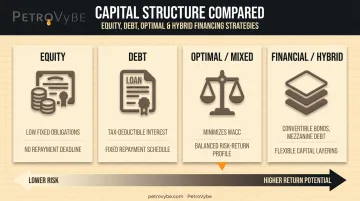
Businesses and investors structuring their own portfolios generally classify financing approaches into four recognized types. Each represents a different point on the risk-reward spectrum.
Equity Capital Structure
This approach relies primarily on shareholder capital and retained earnings, with little to no debt. It's common among conservative businesses, high-growth startups, and companies with unpredictable revenue streams where fixed debt payments would be dangerous.
Biotech firms are a good example. Long development timelines and uncertain cash flow make heavy borrowing risky, so equity financing dominates until products reach market. Oil and gas development partnerships follow similar logic, funding projects through direct investor equity rather than debt to pair long-term production upside with upfront tax advantages like intangible drilling cost (IDC) deductions.
Debt Capital Structure
Here, borrowed funds (loans and bonds) make up the bulk of financing. This works best in industries with stable, predictable cash flows, utilities being the textbook case. Because interest payments are tax-deductible, debt-heavy structures capture a built-in tax advantage that equity simply can't match.
Optimal (or Mixed) Capital Structure
This is the theoretical balance point that minimizes the Weighted Average Cost of Capital (WACC) and maximizes company value. The standard formula:
WACC = (E/V × Ke) + (D/V × Kd × (1 - Tc))
Where E is equity value, D is debt value, V equals D + E, Ke is cost of equity, Kd is cost of debt, and Tc is the corporate tax rate. Every company theoretically has an optimal debt-to-equity ratio; the challenge is finding it before rising risk outweighs the tax benefit.
Financial (Hybrid) Capital Structure
Hybrid instruments—such as mezzanine debt, convertible bonds, and preferred stock—blend debt and equity characteristics. They offer flexibility for structuring tax-efficient capital without committing fully to either category. Finance teams use them to fine-tune leverage without triggering rigid loan covenants.
The Role of Tax Planning in Capital Structure Decisions
The core mechanism driving debt's popularity is the tax shield: interest on debt is tax-deductible, while dividends paid to shareholders are not. This makes debt a cheaper source of capital on an after-tax basis, sometimes by several percentage points.
The math works like this:
- After-tax cost of debt = Kd × (1 - Tc)
- A company borrowing at 6% with a 21% corporate tax rate has an effective cost of debt of roughly 4.74%
- That lower effective cost pulls down the overall WACC, directly increasing company value
Charter Communications illustrates the scale involved. According to the company's fiscal 2025 10-K filing, it reported $94.6 billion in principal debt and $5.0 billion in net interest expense that year, alongside a 22.7% effective tax rate. Its filings also show deferred tax assets tied to interest carryovers under Section 163(j), proof that even massive, sophisticated borrowers actively manage the interplay between debt levels and tax exposure.
That advantage isn't unlimited, though. Tax exhaustion marks the ceiling. This occurs when a company's interest payments exceed its taxable profits, meaning additional debt no longer generates a usable current-year tax benefit. Once a business hits this ceiling, more leverage just adds risk without adding tax savings.
Two more constraints matter here:
- Bankruptcy and financial distress costs rise as leverage increases, so tax savings must be weighed against solvency risk
- Regulatory limits can shift the calculus entirely. Current U.S. rules under Section 163(j) generally cap the business interest deduction at business interest income plus 30% of adjusted taxable income, plus floor-plan financing interest
That 30% ATI cap means companies can't assume unlimited deductibility from adding debt. Capital structure has to be revisited whenever these rules change, which they have, repeatedly, over the past decade.
Debt vs. Equity: Balancing Tax Benefits Against Financial Risk
Two competing theories explain how companies actually make this trade-off in practice.
Trade-off theory holds that companies increase debt to capture tax benefits right up until the marginal benefit gets offset by rising financial and bankruptcy risk. It's a balancing act, not a race to maximum leverage.
Lenders don't leave that balance to chance. Debt agreements typically include covenants that restrict borrower behavior once certain thresholds are crossed.
Research from the Boston Fed found that investment rates fell by about 1.8 percentage points when incurrence-covenant restrictions were triggered. Debt costs more than interest; triggered covenants also restrict operational flexibility.
Pecking order theory offers an alternative view. Under this model, companies:
- Use retained earnings first (cheapest, no information asymmetry issues)
- Turn to debt second (moderate cost, tax-efficient)
- Issue equity only as a last resort (most expensive, dilutes ownership)
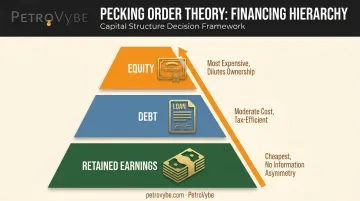
This sequencing minimizes costs and preserves tax efficiency by treating equity as the priciest option, reserved for when other sources are exhausted.
Applying Capital Structure Tax Logic to Personal Investment Planning
The same debt-shield thinking companies use doesn't stay locked inside corporate finance departments. Accredited individual investors can apply an equivalent principle to offset their own active income, W-2 wages, capital gains, or both, through structured alternative investments.
Intangible Drilling Costs as a Personal Tax Shield
Intangible Drilling Cost (IDC) deductions in oil and gas development are the clearest parallel. Under IRC Section 263(c), costs incurred by a working interest holder in drilling activity, including wages, fuel, geology services, and drilling and fracing services, can be expensed rather than capitalized.
What makes this structure distinct: a qualifying working interest held directly, or through an entity that doesn't limit liability, is not classified as a passive activity under Section 469(c)(3). That single provision changes everything. Most passive investments (rental real estate, for example) can only offset passive income. IDC deductions can offset active income directly.
PetroVybe, a Texas-based natural gas development company, offers a real-world illustration of this model through its PetroVybe ONE partnership structure:
- Accredited investor partners who joined in 2024 reported approximately 94% first-year tax deductions against ordinary income
- Partners who joined in 2025 reported approximately 91% first-year deductions
- The structure targets a 10-year MOIC of roughly 2.2x to 5.8x and an IRR near 26%, both described as forecast-dependent projections rather than guarantees
- Reserves underlying the projects have been valued at $48 million (PV-09) by a third-party engineering firm
- Minimum participation starts at $100,000 in liquidity
Because these deductions flow through a K-1 as working-interest income and losses, they apply against W-2 earnings and capital gains directly, not just against other passive income. That's a meaningfully different tax-planning lever than the debt-versus-equity decisions available to public companies.
Before committing capital to any working-interest structure, investors should:
- Request third-party engineering validation of reserve estimates, not just marketing claims
- Confirm accredited investor status through a CPA, tax attorney, or licensed financial advisor
- Review the private placement memorandum in full
- Consult a qualified tax advisor familiar with basis, at-risk, and passive-activity rules, since excess-business-loss and AMT limitations can still cap deductions even under the active-income exception

Key Factors That Shape the Optimal Capital Structure
No formula spits out a universal "correct" debt-to-equity ratio. Three variables consistently drive the decision, for companies and portfolio-building investors alike.
Industry dynamics matter most. Utilities and other businesses with stable, predictable cash flows can sustain heavier debt loads because they know revenue will arrive on schedule to cover interest payments. Cyclical or volatile industries carry more risk per dollar of debt, so they typically lean more on equity.
Growth stage and profitability shift the calculation over time. High-growth companies often favor equity since unpredictable cash flow makes fixed debt payments risky, while mature, profitable firms can service more debt, capturing greater tax benefits without threatening solvency.
Asset tangibility and management risk tolerance round out the picture. Companies with substantial tangible assets (real estate, equipment, proven reserves) have more collateral to support borrowing.
Leadership teams with lower risk tolerance will accept a smaller tax shield in exchange for balance sheet stability. The same trade-off applies to individual investors deciding how much of their portfolio to allocate toward tax-advantaged structures versus conventional holdings.
Frequently Asked Questions
What is the role of tax planning in capital structure decisions?
Tax planning determines how much a company benefits from the tax-deductibility of debt interest versus non-deductible equity dividends. This directly shapes the financing mix that minimizes the after-tax cost of capital.
What are capital structure decisions?
Capital structure decisions are ongoing choices about how a company finances its assets and growth using debt, equity, or some combination of both. The goal is typically the lowest sustainable cost of capital.
What are the four types of capital structure?
The four types are equity (funded through shareholder capital), debt (funded through borrowing), optimal/mixed (balancing WACC), and financial/hybrid (blending instruments like convertible bonds and preferred stock).
How does the tax shield affect a company's cost of capital?
The tax shield lowers the effective cost of debt by the amount of tax saved on deductible interest, which reduces WACC and increases company value. This benefit shrinks once a company hits tax exhaustion or takes on excessive financial risk.
Can individual investors apply capital structure tax strategies to their own portfolios?
Yes. Structures like PetroVybe's oil and gas intangible drilling cost (IDC) deductions let accredited investors replicate a corporate-style tax shield against personal active income, unlike traditional passive equity or debt instruments that are typically limited to offsetting passive income.
What is the difference between capital structure and financial structure?
Financial structure includes all liabilities, both short-term and long-term, plus equity. Capital structure typically focuses more narrowly on long-term debt and equity financing, though the exact scope can vary by convention.