Introduction
In March 2026, the International Energy Agency took an unprecedented step. All 32 member countries agreed to release 400 million barrels of emergency oil stocks, more than double the 182.7 million barrels tapped during the 2022 Russia-Ukraine crisis.
The trigger: an escalating Iran war and a near-total halt of tanker traffic through the Strait of Hormuz. Gasoline prices climbed, Brent crude hovered close to $100 a barrel, and investors were left wondering what emergency stockpiles actually solve.
This article breaks down what the IEA's 2026 report really means. Specifically, it covers:
- The core findings from the IEA's 2026 report
- How much oil is genuinely held in reserve
- Which countries control the bulk of global supply
- What it all signals for anyone building wealth through energy assets
Key Takeaways
- IEA authorized a 400-million-barrel release in March 2026, more than double its 2022 Ukraine response.
- Member states hold roughly 1.8 billion barrels in emergency stocks — a temporary buffer, not new production.
- OPEC members alone control about 79% of the world's proved crude reserves, concentrating global supply risk
- Domestic US natural gas and NGL development is gaining traction as a hedge against Hormuz-exposed supply shocks
The 2026 IEA Emergency Oil Release: What Happened and Why
The Trigger: Iran War and a Blocked Strait
The Strait of Hormuz normally carries close to 15 million barrels of crude per day, roughly a third of all globally traded crude, plus another 4.4 million barrels a day of refined products. When the Iran war escalated and shipping attacks intensified, that flow nearly stopped.
Breaking Down the Numbers
On March 11, 2026, all 32 IEA members unanimously agreed to make 400 million barrels available, the largest collective action since the agency's founding in 1974, according to the IEA's own announcement. The implementation plan totaled roughly 426 million barrels once you break it down:
- 280 million barrels from public stocks
- 119 million barrels from obligated industry stocks
- 28 million barrels from production increases
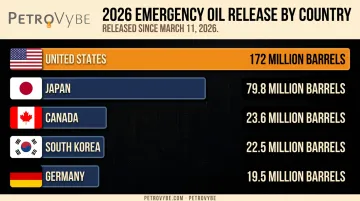
By July 21, Reuters reported that members had actually released 290 million barrels since March, with "substantial" emergency stocks still remaining. Country-level contributions included:
- United States: 172 million barrels from the Strategic Petroleum Reserve
- Japan: 79.8 million barrels
- South Korea: 22.5 million barrels
- Canada: 23.6 million barrels, classified as production increases
- Germany: roughly 19.5 million barrels
Birol's Warning: "Worst Disruption on Record"
IEA Executive Director Fatih Birol described the situation as the largest supply disruption in oil-market history. By April, he cited more than 80 damaged oil and gas facilities across the Middle East, with over a third severely damaged, and crude and product exports falling below 10% of prewar levels.
His caveat mattered as much as the numbers. Birol was clear that the release was "not a solution," only a way to reduce the pain. On April 13, he said the IEA stood ready to tap reserves further if the situation worsened.
How Much Oil Does the IEA Actually Hold in Reserve?
As of March 2026, IEA member states held close to 1.8 billion barrels combined in emergency stocks. That total includes just over 1.2 billion barrels in public reserves, plus roughly 600 million barrels of industry stocks held under government obligation.
The 90-Day Rule
Since 1974, the International Energy Program has required obligated members to maintain stocks equal to at least 90 days of the prior year's net oil imports. Net exporters like Canada, Mexico, and Norway are not bound by this rule, though the United States, despite becoming a net petroleum exporter, still maintains the Strategic Petroleum Reserve as a hedge against future disruptions.
A Rare Emergency: Only Six Releases Since 1974
This system was born out of the 1973-74 Arab oil embargo, and it has only been triggered five times before 2026:
- The 1990-91 Gulf War
- Hurricane Katrina in 2005
- The Libyan civil war in 2011
- Russia's invasion of Ukraine (March 2022)
- A second Ukraine-related action (April 2022)
The 2026 release makes six total actions in over 50 years. Even after this record drawdown, the IEA reported that member countries still held substantial emergency stocks. Reserves shrank, but the system didn't run dry.
Which Countries Control the World's Oil Reserves?
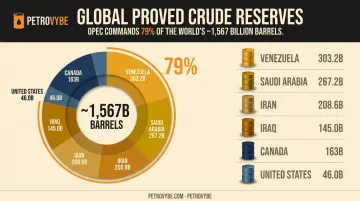
Global oil supply is far more concentrated than most people realize. According to OPEC's 2025 Annual Statistical Bulletin, all OPEC members combined held approximately 79% of the world's proved crude reserves at the end of 2024, out of a global total near 1,567 billion barrels.
| Country/Group | Proved Reserves | Source/Basis |
|---|---|---|
| Venezuela | 303.2 billion barrels | OPEC, end-2024 |
| Saudi Arabia | 267.2 billion barrels | OPEC, end-2024 |
| Iran | 208.6 billion barrels | OPEC, end-2024 |
| Iraq | 145.0 billion barrels | OPEC, end-2024 |
| Canada | 163 billion barrels | EIA, includes oil sands |
| United States | 46.0 billion barrels | EIA, crude and lease condensate |
Venezuela holds the largest oil reserves in the world, driven largely by the extra-heavy crude of the Orinoco Belt. Most of it remains stranded. Sanctions, chronic underinvestment, power outages, and the loss of technical personnel have degraded infrastructure to the point where output is a fraction of what geology suggests is possible.
The United States tells a different story. It doesn't rank among the top proved-reserve holders, but it produced a record 13.6 million barrels per day in 2025, according to EIA data, largely through shale and unconventional development. That production growth, not reserve size, is what has steadily reduced America's reliance on OPEC-aligned supply.
Oil Market Reaction: Prices, Forecasts, and Expert Warnings
Despite the largest coordinated release in history, prices didn't collapse. Brent settled at $91.98 per barrel on March 10, just before the announcement, and stayed elevated for months afterward.
Goldman Sachs warned in early March that Brent could surge past $100 a barrel if Hormuz flows didn't recover, and by July, the bank flagged a possible move above $120 by year-end if disruptions persisted.
Why Economists Remained Skeptical
Not every analyst shared Goldman's bullish read. Energy economists at Rice University's Baker Institute pointed to the underlying catch-22: releasing reserves now offers temporary relief but depletes the flexibility needed to respond to future shocks, while the physical chokepoint remains unresolved. Reserves move stored oil into the market — they don't reopen shipping lanes or rebuild damaged infrastructure.
The broader numbers back that up:
- Roughly 20% of global crude-oil and natural-gas supply was suspended at the height of the conflict
- Asia was hit hardest, with LNG cargoes from Qatar and the UAE going missing
- Asian LNG imports fell to a six-year low of 18.74 million tonnes in April
What the 2026 IEA Report Means for US Energy Investors
The 2026 crisis exposed something structural: global energy markets remain tethered to a handful of physical chokepoints and finite emergency stocks, not durable new supply. Reserve releases buy time. They don't put a single new barrel in the ground.
That's the real argument for continued investment in domestic drilling and development, away from Hormuz-dependent supply chains.
This is where a company like PetroVybe fits into the picture. As a private Texas oil and natural gas development company operating in South Texas and the Gulf Coast Basin, including its flagship project in Lavaca County, PetroVybe gives accredited investors direct equity access to early-stage NGL and gas development.
Production is land-based and feeds the domestic grid, structurally separate from the shipping lanes that seized up during the Iran conflict.
A few specifics worth knowing:
- Minimum investment: $100,000 in liquidity, open only to accredited investors under SEC Regulation D 506(c)
- 10-year targets: roughly 2.2x to 5.8x MOIC and around 26% IRR
- Monthly distributions: projected to peak above $10,000 per month during the production phase
Tax efficiency matters here too. Intangible Drilling Cost deductions can offset active income, including W-2 earnings and capital gains, not just passive income the way most real estate deductions work. PetroVybe partners received a 94% deduction against active income in 2024 and 91% in 2025. In an environment of elevated energy prices and inflation, that's a meaningful lever for household finances.
There's also a demand driver with nothing to do with the Middle East: US data center electricity consumption.
- Growth rate: Climbs 30% between 2022 and 2026
- Volume: Rises from 200 TWh to nearly 260 TWh
- Grid share: About 6% of total US electricity demand by 2026, with natural gas already supplying roughly 42% of generation
That's a structural tailwind for domestic gas development that doesn't depend on what happens in Hormuz.
Frequently Asked Questions
How much oil does the International Energy Agency (IEA) have in member emergency reserves?
As of March 2026, IEA members held close to 1.8 billion barrels combined. This included over 1.2 billion barrels in public stocks and roughly 600 million barrels of industry-obligated stocks, held under the agency's 90-day net import rule.
Has the International Energy Agency (IEA) released oil stockpiles?
Yes. In March 2026, the IEA coordinated a record 400-million-barrel release in response to the Iran war and Strait of Hormuz closure, its sixth emergency collective action since 1974.
Which countries or entities hold roughly 80% of the world's oil reserves?
All OPEC members combined held approximately 79% of the world's proved crude reserves at the end of 2024. Venezuela, Saudi Arabia, Iran, and Iraq are among the largest individual holders within that group.
Which country has the largest untapped oil reserves?
Venezuela, with 303.2 billion proved barrels concentrated in the Orinoco Belt's extra-heavy crude. Sanctions, underinvestment, and deteriorated infrastructure keep most of it offline despite the sheer size of the resource.
What was the largest oil stockpile release in IEA history?
The 2026 release of 400 million barrels stands as the largest ever, more than double the 182.7 million barrels released during the two 2022 actions tied to Russia's invasion of Ukraine.
How does the US Strategic Petroleum Reserve fit into the IEA system?
The IEA's 90-day stockholding rule applies to net-importing members; recognized net exporters like Canada, Mexico, and Norway are not bound by it. The US still maintains its own Strategic Petroleum Reserve and contributed 172 million barrels to the 2026 release.