

Introduction
The top 1% of American households now hold 31.6% of the nation's net worth. The bottom half of the country holds just 2.5%, according to Federal Reserve data on wealth shares by percentile group. That gap has widened steadily since 1989, when the top 1% held 22.8% and the bottom half held 3.5%.
Most conversations about this imbalance jump straight to Washington: wealth taxes, estate reform, stimulus checks. Few address a more immediate question — what can an individual investor actually do about it, today, within the system as it exists?
This article covers both sides. We'll define what equitable distribution actually means and walk through the current data. Then we'll unpack what's driving the gap, summarize the policy debates in play, and close with practical strategies individual investors are using to build wealth on their own terms.
Key Takeaways
- Equitable wealth distribution means fair access to opportunity, not identical outcomes for everyone
- The top 1%'s wealth share has grown sharply since 1989 as the bottom half's share has shrunk
- Racial, generational, and income-type gaps remain the most measurable dimensions of inequity
- Personal strategies like tax-advantaged, diversified investing can complement systemic reform
What Is Equitable Wealth Distribution?
Equitable vs. Equal: Understanding the Difference
Equal distribution means everyone gets the same share. Equitable distribution means everyone gets a fair shot, which often looks different for different people.
Picture an estate split between two siblings: one inherits a paid-off house, the other inherits an equal dollar amount in cash. On paper, that's equal. In practice, it's not equitable — one heir has an illiquid asset with maintenance costs and property taxes, the other has flexible capital ready to invest or spend.
This distinction matters because wealth and income aren't the same thing:
- Income is a flow — what you earn in a given year
- Wealth is a stock — everything you own minus everything you owe
Wealth inequality tends to run deeper and last longer than income inequality, since assets compound across generations while a paycheck resets every pay period.
Why Economists Care About Equitable Distribution
Lower-income households spend a much larger share of every extra dollar than wealthy ones do. Federal Reserve research pegs the marginal propensity to consume at roughly 7.5 cents per dollar for the bottom 80% of earners, versus less than 1 cent for the top quintile. More equitable distribution, in theory, means more consumer spending and stronger demand throughout the economy.
The counterargument deserves fair treatment too. Critics of aggressive redistribution warn that:
- High earners may reduce work effort if returns are taxed away
- Business owners may delay investment or expansion
- Capital may move to lower-tax jurisdictions
That said, the Congressional Research Service has found labor supply and investment behavior relatively insensitive to tax-rate changes historically. The disincentive story is weaker in practice than it sounds in theory.
The State of Wealth Inequality in America Today
The numbers bear repeating in full. As of 2025:Q1, per the Fed's Distributional Financial Accounts:
| Group | Share of Net Worth |
|---|---|
| Top 1% | 31.6% |
| 90th–99th percentile | 36.3% |
| Bottom 50% | 2.5% |
That means the top 10% of households control roughly two-thirds of all wealth in the country, combining the two upper brackets.
The generational split tells a similar story. The St. Louis Fed found that at age 34, Millennials and Gen Z held a 10.1% aggregate wealth share in 2024. That's well below the 19.5% share Baby Boomers held at the same age back in 1989. Younger generations are gaining ground, but they started from a much deeper hole.
The Racial Wealth Gap
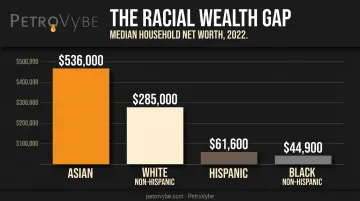
The 2022 Survey of Consumer Finances puts hard numbers on one of the most persistent gaps in American wealth:
| Group | Median Net Worth |
|---|---|
| Asian | $536,000 |
| White (non-Hispanic) | $285,000 |
| Hispanic | $61,600 |
| Black (non-Hispanic) | $44,900 |
Several structural factors feed this gap, according to a 2023 Federal Reserve analysis:
- Homeownership rates near 73% for White households versus roughly 45% for Black households
- Decades of redlining and unequal access to federally backed mortgage credit
- Inheritances concentrated among higher-wealth, predominantly White families
Income Inequality vs. Wealth Inequality
Census data puts the 2024 household income Gini coefficient at 0.483 before taxes, dropping to 0.421 after taxes and transfers. Wealth inequality runs far hotter: the Fed measured a net-worth Gini of 0.852 in 2019, up from 0.787 in 1989.
Why the gap between the two measures? Wealthy households can save more, and they hold assets like stocks and private businesses that appreciate over time. Lower-wealth households tend to hold cash and depreciating durable goods instead.
Income redistribution alone won't close a gap this wide — it requires addressing how assets themselves are owned.
What's Driving the Wealth Gap?
Three forces do most of the heavy lifting here.
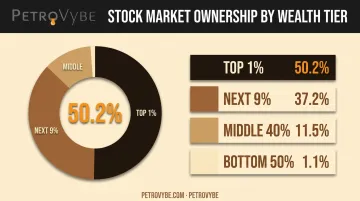
Concentrated stock ownership. According to the Federal Reserve's Distributional Financial Accounts, as of 2026:Q1, the top 1% held 50.2% of corporate equities and mutual fund shares, and the next 9% held 37.2%. The bottom half of American households held just 1.1%. Since equities have historically outpaced inflation and wages, this ownership gap compounds year over year.
Inheritance and generational transfer. Average inheritances at receipt, per the 2019 Survey of Consumer Finances, tell their own story:
- Top 1%: $719,000
- Next 9%: $174,200
- Next 40%: $45,900
- Bottom 50%: $9,700
Wealth transfers overwhelmingly favor families that already have it.
Tax code advantages for asset holders. The so-called "buy, borrow, die" strategy lets wealthy individuals hold appreciated assets, borrow against them tax-free, and pass them to heirs with a stepped-up cost basis that erases the original capital gains tax.
Tax Policy Center research found that top-1% borrowing equals only 1-2% of economic income, while unrealized gains run 20-40 times larger. Borrowing barely matters here. The bigger advantage is avoiding a taxable sale altogether.
Policy Solutions on the Table
Lawmakers are weighing fixes at two different speeds: fast-acting transfers and slower structural reform.
Short-term redistribution tools already in use include:
- Progressive income taxation
- Unemployment benefits
- Targeted subsidies
These shift disposable income quickly but don't touch accumulated wealth.
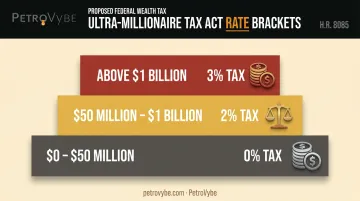
The wealth tax debate is the more contentious piece. H.R. 8085, the Ultra-Millionaire Tax Act of 2026, proposes:
- 0% on net worth up to $50 million
- 2% between $50 million and $1 billion
- 3% above $1 billion
The bill remains in committee with no CBO cost estimate published yet. Critics point to a rough track record elsewhere: an NBER review found that 8 of 12 European countries that adopted wealth taxes later repealed them, citing valuation headaches, administrative cost, and capital flight.
Longer-term structural fixes focus on education access and job creation rather than annual levies. The U.S. collected tax revenue equal to 27% of GDP in 2021, compared to a 34% weighted average across other OECD countries. That gap partly explains why several European nations post lower after-tax inequality than the U.S., even without a dedicated wealth tax.
Building Your Own Path to Equitable Wealth
Systemic reform moves slowly. Individual financial decisions don't have to wait for it.
Here's the imbalance most people never see: for the bottom half of American households, wealth sits almost entirely in home equity, with minimal stock market exposure. Diversifying beyond the traditional stocks-bonds-real estate mix is one of the few equity-building strategies available at the individual level, especially for households without institutional-level access to alternative assets.
Tax-Advantaged Vehicles Level the Playing Field
Wealthy households benefit disproportionately from a tax code that favors capital gains and asset ownership over wages. Tax-advantaged investment structures let other investors access some of that same advantage legally.
One example: natural gas development. Direct-participation drilling partnerships offer something most passive real estate investments can't. Real estate deductions are typically capped by passive-loss rules, meaning they only offset passive income unless you qualify as a real estate professional. Intangible Drilling Cost (IDC) deductions work differently: they aren't restricted to passive income.
At PetroVybe, a Texas-based natural gas development company, this distinction played out in real numbers:
- Partners who joined in 2024 received a 94% deduction against active income, including W-2 earnings and capital gains
- Partners who joined in 2025 saw that settle at 91%, still among the highest allowable IDC deductions available
- The IDC deduction typically represents 60-80% of invested capital, taken in full the first year via K-1 or spread over five years
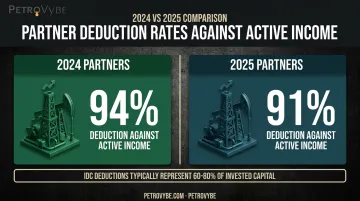
A $100,000 investment can generate $60,000-$80,000 in deductions against active income in year one, a mechanism unavailable to most passive real estate investors without professional status.
Due Diligence Still Matters
Alternative investments aren't a shortcut, and they aren't for everyone. Before evaluating any operator, look for:
- Third-party engineering validation: PetroVybe's $48MM proved reserves valuation (PV-09) was assessed by an independent, licensed engineering firm
- Verifiable operator track record: PetroVybe's Chief Geophysicist has a documented 75.2% success rate on well location selection over a 48-year career, against an industry average below 40%
- Independent reviews: platforms like Invest Clearly provide investor feedback outside company marketing materials
The Honest Caveats
This investment carries real limitations, and no one should oversell it as a universal fit:
- Alternative investments like direct-participation drilling programs carry real illiquidity: capital is typically locked up for years, with PetroVybe structuring a 10-year hold period
- Accredited investor status is legally required, meaning $1 million net worth (excluding primary residence) or $200,000+ individual income
- Commodity price swings and drilling outcomes affect returns; projections are not guarantees
- Professional financial and tax advice should come before any commitment, not after
Equitable wealth-building means understanding which legal tools exist and deciding, with proper guidance, whether they fit your situation.
Frequently Asked Questions
What is equitable distribution of wealth?
Equitable distribution means dividing wealth and opportunity fairly based on circumstances and need, rather than splitting resources into identical, equal shares for everyone.
What race is the wealthiest in the US?
Per the 2022 Survey of Consumer Finances, Asian families reported the highest median net worth at $536,000, though this estimate carries wider sampling uncertainty than larger racial categories.
Is equitable distribution the same as equal distribution?
No. Equal distribution splits resources identically; equitable distribution accounts for differing starting points and needs. A house and cash of equal dollar value, for example, aren't equally useful to two different heirs.
What causes wealth inequality in the United States?
Concentrated stock ownership among top earners, unequal inheritance patterns, and tax code advantages favoring capital gains over wages are the three leading documented drivers.
Can individuals do anything to reduce wealth inequality for themselves?
Yes. Building additional income streams, maximizing retirement contributions, and pursuing homeownership are proven ways to narrow the gap. Accredited investors can also diversify into tax-advantaged vehicles like IDC deductions in oil and gas development.
What policies have been proposed to address wealth inequality?
Current proposals include progressive taxation, transfer payments, a federal wealth tax on fortunes above $50 million (H.R. 8085), estate tax reform, and expanded access to education.