 is Adopting Sustainability](https://file-host.link/website/petrovybe-3y7l2j/assets/blog-images/4ee0fd00-2fe1-4142-ab87-a43f3bf43c3f/1784724832840513_4f93264008574b60a40327739c9d2a7e/360.webp)
Introduction
Ask any energy executive what keeps them up at night, and sustainability now ranks near the top of the list. A 2022 study from SAP and Oxford Economics found that 79% of energy and utilities executives consider sustainability a major concern, not a side project for the marketing team.
That shift shows up in daily operations, not just annual reports. Regulators are tightening methane rules, investors are pricing in stranded-asset risk, and consumers are asking harder questions about where their energy comes from.
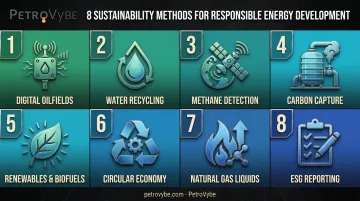
Operators aren't just talking about sustainability anymore. They're building it into drilling programs, water management, and capital allocation decisions. This article breaks down eight concrete ways the oil and gas industry is putting sustainability into practice, from digital oilfields to cleaner-burning natural gas liquids.
Key Takeaways
- Data analytics and digital oilfields close production gaps and cut waste
- Water recycling and methane detection remain the cheapest wins available today
- Capital is shifting toward renewables, biofuels, and carbon capture projects
- Natural gas liquids offer a cleaner bridge fuel for AI-driven power demand
- Third-party verification is replacing vague ESG claims with measurable proof
8 Ways Oil and Gas Companies Are Embedding Sustainability
Sustainability adoption in this industry spans three fronts: technology, field operations, and portfolio diversification. With roughly four out of five energy executives naming sustainability a major concern, the pressure to show results has moved well past the PR department. Here's how operators are responding.
1. Using Advanced Data Analytics & Digital Oilfields
Most offshore platforms run far below their potential. McKinsey found that the typical platform operates at only 77% of maximum production capacity, leaving an estimated $200 billion a year on the table industry-wide.
IIoT sensors, cloud computing, and AI-driven analytics close that gap by flagging inefficiencies before they become expensive problems. A "digital oilfield" setup gives operators real-time visibility into pressure, flow rates, and equipment health.
- Predictive maintenance catches equipment failures before they cause spills or shutdowns
- Real-time monitoring reduces unnecessary site visits and associated emissions
- Better data means fewer wasted resources and safer field decisions
2. Reducing Freshwater Use & Advancing Water Recycling
Hydraulic fracturing is thirsty work. EPA data shows a median well uses roughly 1.5 million gallons of water, with some wells consuming as much as 6 million gallons. That's a lot of freshwater pulled out of local watersheds.
The industry has responded by pushing hard toward non-potable and recycled water use. Roughly 49% of US produced water was reused for enhanced recovery as of 2021, a meaningful jump from earlier practices.
Chemical-free treatment is part of that story. UV disinfection technology, for example, neutralizes sulfate-reducing bacteria in produced and seawater streams without adding harsh chemicals, making reinjection and reuse safer and cheaper.
3. Detecting & Reducing Methane Emissions
Methane traps far more heat than CO2 over a 20-year window, which makes it one of the highest-leverage targets in emissions reduction. The IEA estimates that roughly 70% of methane emissions from fossil-fuel operations can be avoided using technology that already exists, often at little to no net cost.
Satellite and drone-based detection is making that avoidance practical at scale. Petrobras, for instance, partnered with GHGSat and MAVIPE to monitor methane across its Brazilian offshore and onshore operations, catching leaks that ground crews would miss entirely.
4. Scaling Carbon Capture, Utilization & Storage (CCUS)
CCUS captures CO2 from operations and stores it underground instead of releasing it to the atmosphere. Shell's Quest facility in Alberta has been running since 2015 and had banked 1 million tonnes of CO2 within its first year of commercial operation.
ExxonMobil reports cumulative capture of more than 120 million metric tons, a figure the company says represents roughly 40% of all anthropogenic CO2 captured globally to date.
Scale remains the challenge. The IEA has noted global CCUS capacity would need to grow more than twentyfold from around 40 Mt/year to hit longer-term climate scenarios, so this technology is still early in its buildout.
5. Investing in Renewable Energy & Biofuels
Diversification is showing up on balance sheets, not just in press releases. BP set up a $100 million Upstream Carbon Fund in 2019 to finance emissions-reduction projects within its own operations.
ExxonMobil, meanwhile, set a technical target with Synthetic Genomics for 10,000 barrels a day of algae biofuel by 2025. More concretely, Imperial Oil's Strathcona refinery began producing renewable diesel in August 2025, with capacity up to 20,000 barrels a day.
6. Advancing a Circular Economy Through Used Oil & Waste Recycling
Small-scale re-refining is turning a disposal problem into a supply source. TAYRAS's Osmaneli facility in Turkey processes up to 60,000 metric tons of waste oil per year into API Group II+ base oil, a recognized recycling pathway the EPA also endorses for used-oil management in the US.
The benefit cuts both ways: less waste oil ends up in landfills or waterways, and recovered base oil lowers input costs compared to virgin feedstock.
7. Prioritizing Natural Gas Liquids (NGLs) as a Cleaner Bridge Fuel
NGLs, think ethane, propane, and butane, burn cleaner than crude oil and typically command a pricing premium over dry natural gas. That combination makes them an attractive piece of a sustainability-minded portfolio, even for developers who aren't walking away from hydrocarbons.
This matters more than ever because electricity demand is climbing fast. AI data centers alone could push global electricity consumption up by roughly 1,000 TWh by 2030, according to IEA projections, and natural gas is positioned to supply a large share of that growth.
PetroVybe, a natural gas developer working South Texas and the Gulf Coast Basin, has built its development program directly around this dynamic. Its flagship PetroVybe ONE project targets NGL-rich production designed to feed reliable, lower-carbon power generation as grid demand accelerates, rather than treating gas development and cleaner energy as separate goals.
8. Aligning Corporate Strategy with ESG Reporting & UN SDGs
Companies are increasingly mapping specific initiatives to UN Sustainable Development Goals, particularly Goal 7 (affordable clean energy), Goal 9 (infrastructure), Goal 13 (climate action), and Goal 17 (partnerships).
Reporting alone isn't enough anymore, though. An EY benchmark of the 50 largest US oil and gas firms found that 66% reported Scope 1 and 2 emissions, but only 21% obtained external assurance on those numbers.
That gap between disclosure and verification is exactly what's fueling greenwashing skepticism. It's why independent engineering reviews and third-party assurance are becoming standard practice rather than a nice-to-have.
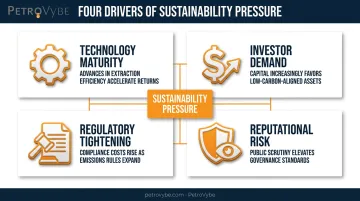
What's Driving These Sustainability Trends in the Oil and Gas Industry
A convergence of regulation, technology, and capital markets is pushing this shift forward. With 79% of energy executives already naming sustainability a major concern, the question for most companies isn't whether to act but how fast.
- Technology maturity: Clean tech and analytics tools that were experimental a decade ago are now commercially viable at scale
- Investor demand: Accredited investors increasingly seek tax-advantaged positions in cleaner-burning fuels, fueling demand for structures like PetroVybe's natural gas partnerships
- Regulatory tightening: The Paris Agreement's 1.5°C goal, the EU's 55% emissions cut target by 2030, and the EPA's 2023 methane rule (avoiding 58 million tons of methane through 2038) are raising the compliance bar
- Reputational risk: Public and shareholder scrutiny makes credible action a defensive necessity, not just a growth strategy
How These Trends Are Impacting the Oil and Gas Industry
Sustainability adoption is reshaping how companies operate, deploy capital, and staff their teams. This shift is becoming the industry's core operating model.
Operational Impact
Digital monitoring and better data use are cutting waste and reducing safety incidents, while surfacing production bottlenecks that once went unnoticed for months at a time.
Business Impact
Capital is shifting toward cleaner technologies as scrutiny of stranded-asset risk grows. The IEA estimates private oil and gas valuations could fall by 25% under current national climate goals, and by as much as 60% in a full 1.5°C-aligned transition. Frameworks like the Transition Pathway Initiative now track this risk explicitly, comparing company emissions intensity against sector-wide pathways.
Workforce Impact
Demand is growing for talent in data analytics, emissions monitoring, sustainability reporting, and decarbonization strategy. Roles once considered niche, like asset intelligence and performance optimization, are becoming standard fixtures on leadership teams across the industry.
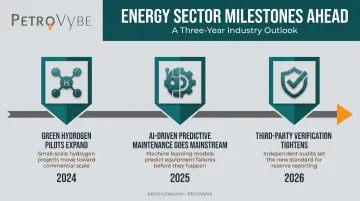
Future Signals for Sustainability in the Oil and Gas Industry
Watch for these developments over the next one to three years:
- Green hydrogen pilots expand: BP and Iberdrola already took a final investment decision in 2024 on a 25 MW green-hydrogen project at BP's Castellon refinery, targeting operations in late 2026
- AI-driven predictive maintenance goes mainstream: Shell has already scaled its system to more than 10,000 pieces of equipment, and adoption is spreading fast across peers
- Third-party verification tightens: The IAASB's ISSA 5000 standard, issued in 2024, is pushing the industry toward consistent, assurance-backed sustainability claims instead of self-reported metrics
Conclusion
Sustainability in oil and gas now touches technology, water and emissions management, portfolio diversification, and transparent reporting all at once. It's no longer confined to a single department or a single glossy report.
Companies and investors who adapt early are positioning themselves for a real competitive and reputational edge that goes beyond compliance checkboxes. The operators making the strongest case for value combine strategic foresight with credible execution, and that pairing will separate the industry's leaders from those left playing catch-up.
Frequently Asked Questions
What is sustainability in the oil and gas industry?
It means balancing environmental stewardship, operational efficiency, and social responsibility while continuing to meet global energy demand. In practice, that includes emissions reduction, water management, and transparent reporting.
What are the 4 pillars of sustainability?
Most corporate frameworks apply an ESG-plus-economic model: environmental, social, economic, and governance. Each pillar covers a distinct set of risks and responsibilities that companies track and report on.
What are 5 examples of sustainability?
Renewable energy adoption, water recycling, waste reduction, emissions monitoring, and circular economy practices like used-oil re-refining are common examples across the energy sector.
What are the main 4 sustainable energy sources?
Solar, wind, hydropower, and bioenergy (including biofuels) make up the primary categories of renewable energy recognized by the UN, alongside smaller contributions from geothermal and ocean energy.
Why is the oil and gas industry moving toward sustainability?
Regulatory pressure, investor demand, falling clean-tech costs, and reputational risk are all pushing companies to act. Recent industry surveys show a growing majority of energy executives now rank sustainability as a top-tier business concern rather than a secondary issue.
What are the biggest challenges to achieving sustainability in oil and gas?
Continued global demand for fossil fuels, the high capital cost of new technology, and a credibility gap between disclosed goals and verified results remain the industry's toughest hurdles.