

Here's the pain point: high-income earners and accredited investors often get stuck. They keep the same savings mindset or the same aggressive stock-picking approach for decades, long after their life stage has changed. That mismatch causes missed opportunities on one end and unnecessary risk on the other.
This guide breaks down the four stages of the wealth cycle, the mistakes people make at each one, and how tax-advantaged alternative investments can help you move through the cycle faster.
Key Takeaways
- Four wealth-cycle stages: Creation, Accumulation & Growth, Preservation, and Distribution
- Risk tolerance, strategy, and tax planning shift as you move between stages
- High earners in Accumulation carry the heaviest tax burden and gain the most from tax shelters
- Knowing your stage sharpens decisions on capital allocation, growth, and protection
What Is the Wealth Cycle?
The wealth cycle describes the lifelong progression your finances move through, from the first paycheck to eventually preserving and transferring what you've built. It's not a steady climb. A business exit, inheritance, market downturn, or career change can push you forward several years or knock you backward overnight.
Different wealth management frameworks slice this progression into three or four stages. Some models fold "Creation" into the broader Accumulation phase. Others split Distribution into separate "utilization" and "transfer" steps. The labels vary, but the core idea holds across all of them: earn, grow, protect, transfer.
Why Your Stage Matters More Than Your Age
The right investment decision at 28 is aggressive growth and a high risk tolerance. That same decision at 58 could wreck a retirement timeline. Stage, not birthday, should drive your strategy.
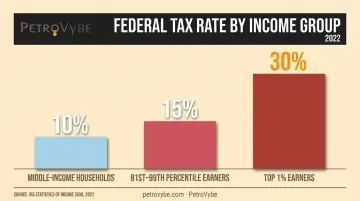
Tax strategy needs to evolve right alongside your stage. According to the CBO's Distribution of Household Income report, average federal tax rates in 2022 varied sharply by income level:
- Middle-income households: 10%
- 81st-99th percentile earners: 15%
- Top 1% earners: 30%
As income rises through your working years, so does the tax bill. That's exactly why Accumulation-stage investors need sharper tax planning than someone just starting out.
The 4 Stages of the Wealth Cycle
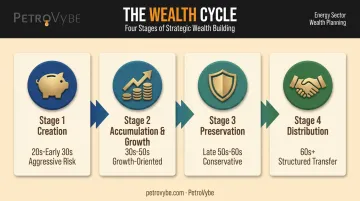
Each stage answers a different question: how much risk can I take, and what am I optimizing for? Here's a quick comparison before we go stage by stage:
| Stage | Typical Age Range | Primary Focus | Risk Posture |
|---|---|---|---|
| Creation | 20s-early 30s | Build habits, kill debt | Aggressive, time-rich |
| Accumulation & Growth | 30s-50s | Compound wealth, manage tax exposure | Growth-oriented, diversified |
| Preservation | Late 50s-60s | Protect capital, reduce volatility | Conservative, income-focused |
| Distribution | 60s+ | Transfer wealth efficiently | Structured, tax-aware |
Stage 1: Wealth Creation
This is the foundational stage, usually your 20s through early 30s. The tasks are simple to state and hard to execute: launch a career, build an emergency fund, and pay down debt like student loans.
Risk tolerance is naturally at its highest here. Time is on your side, meaning setbacks can be recovered from. This makes Creation the ideal window to learn investing fundamentals through actual practice rather than theory.
The primary job during this stage is developing saving habits and avoiding the mistakes that set back the entire cycle:
- Carrying high-interest credit card debt
- Letting lifestyle inflation eat every raise
- Skipping an emergency fund to chase investment returns
Stage 2: Wealth Accumulation & Growth
Roughly spanning your 30s through 50s, this is peak earning territory. Strategic, diversified investing becomes critical because this is where compounding does its heaviest lifting.
It's also where tax exposure jumps. Rising W-2 income, bonuses, and capital gains push many investors into higher brackets fast. For 2026, the top ordinary income rate of 37% kicks in above $640,600 for married couples filing jointly, and long-term capital gains hit the 20% band above roughly $613,700 in taxable income.
Many investors plateau here. They lean entirely on 401(k)s, index funds, and bonds, and never look at alternative asset classes that offer both growth and tax efficiency. That plateau is expensive. It means paying full marginal rates on income that could have been offset through legitimate, structured investment vehicles.
Stage 3: Wealth Preservation
As retirement approaches, the mindset flips. Protecting what you've built matters more than chasing another percentage point of return.
This stage is about reducing portfolio volatility and hedging against inflation. A market downturn hits far harder here than it would during Creation, simply because there's less runway to recover.
Morningstar's 2025 retirement-income research pegs a 3.9% base-case starting withdrawal rate for a 30-year retirement horizon with a 90% probability of success, according to Morningstar's retirement withdrawal rate analysis. That figure is a modeled starting point, not a guarantee, and it assumes a diversified allocation.
Ask yourself two questions in this stage:
- How much can I withdraw annually without outliving my assets?
- Is my portfolio structured to weather a downturn in the first five years of retirement?
Stage 4: Wealth Distribution
The final stage focuses on transferring wealth to heirs, causes, or beneficiaries with as little friction and tax drag as possible.
This involves more than signing estate documents. Complex assets need simplifying so the people inheriting them can actually manage what they receive. A tangled portfolio of illiquid holdings burdens heirs instead of benefiting them.
Proactive tax planning matters here. The federal estate tax's basic exclusion amount is set at $15 million per individual for 2026, but amounts above that threshold face a statutory tax schedule that tops out at 40%, per the IRS estate and gift tax guidance.
That tax applies only to the portion above the exclusion, not the entire estate. For large estates, structured gifting and trusts remain valuable tools for keeping more wealth in the family.
Common Wealth Cycle Mistakes to Avoid
Even disciplined investors trip on the same handful of issues as they move through the cycle:
- Staying too conservative too early – Parking cash in low-yield accounts during Creation or early Accumulation sacrifices decades of compounding when risk capacity is at its highest.
- Failing to adjust tax strategy as income rises – High W-2 earners and capital gains holders often keep using the same tax approach from their 20s well into their peak-earning years, overpaying what could legally be offset.
- Over-relying on stocks, bonds, and real estate – This concentration raises correlation risk, since CFA Institute research (2003-2022) found many "alternative" strategies still carry hidden equity exposure, unlike truly uncorrelated assets such as direct oil and gas investments.
Accelerating Your Wealth Cycle with Tax-Advantaged Alternative Investments
Investors in the Accumulation stage with high active income, meaning W-2 earnings and capital gains, tend to look for one thing: a way to grow wealth faster while cutting the tax bill at the same time. Most traditional investment vehicles don't do both.
Why Intangible Drilling Costs Are Different
One tool that stands apart is the Intangible Drilling Cost (IDC) deduction available in oil and natural gas development. Under IRC Section 263(c), qualifying drilling and development costs can be deducted rather than capitalized.
A working interest in a qualifying oil and gas project is treated as nonpassive under IRC Section 469(c)(3). This means the deduction can offset active income directly, not just passive income the way most real estate depreciation does.
This is where PetroVybe fits the picture. The Texas-based natural gas development company gives accredited investors direct access to early-stage development projects in Lavaca County and the broader Gulf Coast Basin.
Partners in the company's flagship offering, PetroVybe ONE, received a 94% first-year tax deduction against active income in 2024 and 91% in 2025. Both figures sit well above the general industry baseline of 60-80% of invested capital typically classified as IDC.
That structure pairs three wealth cycle needs at once:
- Near-term tax efficiency through the IDC deduction against active income
- Inflation-resistant passive income from natural gas liquids production once wells reach peak output
- Long-term tangible asset growth with a defined cash exit over a projected 10-year horizon
What to Verify Before Committing Capital
Return benchmarks matter when evaluating any alternative investment. PetroVybe targets a 10-year MOIC of roughly 2.2x to 5.8x and an IRR near 26%, figures the company frames as forecast-dependent on commodity pricing and production performance.
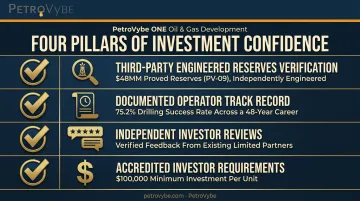
Its $48 million proved reserves valuation was independently verified by a licensed third-party engineering firm. The company's Chief Geophysicist brings a 48-year track record with a 75.2% well-location success rate, nearly double the sub-40% industry peer average.
Before committing capital to any operator, check for:
- Third-party engineering verification of reserves
- A documented operator track record, not just projected returns
- Independent investor reviews (PetroVybe holds a 5.0 rating across 8 verified reviews on Invest Clearly)
- Clear accredited investor requirements and minimum investment thresholds ($100,000 minimum liquidity for PetroVybe ONE)
Alternative investments like this should complement a diversified wealth cycle strategy, not replace it. Talk to a CPA or financial advisor to confirm suitability for your specific tax situation before investing.
How to Identify Your Current Wealth Cycle Stage
A simple self-assessment can clarify where you stand. Weigh these factors together rather than relying on age alone:
- Your income trajectory (rising, peaked, or declining)
- Current debt levels and dependents
- Years until retirement
- Whether your income comes from active work or from assets you've already built
Ask yourself two direct questions: are you prioritizing growth or protection right now, and is your current income active or passive? Your honest answers usually point straight to your stage.
Major life events reset this assessment regardless of age. A business sale, inheritance, divorce, or career change can shift someone from Accumulation straight into Preservation, or push a Preservation-stage retiree back into growth mode. Revisit this evaluation periodically, treating it as an ongoing check-in rather than a one-time exercise.
Frequently Asked Questions
What are the stages of the wealth cycle?
The wealth cycle typically includes four stages: Creation, Accumulation & Growth, Preservation, and Distribution. Some financial models condense this into three stages by folding Creation into Accumulation.
What is the difference between wealth building and wealth preservation?
Wealth building focuses on aggressive growth and higher risk tolerance during your peak earning years. Wealth preservation shifts toward protecting capital and reducing volatility as retirement approaches.
How long does each stage of the wealth cycle typically last?
Stage duration varies widely by individual circumstances, often spanning one to three decades per stage. Major life events like a business sale or inheritance can accelerate transitions regardless of age.
Can alternative investments help accelerate the wealth cycle?
Yes. Tax-advantaged alternatives like natural gas development can compress the time needed to build wealth by combining significant tax savings with passive income potential during the Accumulation stage.
What is the best age to start wealth accumulation?
There's no fixed age. The earlier disciplined saving and investing begins, the more time compounding and risk capacity work in your favor. Starting later simply means adjusting your strategy accordingly.
How do taxes impact each stage of the wealth cycle?
Tax exposure typically peaks during Accumulation due to rising active income from salaries, bonuses, and capital gains. This makes tax-efficient investment strategies most valuable during that specific stage.