Introduction
You just sold some stock, closed a business deal, or simply built up a six-figure cash cushion. Now what? Parking it in a savings account feels safe, but it's also losing value every month.
This is where the term investment vehicle comes in — the container that holds and grows your capital.
Choosing the right one carries real financial weight. Consumer prices rose 2.7% year-over-year through December 2025, according to Bureau of Labor Statistics data, while market volatility swung sharply between 2024 and 2025.
Add a heavy tax bill on top of that, and the case for looking beyond a default 401(k) or brokerage account gets stronger.
This guide breaks down what an investment vehicle actually is, the main categories available, and how to match one to your goals, risk tolerance, and tax situation.
Key Takeaways
- An investment vehicle is the product or structure that holds capital, not the asset itself
- Main categories: ownership, lending, pooled funds, and alternative/private vehicles
- Risk, liquidity, cost, and tax treatment vary dramatically by vehicle type
- Diversifying across categories, not just assets, helps balance growth with tax efficiency
What Is an Investment Vehicle (and Why It Matters)?
An investment vehicle is a method, product, or legal structure through which you deploy capital to generate income, appreciation, or tax benefits. It's the practical mechanism: the account, fund, partnership, or direct asset, not an abstract category of investment.
This distinction trips people up constantly. Asset class describes what you're invested in (stocks, bonds, real estate, commodities). Investment vehicle describes how you access it. You can own "stocks" through a brokerage account, a mutual fund, an ETF, or an employee stock plan: four different vehicles, same asset class.
| Concept | Example | What It Tells You |
|---|---|---|
| Asset class | Real estate | The type of exposure |
| Investment vehicle | A REIT, a rental property, a private fund | How you actually hold that exposure |
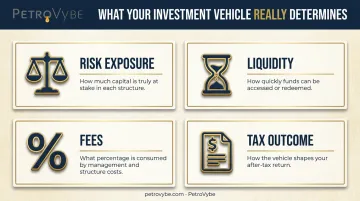
Why does this matter beyond semantics? Because the vehicle you choose directly shapes:
- Risk exposure: a leveraged fund and an unleveraged index fund can hold similar assets with wildly different risk profiles
- Liquidity: some vehicles trade instantly, while others lock up capital for years
- Fees compound quietly, and even small differences erode returns over decades
- Vehicle choice also determines your tax outcome, often the biggest hidden variable of all
Most investors default to whatever is familiar: a 401(k), some individual stocks, maybe a savings CD. That's not wrong, but it often leaves money on the table, particularly for high-income earners facing large tax bills who never explore vehicles built for tax efficiency. Some vehicles are open to anyone. Others, like private placements, require accredited investor status because of their risk profile and regulatory structure.
Types of Investment Vehicles
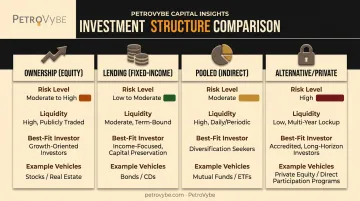
Investment vehicles differ by ownership structure, liquidity, management style, and who's allowed to access them. A beginner looking for simplicity has very different needs than a high-income earner trying to reduce a tax bill. Here are the four broad categories worth understanding.
Ownership (Equity) Investment Vehicles
These are vehicles where you directly own an asset or stake (stocks, real estate, or business equity) with the expectation it appreciates over time.
- How it works: Capital buys an asset; returns come from price appreciation and, sometimes, income distributions like dividends or rent
- How it differs: You carry direct exposure to asset-specific risk and volatility, unlike lending vehicles with fixed returns
- Best for: Long-term wealth builders comfortable with fluctuations, prioritizing growth over income stability
- Strengths: Highest long-term growth potential and inflation-hedging characteristics
- Limitations: No guaranteed return; real estate adds illiquidity and maintenance costs
The S&P 500 returned 25.02% in 2024 and 17.88% in 2025: strong years, but not a promise of future performance. Real estate tells an uneven story too: U.S. home prices rose 4.5% from Q4 2023 to Q4 2024, while office property values remained roughly 34% below pre-2020 levels. Ownership vehicles reward patience, not timing.
Lending (Fixed-Income) Investment Vehicles
Here, you loan capital to a government, company, or institution in exchange for interest payments and eventual principal repayment.
- How it works: Bonds, CDs, and Treasury securities pay a fixed or variable rate over a defined term
- How it differs: Returns are contractual and predictable, not tied to market appreciation
- Best for: Conservative investors, those nearing retirement, or anyone prioritizing capital preservation
- Strengths: Lower volatility and reliable income
- Limitations: Returns may not outpace inflation, and bond prices generally fall when interest rates rise
Lending vehicles are the ballast in a portfolio. They won't make you rich, but they steady the ship when equity markets get rough.
Pooled (Indirect) Investment Vehicles
Mutual funds, ETFs, and unit investment trusts combine many investors' capital into one professionally managed structure.
- How it works: A fund manager selects underlying holdings; you own shares of the pool, not the individual securities
- How it differs: You get diversified exposure without picking individual stocks or bonds yourself
- Best for: Investors who want low-cost diversification and hands-off management
- Strengths: Instant diversification, professional oversight, strong liquidity — especially with ETFs
U.S.-registered investment companies held $39.2 trillion at year-end 2024, according to the Investment Company Institute's 2025 Fact Book. Fees vary widely: equity mutual funds carried a simple-average expense ratio of 1.10%, while index equity ETFs averaged 0.45%. Limitation: you don't control which underlying holdings you own, and fees compound over years even when they look small.
Alternative & Private Investment Vehicles
These sit outside public markets entirely, including private equity, hedge funds, and direct participation programs like oil and gas development partnerships.
- How it works: Capital is pooled or directly deployed into non-public assets, usually through partnerships requiring accredited investor status
- How it differs: Typically illiquid and less regulated, but they open access to unique risk/return profiles and tax advantages public markets don't offer
- Best for: Accredited investors with capital gains or high W-2 income seeking diversification and tax efficiency
- Strengths: Potential for outsized returns and portfolio diversification beyond stocks and bonds
- Limitations: Higher minimums, illiquidity, longer holding periods, and access restricted to accredited investors, generally those with $200,000+ individual income or $1 million net worth excluding a primary residence
This is where a vehicle like PetroVybe's natural gas development partnerships fits. Structured as limited partnership units in Lavaca County, Texas projects, these partnerships pass intangible drilling cost (IDC) deductions through to investors via K-1s, deductions that apply against active income, including W-2 wages and capital gains, not just passive income like real estate depreciation does.
PetroVybe partners received a 94% deduction against active income in 2024 and 91% in 2025, alongside long-term passive income potential from production. It's a category built specifically for investors who've already maxed out the tax efficiency of traditional vehicles.
How to Choose the Right Investment Vehicle
The right vehicle depends on your specific financial situation, not what's trending or what your neighbor is doing.
- Clarify your purpose. Are you chasing growth, income, tax reduction, or capital preservation? Each goal points toward a different category.
- Map your time horizon and liquidity needs. Money you'll need in two years shouldn't sit in a vehicle with a five-year lockup.
- Match risk tolerance honestly. A vehicle's volatility should align with what you can stomach, not what looks good on paper.
- Compare costs and fees. Management fees, trading costs, and tax drag all chip away at returns over time.
- Evaluate tax efficiency. Retirement accounts, deductions from direct participation programs, and capital gains treatment can change your after-tax result.
- Confirm eligibility. Private and alternative vehicles, including direct participation programs like oil and gas partnerships, require accredited investor status — verify this before you get attached to an opportunity.
No single vehicle checks every box. Most experienced investors hold several types simultaneously, weighting them differently as goals and tax situations shift.
What to Check Before Finalizing a Type of Investment Vehicle
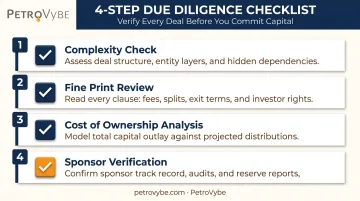
Before committing capital, run through a short checklist:
- Complexity check: A leveraged fund or private placement isn't automatically better than a simple index fund if it doesn't match your goal.
- Fine print: Illiquidity periods, redemption restrictions, and fee structures are disclosed for a reason.
- Cost of ownership: Hidden fees and tax consequences over ten years matter more than the entry price today.
- Sponsor verification: Look for third-party validation, independent audits, engineering reports, and regulatory licenses, rather than relying on familiarity alone.
For context, PetroVybe backs its projects with a clean 2025 independent audit from Weaver and a third-party engineered $48 million reserves valuation (PV-09).
That kind of documentation is exactly what FINRA guidance recommends investors confirm before entering any private placement. Keep in mind that Form D filings on EDGAR show a notice was made, not that the SEC approved or endorsed the offering.
Conclusion
Investment vehicles are the practical tools through which capital actually gets deployed — the difference between having money and putting it to work. Ownership, lending, pooled, and alternative vehicles each serve different goals, risk appetites, and tax situations, and understanding those differences is foundational to investing well.
For accredited investors carrying a heavy tax burden and looking for diversification beyond traditional stocks, bonds, and real estate, alternative vehicles like PetroVybe's direct natural gas development partnerships represent a category worth evaluating carefully. Investors should go in with eyes open to both the upside and the illiquidity that comes with it.
Frequently Asked Questions
What is considered an investment vehicle?
Any product, account, or structure used to deploy capital for returns qualifies: stocks, bonds, mutual funds, real estate, or private partnerships all count as investment vehicles.
What are some good investment vehicles?
It depends on your goals: index funds and ETFs suit most investors, bonds offer stability, and alternative vehicles like private natural gas partnerships suit accredited investors chasing tax efficiency and diversification.
What's the difference between an investment vehicle and an asset class?
An asset class describes the type of investment, like stocks or real estate. An investment vehicle is the specific structure or product you use to access that asset class.
Are investment vehicles only for experienced investors?
No. Most public vehicles like ETFs and mutual funds are beginner-friendly. Private and alternative vehicles typically require accredited investor status and more financial sophistication.
Can accredited investors access exclusive investment vehicles?
Yes. Accredited investors can access private placements, hedge funds, and direct participation programs like oil and gas development partnerships that aren't available to the general public.
How do taxes differ across investment vehicles?
Tax treatment varies widely: capital gains apply to stocks, interest income to bonds, and some vehicles like natural gas development partnerships offer significant upfront deductions against active income through IDC provisions.