

For most filers, that "tax-free" floor sits somewhere between $15,750 and $31,500 for 2025. That might sound reasonable if you're just starting out. It feels almost insulting once you cross into six-figure territory and watch a third of your paycheck disappear before it hits your bank account.
This guide breaks down the 2025 standard deduction thresholds, how progressive tax brackets actually work, and the legal strategies — including some most filers have never heard of — that let higher earners shelter far more income than the average person realizes.
Key Takeaways
- The 2025 standard deduction creates a tax-free floor: $15,750 (single), $23,625 (HOH), $31,500 (MFJ)
- Federal tax brackets are progressive — only income above each threshold gets taxed at the higher rate
- High earners can legally shrink taxable income below their paycheck using retirement accounts, HSAs, and specialized investments
- Intangible Drilling Cost (IDC) deductions offer rare tax relief that applies directly to active income, not just passive gains
- Always verify current-year thresholds with a CPA before making decisions based on projected deductions
Understanding How Federal Income Tax Brackets Work
The U.S. federal income tax system runs on seven brackets, from 10% to 37%. Here's the part that trips people up: those rates apply only to the income that falls within each specific range, not your entire paycheck.
Think of your income as filling up buckets. The first bucket gets taxed at 10%. Once that's full, the next dollars land in the 12% bucket, then 22%, and so on. Nobody pays their top rate on every dollar they earn.
Marginal Rate vs. Effective Rate
These two terms get confused constantly, and the mix-up costs people peace of mind:
- Marginal rate: the rate applied to your last dollar earned (the bracket you're "in")
- Effective rate: your total tax bill divided by your total income: what you actually pay on average
Here's a real illustration using the 2025 IRS federal tax brackets. A single filer with $100,000 in taxable income sits in the 22% marginal bracket. But running the actual math across all seven layered brackets produces a tax bill of roughly $16,914, an effective rate of just under 17%, not 22%.
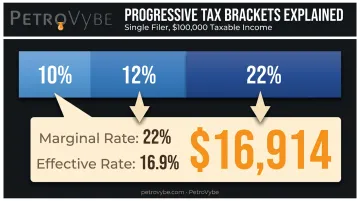
That gap matters. It's why someone can move into a "higher bracket" without their whole paycheck suddenly getting taxed harder.
One more wrinkle: long-term capital gains and qualified dividends don't follow these same seven brackets. They're taxed separately at 0%, 15%, or 20%, depending on your total taxable income. A single filer can realize gains completely tax-free up to $48,350 in 2025, for example — a very different calculation than ordinary wage income.
The Maximum Income You Can Earn Without Paying Federal Income Tax in 2025
Here's the direct answer: income up to your standard deduction amount is effectively taxed at 0% federally, because taxable income only starts accumulating after that deduction is subtracted.
The 2025 standard deduction amounts break down like this:
| Filing Status | 2025 Standard Deduction |
|---|---|
| Single | $15,750 |
| Married Filing Jointly | $31,500 |
| Head of Household | $23,625 |
| Married Filing Separately | $15,750 |
Filers who are 65 or older, or legally blind, get an additional bump: $2,000 more if unmarried, $1,600 more per qualifying condition if married. A single filer who's 65+ effectively pushes their tax-free threshold to $17,750.
Dependents face a different, lower set of thresholds. A dependent with earned income above $15,750, or unearned income above $1,350, generally must file, even if they'd owe nothing.
A Worked Example
Take a single filer earning exactly $15,750 in 2025. Subtract the standard deduction, and taxable income lands at $0. Result: zero federal income tax owed.
Now bump that income to $15,751. That extra dollar becomes taxable income, taxed at the 10% starting rate, meaning this filer owes about 10 cents. Not zero, but nowhere close to what most people assume "getting taxed" feels like.
Important caveat: this threshold applies to how taxable income is calculated, not a blanket exemption. Self-employed individuals with over $400 in net earnings must still file a return, regardless of how low their total income sits below the standard deduction.
Why "Zero Tax" Isn't Just for Low-Income Earners
Here's where the conversation usually stops. It shouldn't. The standard deduction caps out around $15,750 to $31,500. High earners making six or seven figures obviously blow past that number instantly.
But they're not stuck paying full freight either. The strategy shifts from finding a low-income threshold to shrinking taxable income before rates ever apply.
There's a meaningful difference here. Reducing your rate means moving into a lower bracket, rarely possible for high earners without major income changes. Reducing your base means using deductions that shrink your Adjusted Gross Income before any bracket calculation happens.
Common levers high earners use to shrink that base:
- Maximizing pre-tax 401(k) and traditional IRA contributions
- Funding a Health Savings Account
- Harvesting investment losses
- Claiming business losses tied to real estate or other ventures

That last one has a catch most people discover the hard way. Under IRS passive activity loss rules, losses from rental real estate or passive business interests generally can only offset passive income, not your W-2 wages or capital gains from selling stock.
If you're a high-earning professional with a day job, those passive losses often just sit suspended, carried forward year after year with no immediate benefit.
This is where a narrow but powerful exception in the tax code comes into play: one written specifically for working interests in oil and gas development.
Oil & Gas Investment Deductions: A High-Earner's Legal Tool for Reducing Taxable Income
Intangible Drilling Costs, or IDCs, cover the upfront expenses of drilling and preparing a well for production : labor, fuel, chemicals, hauling, and similar costs that have no salvage value once the well is drilled. Under Section 263(c) of the tax code, the IRS allows these costs to be deducted in the same year they're incurred, rather than capitalized and depreciated over years.
That timing matters enormously. IDCs typically represent 60% to 80% of total invested capital in a new drilling project, so a large chunk of an investment becomes deductible almost immediately.
Here's what makes this genuinely rare: a working interest in an oil or gas well is classified as nonpassive under the tax code, regardless of how much the investor participates day-to-day. That means the resulting deduction isn't boxed into offsetting passive income only. It can apply directly against:
- W-2 wages
- Capital gains
- Other active, ordinary income
We've seen this play out directly with our own investors at PetroVybe. Partners who joined our natural gas development projects in Lavaca County, Texas, received deductions of 91% to 94% against ordinary income in 2024 and 2025.
The typical first-year deduction runs around 70% against active income, figures pulled directly from real K-1s issued to partners, not projections.
One investor, Nizar A., had a $30,000 tax liability completely eliminated through this structure in a single year.
This isn't just a deduction with nothing behind it, either. PetroVybe's natural gas projects target a 10-year MOIC of roughly 2.2x to 5.8x and an IRR near 26%, meaning investors are building a tangible, income-producing asset alongside the tax benefit, not just deferring a bill.
A few things worth knowing before considering this route:
- This opportunity is limited to accredited investors under SEC Regulation D 506(c), verified through a CPA or tax attorney
- Basis, at-risk, and excess-business-loss rules still apply, and IDC deductions can trigger Alternative Minimum Tax considerations
- Working with a CPA to confirm eligibility and suitability before committing capital is essential
Part of why we've been comfortable putting these numbers behind our own name comes down to who's picking the well locations. Our Chief Geophysicist, Michael Stamatedes, spent 48 years in the industry, including a stretch as a Geology leader at ExxonMobil, and carries a career well-success rate of 75.2% against an industry average below 40%.
Our President, Blaine Yeary, scaled a $5 billion asset from zero to 35,000 barrels of oil equivalent per day over eight years. That track record is the asset behind the deduction, not just the paperwork.

Other Legal Ways to Reduce Your Taxable Income
Oil and gas IDC deductions aren't the only tool available. Several standard options remain some of the most effective ways to shrink taxable income each year.
Retirement accounts offer the most straightforward path:
| Account | 2025 Limit | Catch-Up (50+) |
|---|---|---|
| 401(k) elective deferral | $23,500 | $7,500 (or $11,250 for ages 60-63) |
| Traditional/Roth IRA (combined) | $7,000 | $1,000 |
Health Savings Accounts deliver a triple tax advantage:
- Contributions are deductible, even without itemizing
- Growth inside the account is tax-free
- Withdrawals for qualified medical expenses are also tax-free
For 2025, HSA contribution limits sit at $4,300 for self-only coverage and $8,550 for family coverage, with an extra $1,000 allowed at age 55+.
Two more tools deserve mention. Tax-loss harvesting involves selling losing investments to offset gains, with up to $3,000 in excess losses applied against other income annually. Municipal bond interest is generally exempt from federal income tax, making it useful for investors managing a heavier capital gains load.
None of these replace professional advice. But stacked together, they show that "zero tax" isn't reserved for people earning under $16,000.
Frequently Asked Questions
What is the maximum income you can earn without paying income tax?
For 2025, it's roughly $15,750 for single filers and $31,500 for married couples filing jointly, the standard deduction amount. Additional deductions and credits can push the real number higher.
Do I have to pay taxes on Social Security benefits?
Social Security becomes taxable once your combined income (adjusted gross income, tax-exempt interest, and half your benefits) crosses $25,000 for single filers or $32,000 for joint filers. Below that threshold, benefits typically aren't taxed at all.
What's the difference between a tax deduction and a tax credit?
A deduction reduces the income you're taxed on. A credit reduces the tax you owe, dollar for dollar, making credits generally more valuable per dollar than deductions.
Can high-income earners really legally pay little to no tax?
Yes, through legitimate tools like maximized retirement contributions, HSAs, and specialized investments such as oil and gas IDC deductions, when properly structured and documented with a tax professional.
What is the IDC deduction in oil and gas investing?
Intangible Drilling Costs let investors deduct a large share of upfront well development costs, often 60% to 80% of invested capital, against active income in the same tax year the well is drilled.
Do I need to file a tax return if I make less than the standard deduction threshold?
Filing generally isn't required below that threshold, but it's often worth doing anyway to claim withheld taxes back or collect refundable credits you'd otherwise miss.