

That's the appeal behind what's often marketed as cash flow insurance: a type of permanent life insurance built to generate usable cash value while the policyholder is still alive, not just a payout for beneficiaries after they're gone. Unlike term life, which only pays out on death, these policies double as a living financial asset.
This guide covers how cash flow insurance works, which policy types build cash value fastest, how to access your money, and where it fits alongside other tax-advantaged strategies high earners use to diversify.
Key Takeaways
- Only permanent policies (whole life, universal life, IUL, VUL) build cash value; term life doesn't.
- Cash value grows tax-deferred and can typically be accessed via withdrawal, loan, or surrender.
- Withdrawals up to your premium basis are usually tax-free; loans stay untaxed unless the policy lapses.
- Surrender charges often apply for the first 10-15 years, making this a long-term commitment.
- High earners often pair cash value policies with direct investments, like energy development, for added tax efficiency.
What Is Cash Flow Insurance?
"Cash flow insurance" isn't a distinct product category you'll find in an insurer's brochure. It's a colloquial term for permanent life insurance structured and used deliberately to maximize living benefits: accessible, growing cash value alongside the death benefit.
Here's the core mechanic. Every premium payment gets split three ways:
- Cost of insurance — covers the actual mortality risk
- Administrative fees and charges — insurer overhead and policy expenses
- Cash value allocation — what's left after the above, credited to a tax-deferred savings component inside the policy
Only permanent policies build this cash value. Term life insurance, no matter how long the term, expires with zero cash value and cannot be borrowed against or cashed out.
Demand for permanent, cash-value-building policies has been climbing. LIMRA's 2026 report on 2025 sales found new individual life insurance premium topped $17.5 billion, with whole life premium up 7% and indexed universal life (IUL) premium up 17% year-over-year.
That growth reflects broader interest in permanent coverage generally. It doesn't prove a specific surge among high-net-worth buyers, but the trend line is clear enough.
Cash Flow Insurance vs. Traditional Cash Value Life Insurance
There's no product difference here — just a difference in intent. "Cash value life insurance" is the umbrella term for any permanent policy that accumulates savings. "Cash flow insurance" describes the strategy of intentionally structuring premiums and loan access to treat that cash value like a personal banking system.
In other words, the policy is identical. What changes is whether the owner is passively letting cash value sit, or actively planning around it for liquidity, tax deferral, and long-term access.
How Cash Flow Insurance Works & Which Policy Types Build the Most Cash Value
Cash value growth is slow at first. Early premiums are weighted heavily toward insurance costs and commissions, so the cash value line in your policy illustration barely moves in years one through three. After that initial drag, the remaining balance compounds tax-deferred, and growth accelerates as the cost-of-insurance percentage shrinks relative to a larger account value.
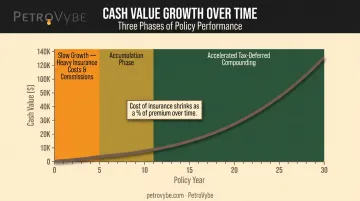
This is why cash flow insurance is a long game. Policyholders expecting meaningful liquidity in year two will be disappointed. Substantial cash value typically takes several years to materialize.
Comparing the Main Types of Cash Value Policies
Not all permanent policies build cash value the same way. Here's how the four main types stack up:
| Policy Type | Growth Mechanism | Risk Level | Guarantee |
|---|---|---|---|
| Whole life | Guaranteed schedule + insurer dividends (non-guaranteed) | Low | Guaranteed minimum cash value growth |
| Universal life (fixed) | Declared interest rate on account value | Low-moderate | Guaranteed minimum interest rate |
| Indexed universal life (IUL) | Interest credited via index formula (cap, participation rate, floor) | Moderate | Floor limits negative index credit, typically at or near 0% |
| Variable universal life (VUL) | Cash value invested in market subaccounts | High | None — value can decline |
A few notes worth flagging:
- Whole life is the most predictable option. Northwestern Mutual, for example, has paid dividends for 155 straight years, including a $9.2 billion payout announced for 2026. Past performance doesn't guarantee future dividends.
- IUL floors vary by carrier and product. Some sit at 0%, but the floor only protects against negative index credits, not the ongoing policy charges that can still erode value.
- VUL carries no floor at all, meaning a bad market year can shrink your cash value directly.
Key Benefits of Cash Flow Insurance
Cash flow insurance offers more than a death benefit: it combines favorable tax treatment with flexibility while you're alive.
Tax-deferred growth. Cash value compounds without annual taxation on gains, similar to a 401(k) or IRA, but without contribution limits. High earners who've maxed out qualified accounts often find this the primary draw.
Tax-free access, within limits. Policyholders can generally withdraw up to their cost basis (total premiums paid) tax-free. Policy loans are typically not treated as taxable income either, as long as the policy stays in force and doesn't lapse, according to Investopedia's breakdown of policy loan tax rules.
A death benefit that persists. Unlike a brokerage account, the policy keeps paying beneficiaries even while you're actively using the cash value, provided the policy remains funded correctly.
Loan flexibility. Policy loans require:
- No credit check required
- Skips the traditional loan approval process
- Places no restriction on use: education, real estate, business capital, anything
Stability during market swings. Whole life policies, in particular, offer guaranteed minimum growth regardless of what the S&P 500 is doing that year. That's the trade-off: lower ceiling, but no floor to fall through.
Mutual insurers with century-plus dividend records illustrate this consistency: Guardian has paid dividends annually since 1868, and MassMutual just announced its 158th consecutive year of payouts. Dividends are never guaranteed contractually, but the historical pattern is hard to ignore.
How to Access & Use Your Cash Value
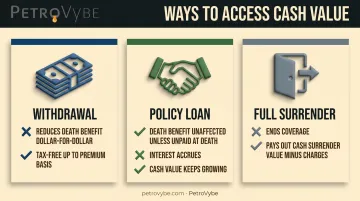
There are three ways to pull money out of a cash value policy, and each has different consequences.
- Withdrawals: Reduce your death benefit dollar-for-dollar. Amounts up to your premium basis come out tax-free; the gain above that is taxed as ordinary income.
- Policy loans: Don't reduce the death benefit unless still outstanding at death. Interest accrues, but your cash value keeps growing since the insurer treats the loan separately.
- Full surrender: You cash out entirely, receiving the cash surrender value (cash value minus any remaining surrender charges) and forfeiting all future coverage.
A quick example: say you've paid $50,000 in premiums into a policy now worth $70,000 in cash value. You can withdraw up to $50,000 tax-free. Take out more than that, and the extra $20,000 gets taxed as income.
A loan against the same $70,000, by contrast, generally isn't taxed at all, unless the policy lapses with the loan still outstanding. That scenario can trigger a surprise tax bill.
Pros, Cons & Costs to Weigh Before Buying
Cash flow insurance isn't a fit for everyone. The trade-offs deserve an honest look before you commit.
Pros:
- Lifelong coverage that doesn't expire like term insurance
- Tax-deferred growth plus tax-advantaged access
- Flexible liquidity through loans or withdrawals
- A death benefit legacy for beneficiaries, even after cash value use
Cons:
- Premiums run higher than equivalent term coverage
- Cash value takes years to build to a meaningful level
- Surrender charges often apply for the first 10 to 15 years, based on typical policy filings — the exact period varies by contract
These trade-offs make due diligence essential. Before you buy, ask your agent:
- Is the cash value growth guaranteed, or dependent on dividends, index performance, or market returns?
- What fees and surrender charges apply, and for how long?
- What happens to the policy if I reduce or stop paying premiums?
These aren't throwaway questions. Underfunded universal life and IUL policies, in particular, can lapse unexpectedly if the account value can't cover rising insurance costs later in life.
Is Cash Flow Insurance Right for You? Exploring Complementary Passive Income Alternatives
Cash flow insurance suits people who want guaranteed, tax-advantaged, low-risk savings paired with permanent coverage. It's not designed to outperform direct market investments: the returns are steady, not spectacular.
That's precisely why many high-income earners and accredited investors don't stop at insurance. They pair it with other tax-efficient, passive-income assets that diversify beyond stocks, bonds, and policy cash value.
One option worth understanding: direct participation in natural gas development. PetroVybe, for instance, offers accredited investors equity units in Natural Gas Liquids projects in Lavaca County, Texas, structured around growing electricity demand from AI data centers, which industry analysts project could roughly double U.S. data center power needs by 2030.
Unlike the tax-deferred structure of a life insurance policy, this kind of investment offers:
- **Upfront tax deductions against active income** — including W-2 wages and capital gains, through Intangible Drilling Cost (IDC) deductions
- Targeted long-term passive income during the production phase
- A projected MOIC and IRR tied to physical energy assets rather than policy crediting rates
Neither vehicle replaces the other. Cash value insurance offers guarantees and liquidity insurance can't match anywhere else; direct energy investment offers upside and tax leverage insurance products don't provide. A financial or tax advisor can help you determine the right mix for your income level, risk tolerance, and timeline.
Frequently Asked Questions
What is cash flow insurance?
Permanent life insurance structured to build tax-advantaged cash value you can access during your lifetime, while still paying a death benefit. The term describes a strategy for using a policy, rather than a distinct insurance product.
Is cash flow insurance the same as cash value life insurance?
Yes, essentially. Cash flow insurance describes the intentional, banking-style use of a standard cash value policy — the underlying contract is identical either way.
How do I access the cash value in my policy?
Three main ways:
- Withdrawals reduce the death benefit
- Policy loans accrue interest but don't reduce the death benefit unless unpaid at death
- Full surrender ends coverage entirely
Are withdrawals or loans from a cash flow insurance policy taxable?
Withdrawals up to your premium basis are typically tax-free, with gains above that taxed as income. Loans are generally tax-free unless the policy lapses while the loan is outstanding.
How long does it take for cash value to grow significantly?
Usually several years. Early premiums go heavily toward insurance costs and fees, so meaningful cash value accumulation takes patience.
Can cash flow insurance be part of a broader passive income or tax strategy?
Yes. Many investors combine it with other tax-advantaged vehicles, such as direct energy development investments, to diversify their income sources and tax benefits.