

Introduction
The IRS applies a 3.8% Net Investment Income Tax once your income crosses $200,000 (single) or $250,000 (married filing jointly) — thresholds that have never been adjusted for inflation since the tax was created.
That matters more than it looks on paper. A $30,000 bonus or a well-timed stock sale can push you past that line, tacking on an extra 3.8% surtax even though your raise just kept pace with inflation.
Add in a jump from the 24% to 32% bracket, and an extra $10,000 to $50,000 in income can cost far more than the sticker math suggests.
Here's the good news: taxable income isn't fixed. It's shaped by decisions: what you contribute, when you sell, how you structure investments.
This guide covers the foundational moves everyone should make, active strategies for ongoing management, and the advanced options available once you've maxed out the basics, including approaches built for high W-2 earners and accredited investors.
Key Takeaways
- Stacking income types can push your effective rate higher through thresholds like the NIIT, even without a raise
- Retirement accounts, HSAs, and itemized deductions remain the foundation for most filers
- Tax-loss harvesting and Roth conversions actively lower long-term tax exposure
- High earners who've maxed traditional deductions often use oil and gas development to offset active income
How Taxable Income Builds Up Over Time
Taxable income accumulates as a running total, not a single number you earn. The IRS adds up W-2 wages, self-employment income, investment gains, dividends, and other income streams every year, then applies your bracket to the whole pool.
Sometimes it climbs quietly:
- Annual raises and cost-of-living adjustments
- Employer bonuses
- Investment growth that compounds year over year
Other times it jumps overnight — a stock sale, a severance package, a business windfall that lands in a single tax year.
Why the Jump Sneaks Up on You
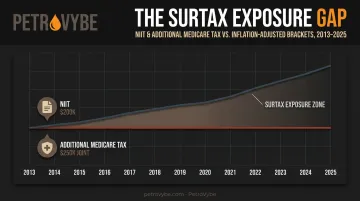
Here's the trap: the IRS adjusts tax brackets and the standard deduction for inflation every year. But several of the thresholds that trigger surtaxes and phase-outs don't move at all.
The Net Investment Income Tax kicks in at $200,000 for single filers and $250,000 for joint filers, the same numbers since the tax was created and never indexed for inflation. The Additional Medicare Tax follows the identical pattern. As nominal income rises, the gap between indexed brackets and fixed thresholds shrinks, pulling more income into higher-taxed territory each year.
By the time the number appears on your return, the window to act on that year's income has already closed. Proactive planning works while that window is still open; reactive filing only reports what already happened.
Key Drivers of High Taxable Income
For salaried employees, wage growth is the single biggest driver. Raises and bonuses push nominal income higher every year, while deduction phase-outs and surtax thresholds stay put. Your effective tax rate rises even if your lifestyle hasn't changed much.
For investors, realized capital gains, dividends, and investment income are often the largest and most controllable driver. Unlike wages, the timing of a sale is within your control — sell in December instead of January, and you've shifted an entire year's liability.
An IRS study of gains accrued between 1954 and 2021 found that less than 20% of an estimated $116 trillion in gains ever appeared on individual tax returns. Owners simply deferred or never realized them. That's a macro data point, not a personal strategy, but it shows how much control taxpayers actually have over when gains hit a return.
The Deduction Gap
Income level alone doesn't determine your tax bill; awareness of available deductions does. Common oversights include:
- Underused retirement catch-up contributions after age 50
- Missed HSA eligibility while on a high-deductible plan
- Overlooked education or dependent credits
The drivers that matter most depend on your income type. A salaried professional's biggest lever might be maxing a 401(k). An investor's might be controlling when a gain is realized. Knowing which lever applies to you is step one.
Strategies to Reduce Taxable Income
Reducing taxable income works as a layered system, not a single trick. Some strategies change decisions made once, upfront. Others require active management throughout the year. And for high earners who've maxed out the conventional playbook, the real lever becomes the type of investment itself.
Strategies Through Smart Financial Decisions
These work by changing choices made before or during the tax year, directly lowering gross income or increasing deductions.
Max out tax-advantaged retirement accounts. Every dollar contributed to a traditional 401(k), IRA, or SEP-IRA comes off the top of your taxable income before you ever see a tax bill on it.
| Account | 2025 Contribution Limit |
|---|---|
| 401(k) employee deferral | $23,500 |
| 401(k) catch-up (50+) | $7,500 ($11,250 for ages 60–63) |
| Traditional/Roth IRA combined | $7,000 (+$1,000 if 50+) |
| SEP-IRA | Lesser of 25% of compensation or $70,000 |
Contribute to an HSA if you're on a high-deductible health plan: $4,300 self-only or $8,550 family coverage for 2025, plus a $1,000 catch-up past age 55. It's the only account offering a triple tax break: deductible contributions, tax-free growth, and withdrawals with no tax owed on qualified expenses.
Compare standard vs. itemized deductions. The 2025 standard deduction is $15,000 single or $30,000 married filing jointly. Itemizing only wins if mortgage interest, medical expenses over 7.5% of AGI, and state and local taxes (capped at $40,000, phasing down above $500,000 MAGI) exceed that number.
Bunch charitable contributions. If you're close to the itemizing threshold, funnel two or three years of giving into a donor-advised fund in a single year. You claim the full deduction upfront and distribute grants to charities over time.
Claim every credit you're eligible for. Credits reduce your bill dollar-for-dollar:
- Child Tax Credit
- Education credits (American Opportunity, Lifetime Learning)
- Earned Income Tax Credit (roughly one in five eligible workers never claims it)
Strategies Through Active, Ongoing Management
These depend on how you manage and time income and investments throughout the year, not a once-and-done decision.
Harvest losses to offset gains. Selling losing positions to offset realized capital gains, plus up to $3,000 of ordinary income annually, is one of the most reliable tools available. Unused losses carry forward indefinitely.
Use asset location strategically. Hold tax-inefficient assets (bonds, high-turnover funds) inside tax-advantaged accounts. Keep tax-efficient holdings like index funds in your taxable brokerage account.
Defer income when it makes sense. If a bonus or large asset sale can wait until a lower-income year, that timing shift alone can drop you a bracket.
Direct your RMD through a QCD. If you're over 70½, a Qualified Charitable Distribution sends up to $108,000 (2025 limit) straight from your IRA to charity. It counts toward your required minimum distribution but never touches your taxable income.
Convert to Roth in low-income years. A slower business year or early retirement before Social Security starts is often the cheapest time to convert traditional IRA dollars, paying tax now at a lower rate and avoiding larger RMD-driven bills later.
Strategies by Changing Your Investment Context
For high W-2 earners and accredited investors who've already maxed out retirement accounts, HSAs, and itemized deductions, the standard playbook runs out of runway. At that point, the investment structure itself, not just your income level, becomes the limiting factor.
Certain alternative asset classes offer deductions conventional retirement or brokerage accounts simply don't allow, because development costs get treated differently than passive investment income.
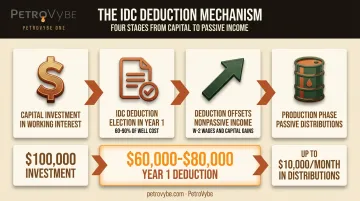
Intangible Drilling Costs (IDCs) are one example. Direct investment in natural gas and oil development can generate these deductions. The Independent Petroleum Association of America puts these costs at 60% to 90% of total well cost, with shale wells often at the higher end.
Under IRC Section 263(c), a working interest owner can elect to deduct these costs the year they're incurred instead of capitalizing them.
What makes this distinct: a qualifying working interest held without limited liability isn't treated as a passive activity under IRS rules. That means the deduction can offset nonpassive income, including W-2 wages and capital gains, not just passive income, unlike most real estate or business losses.
PetroVybe, a Texas-based natural gas development company, gives accredited investors direct access to this kind of development-stage asset. Partners who joined in 2024 and 2025 saw first-year deductions against active income reach 91% to 94%, according to the company's investor materials. On a $100,000 investment, that translates to roughly $60,000-$80,000 in Year 1 deductions alone.
Beyond the tax benefit, partners hold a stake in long-term production, with monthly passive distributions projected to peak above $10,000 during the production phase.
This isn't for everyone. It fits best for:
- Accredited investors with $100,000+ in liquidity
- Investors already carrying a high tax burden
- Those looking to diversify beyond stocks, bonds, and traditional real estate
- Investors comfortable with a long hold period and moderate risk tolerance
Accredited status alone doesn't confirm fit. The SEC's tests require income over $200,000 individually (or $300,000 jointly) or net worth over $1 million excluding your primary residence. Meeting that bar means you're eligible, not that the investment matches your goals. Always run the numbers with a CPA or tax advisor before committing capital.
Conclusion
Reducing taxable income comes down to identifying which drivers apply to your income profile, whether wages, capital gains, or business income, then layering the right decisions, ongoing management, and, for high earners, the right investment structure on top of each other.
For most filers, the standard playbook covers the bulk of what's available:
- Retirement contributions (401(k), IRA)
- HSA contributions
- Itemized deductions
But as income grows, this playbook reaches its limit fast. A W-2 earner already maxing out a 401(k) and HSA needs a different lever.
That's where strategies like PetroVybe's direct natural gas development program come in, not as a replacement for the fundamentals, but as the next layer for accredited investors who want meaningful deductions against active income while building long-term, tangible wealth.
Frequently Asked Questions
How do I lower my taxable income?
Layer your approach: max out retirement and HSA contributions, itemize or bunch deductions where it helps, harvest losses, and time income strategically. High earners who've exhausted those levers often look at alternative investments for additional deductions against active income.
What is the difference between a tax deduction and a tax credit?
A deduction lowers the income subject to tax. A credit reduces your tax bill dollar-for-dollar, making it generally more valuable per dollar than a deduction of the same size.
Can I reduce my taxable income if I take the standard deduction instead of itemizing?
Yes. Above-the-line deductions, including retirement and HSA contributions, student loan interest, and self-employment deductions, apply regardless of whether you itemize.
How much can retirement account contributions actually reduce my taxable income?
Contributions reduce taxable income dollar-for-dollar up to annual IRS limits. Check current-year 401(k), IRA, and SEP limits before contributing, since they change annually.
What is an Intangible Drilling Cost (IDC) deduction and how does it work?
IDCs cover the majority of costs to develop an oil or gas well. Qualifying working interest owners can deduct them against active income in the year incurred, unlike most passive investment losses.
Is investing in oil and gas development a good tax strategy for high-income earners?
It can be highly effective for accredited investors with a high tax burden seeking large first-year deductions against active income. Suitability depends on risk tolerance and liquidity, and it should always be reviewed with a tax professional.