
You're not alone. Family income sounds simple until you actually have to calculate it. It's a foundational number used for taxes, loans, financial aid, and government benefits, yet it's routinely confused with household income or individual income.
This guide breaks down what family income actually means, walks through how to calculate it step by step, explains why the number matters so much, and covers legitimate ways to grow and protect it once you know where you stand.
Key Takeaways
- Family income combines the gross earnings of every related member living in one household.
- It differs from household income, which includes unrelated occupants like roommates.
- Calculating it correctly means listing each qualifying member's income, not just the primary earner's.
- Strategic tax-advantaged investments can reduce what you owe while building long-term wealth.
What Is Family Income?
Family income is the total combined income earned by every related member of a household, from every source, typically measured over a year. That means the sum of everyone in the family unit who has income to report, not just one person's paycheck.
The U.S. Census Bureau defines a family as two or more people related by birth, marriage, or adoption who live in the same housing unit. That relationship requirement is the whole ballgame here. A roommate doesn't count. A cousin visiting for the summer doesn't count. A spouse or dependent child does.
One more detail that trips people up: family income is almost always reported before taxes, unless a specific form tells you otherwise. Census money-income figures are pretax by design, and most applications follow that same convention.
Sources of Income Included
When you're totaling family income, include:
- Wages and salaries from employment
- Self-employment income (net, after business expenses)
- Investment income: interest, dividends, capital gains
- Retirement and pension income
- Rental income
- Qualifying cash government benefits, such as Social Security or veterans' payments
What Family Income Typically Excludes
Not everything that lands in your bank account counts. Common exclusions include:
- One-time gifts and inheritances
- Loans (borrowed money isn't income)
- Tax refunds
- Income earned by unrelated individuals sharing your home, such as roommates

Family Income vs. Household Income vs. Individual Income
These three terms get used interchangeably in casual conversation, but they mean different things on official paperwork, and mixing them up can cost you.
Household income includes everyone living under one roof, related or not. Family income only counts people connected by birth, marriage, or adoption. Individual income is just one person's earnings, the building block used to construct the larger family figure.
Here's a concrete example: two unmarried roommates, Maria and James, share an apartment. Maria earns $65,000 a year. James earns $50,000. Their combined household income is $115,000. But since they aren't related, each reports their own individual income separately, and neither has a "family income" figure that includes the other.
| Scenario | Household Income | Family Income | Individual Income |
|---|---|---|---|
| Married couple, no roommates | Sum of both spouses | Same as household income | Each spouse's income alone |
| Married couple + unrelated roommate | Couple + roommate combined | Couple only (roommate excluded) | Each person's income alone |
| Single parent + adult child (related) | Parent + child combined | Parent + child combined | Each person's income alone |
Agencies don't always define "family" identically, either. The Census Bureau, the IRS, and the CDC's National Health Interview Survey each apply slightly different rules about who counts, which can shift the reported number even for the same household.
Why the Distinction Matters
Financial aid programs, tax credits, and benefit applications often specify one term over another. Use the wrong figure, and your eligibility calculation could be off before you even submit the form.
- FAFSA asks about parent and student income, not full household income
- Medicaid eligibility uses tax-filing relationships, not simple cohabitation
- Mortgage lenders look at qualifying borrower income, which may exclude a non-borrowing spouse
Reading the form's exact wording before you fill in a number saves you from a rejected application or an inaccurate benefit estimate.
How to Calculate Family Income (Step-by-Step)
Calculating family income isn't complicated once you know the sequence. It just requires patience and the right documents.
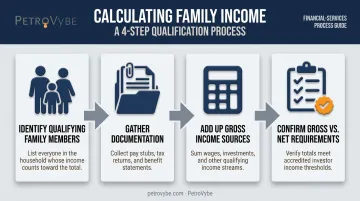
- Identify every qualifying family member: this typically means the householder, spouse, and any related dependents living at home who meet income filing thresholds.
- Gather documentation for each person: pull W-2s, 1099s, recent pay stubs, and investment or brokerage statements.
- Add up all gross income sources: combine wages, self-employment earnings, investment income, and any qualifying benefits before subtracting taxes.
- Confirm gross vs. net requirements. FAFSA, loan applications, and benefit programs don't all ask for the same thing, so check the form's instructions carefully.
Worked Example
Say you're a two-income household: one spouse earns $72,000 in wages, while the other runs a small consulting business netting $38,000 after expenses. Together, they also earned $2,500 in dividend income last year.
Add it up: $72,000 + $38,000 + $2,500 = $112,500 in combined family income.
A faster shortcut: pull the Adjusted Gross Income (AGI) line from your most recent joint tax return (Form 1040, line 11). It won't match every definition perfectly, but it's a solid starting estimate for most family income calculations, especially since it already aggregates a married couple's combined earnings.
Why Family Income Matters
Family income isn't just a number for paperwork. It drives real decisions that affect your household's finances and access to programs.
- Financial aid and lending. FAFSA's Student Aid Index formula starts with AGI, and mortgage underwriters use verified qualifying income to calculate debt-to-income ratios.
- Government benefit eligibility. Medicaid and SNAP compare family income against federal poverty guidelines adjusted for family size, with SNAP requiring gross income under 130% of the poverty line plus a stricter net-income test.
- Tax brackets. Married couples filing jointly combine their taxable income on one return, which determines which federal bracket applies.
Beyond individual households, family income is tracked nationally as an economic health indicator. The Census Bureau reported median U.S. household income at $83,730 in 2024, statistically flat compared to the prior year.
Agencies like the CDC use similar data to study health outcomes, access to care, and inequality trends across the population.
Growing and Protecting Your Family Income
Once you know your number, the next question is how to grow it and keep more of it. A few foundational moves matter regardless of income level:
- Build a written budget that tracks every income source you calculated above
- Maintain an emergency fund covering 3-6 months of expenses
- Diversify income beyond a single paycheck through side income, rental property, or investments
For higher earners, though, the bigger lever is often tax strategy. Most conventional deductions phase out as income climbs, which is frustrating if you're a high-W2 earner or sitting on capital gains with few remaining options.
Tax-Advantaged Investments Beyond the Usual Deductions
This is where certain alternative investments stand apart. Real estate depreciation, for example, is typically restricted to offsetting passive income only, unless you qualify as a full-time real estate professional. That leaves W-2 earners with limited relief.
Natural gas and oil development projects work differently. Under longstanding federal tax rules, Intangible Drilling Costs (IDCs) connected to new well development are deductible in the year they're incurred, and that deduction isn't limited to passive income. It can be applied against active income, including W-2 wages and capital gains.
PetroVybe, a Texas-based natural gas development company operating in Lavaca County within the Gulf Coast Basin, offers accredited investors direct access to early-stage energy assets structured around this exact mechanism.
Recent partner results show the range:
- First-year deductions typically project around 70% of invested capital
- 2024 partners reported deductions as high as 94% against active income
- Long-term passive income potential builds once production ramps up, layered on top of the upfront tax benefit
This kind of structure won't fit every family's situation. It requires accredited investor status and a meaningful liquidity commitment. But for families with a high tax burden and a long time horizon, it stands as one option among several for offsetting active income while building generational wealth.

Frequently Asked Questions
How do you describe family income?
Family income combines the gross earnings of related household members from wages, investments, and other qualifying sources. It's typically measured on an annual basis.
What's the difference between household income and family income?
Household income includes every occupant of a home regardless of relationship, while family income only includes members related by birth, marriage, or adoption.
What do I put for family income?
Total the gross income of all qualifying family members using documents like W-2s, 1099s, and the AGI figure from your most recent tax return.
Is family income calculated before or after taxes?
Most forms want gross, pretax income unless stated otherwise.
Does family income include a teenager's part-time job earnings?
Only if the earnings meet IRS filing thresholds for dependents. Below that threshold, a teen's part-time income is typically excluded from the family total.
How is family income used to determine the poverty level?
Family income is compared against federal poverty guidelines, adjusted for family size. This comparison determines poverty status and eligibility for assistance programs like Medicaid and SNAP.