That's the real story researchers have been circling for over a decade. Most of us don't experience income as a fixed number. We experience it as a series of changes: a promotion, a bonus, a slow month of freelance work, a pink slip. The emotional impact of those shifts matters more than any single salary figure ever could.
You've probably heard the claim that happiness plateaus at $75,000 a year. That statistic has been repeated so often it's practically folklore. Newer research has significantly revised that story, and the real findings are more useful than the myth.
This article breaks down what the science actually shows about income increases, income drops, and why financial resilience protects your mental health regardless of your paycheck size.
Key Takeaways
- Income reduces suffering more reliably than it boosts happiness at higher earnings
- The "$75k happiness plateau" only applies to the unhappiest 15-20%; happiness keeps climbing for everyone else
- Losing income hurts more than gaining the same amount helps, thanks to loss aversion
- Liquid wealth and passive income protect emotional well-being better than income level alone
The Income-Happiness Debate: What Decades of Research Actually Show
For over a decade, one number dominated the happiness conversation: $75,000.
The $75k Myth: How It Started and How It Fell Apart
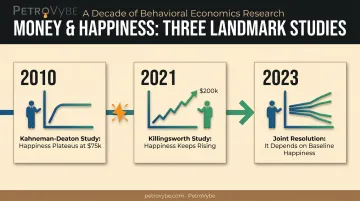
In 2010, Princeton researchers Daniel Kahneman and Angus Deaton analyzed 450,417 survey responses and found something specific: emotional well-being rose with income up to roughly $75,000, then flattened. Life satisfaction, a separate measure, kept climbing regardless of income.
Media coverage collapsed these two findings into one soundbite: "money stops buying happiness past $75k." That's not what the original PNAS study actually said.
In 2021, psychologist Matthew Killingsworth used real-time smartphone check-ins with over 33,000 employed adults instead of retrospective surveys. His data showed happiness rising steadily with income well beyond $200,000, with no plateau in sight. The two studies seemed to flatly contradict each other.
The 2023 Resolution: Averages Hide the Real Pattern
Kahneman, Killingsworth, and Barbara Mellers teamed up for an adversarial collaboration in 2023, reanalyzing the data together. The answer was hiding in the averages all along.
The flattening effect wasn't universal. It was concentrated almost entirely in the unhappiest 15-20% of the population. This "conflict resolved" PNAS paper found dramatically different slopes depending on which happiness quantile you looked at:
| Happiness percentile | Slope below $100k | Slope above $100k |
|---|---|---|
| 15th (least happy) | 1.90 | 0.34 (not significant) |
| 30th | 1.33 | 1.21 |
| 85th (happiest) | Steady | Accelerates |
For the least happy people, income below six figures matters enormously. Beyond that, it barely moves the needle for that group. Meanwhile, happier people keep gaining, and the happiest group actually accelerates past $100,000.
A separate 2024 Gallup World Poll analysis covering 386,654 people across 142 countries found higher income linked to better outcomes across all 31 well-being measures studied, though the size of that effect varied by region, gender, age, and education.
The core takeaway: income's real psychological power is alleviating financial suffering and instability, not guaranteeing an endless happiness upgrade.
How Income Increases Affect Mental Health and Emotional Well-being
Not all income boosts feel the same, and the research shows some clear patterns worth knowing.
One-Time Boosts Reduce Stress Fast
Researchers at the Upjohn Institute studied the 2008 economic stimulus tax rebates, small one-time payments ranging from $300 to $1,200 depending on filing status. Even this modest, temporary income bump measurably reduced worry and stress. The effect was strongest among lower-income recipients, the group with the least financial cushion to begin with.
Here's the behavioral piece: reduced financial stress improves patience and decision-making quality. Less scrambling means clearer thinking, which means better financial choices going forward. It's a positive feedback loop.
Life Satisfaction vs. Daily Mood
These aren't the same thing:
- Life satisfaction is your evaluative judgment: "how's my life going overall?"
- Emotional well-being is your moment-to-moment mood: "how do I feel right now?"
Income increases tend to move life satisfaction more reliably than they move daily emotional experience. A raise makes you feel better about your life. It doesn't necessarily make Tuesday afternoon feel less stressful.
Income's Effect Is Smaller Than You'd Think
Kahneman and Deaton's original research put this in perspective. A roughly fourfold income difference had an emotional impact comparable to being a caregiver or getting married, not a dramatic life-changing shift, but a meaningful one.
Lottery-style windfalls follow a similar pattern. Studies of medium-sized lottery wins found measurable but often delayed and temporary well-being improvements, reinforcing a simple point: sustained financial security beats a one-time gain every time.
How Income Drops and Financial Volatility Affect Mental Health
Losing income doesn't just cancel out the good feeling of gaining it. It hurts more.
Loss Aversion Makes Drops Feel Worse
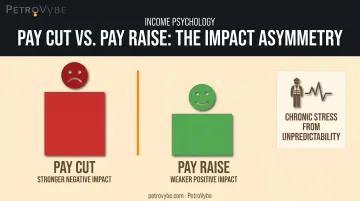
This is one of the most consistent findings in behavioral economics: losing income creates a psychologically larger negative impact than an equivalent gain's positive impact. A $10,000 pay cut stings more than a $10,000 raise feels good, and it's not close.
Why Low Income Amplifies Emotional Pain
Researchers at George Mason University's Center for the Advancement of Well-Being point to a compounding effect: people with lower income or a thin financial cushion struggle more to emotionally cope with hardship like divorce, illness, or job loss.
Here's why that happens:
- Fewer resources mean fewer ways to buy time, hire help, or reduce other stressors
- Financial stress competes for the same mental bandwidth needed to cope with the crisis itself
- Recovery options (moving, retraining, taking unpaid leave) simply cost more than low-income households can absorb
Volatility Creates Its Own Chronic Stress
It's not just about the level of income. Unpredictable income (gig work, commission-based pay, irregular freelance gigs) creates a background hum of anxiety distinct from the actual dollar amount earned.
Research on UK gig workers found worse mental health and life satisfaction compared to traditional employees, driven partly by financial precarity. A separate study of Danish workers who moved to performance-based pay saw stress-medication use rise afterward.
The 2023 PNAS reanalysis reinforces this: unhappiness is most sensitive to income changes below roughly $100,000. That means a pay cut in this range disproportionately worsens well-being compared to the same-sized cut higher up the income ladder.
Inflation: The Hidden Pay Cut
Here's another wrinkle: inflation steadily erodes purchasing power even when your paycheck stays flat. A frozen salary in a high-inflation year functions like an income drop, just without the layoff notice.
Income vs. Wealth: Why Passive Cash Flow Matters More Than Paycheck Size
Income is what flows in. Wealth is what you keep. That distinction turns out to matter enormously for mental health.
Liquid Cash, Not Net Worth, Predicts Peace of Mind
A study tracking UK bank customers found that liquid wealth, actual checking and savings balances, predicted financial well-being and life satisfaction even after accounting for income, spending, debt, and investments. Bank balance, not paper net worth, is what your brain seems to register as security.
Why You Never Feel "Caught Up"
This connects to the hedonic treadmill: people adapt quickly to income increases, then chase the next raise or purchase to feel the same relief. A bigger salary that immediately funds a bigger mortgage doesn't buy more peace of mind. It just resets the baseline.
Durable assets and passive cash flow break that cycle because they don't depend on you working harder or earning more next year.
Building the Kind of Wealth That Sticks
Diversification beyond a single paycheck becomes practical here, not theoretical. Real estate, dividend-paying investments, and tax-advantaged energy development programs all serve the same function: converting active income into a resilient asset base that keeps producing regardless of your job status.
For accredited investors with capital to deploy, PetroVybe's natural gas development partnerships illustrate this structure in action. Partners who commit capital receive:
- An upfront tax deduction of up to 94% against active income for 2024 partners, applying to both W-2 earnings and capital gains
- Monthly passive distributions projected to reach over $10,000 per unit at peak production
- A tangible asset base backed by a $48 million third-party engineered proved-reserves valuation
That's the income-versus-wealth distinction in practice: instead of a bigger number on a pay stub, you're building a cushion that keeps generating cash flow independent of any single employer or economic cycle.
Building Financial Resilience to Protect Your Mental Health During Income Changes
Building financial resilience means creating a buffer that keeps you steady when income shifts, regardless of how much you earn.
Here's where to start:
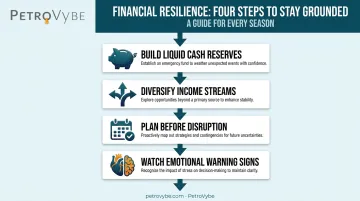
- Build liquid cash reserves first. Accessible savings, not net worth on paper, is what most reliably reduces anxiety during an income shock.
- Diversify beyond one active income stream. Passive, tax-efficient vehicles reduce dependence on a single paycheck. For high-income earners with existing liquidity and a heavy tax burden, structures like PetroVybe's development program can supplement — not replace — the reserves from step one while lowering taxable income.
- Plan before disruption hits, not after. Budget for volatility, run worst-case scenarios, and talk to a financial advisor while things are stable.
- Watch for emotional warning signs. Sleep issues, constant worry, and strained relationships often show up before you consciously register financial stress. Don't wait to seek support from a mental health professional or financial counselor.
Start building that system now, while income is stable — waiting until disruption hits already puts you behind.
Frequently Asked Questions
Does money really buy happiness?
Income reliably reduces unhappiness and financial stress, especially at lower income levels. Its power to maximize happiness at higher incomes is real but smaller and more nuanced than popular claims suggest.
Is there a specific income level where happiness stops increasing?
The popular "$75,000 plateau" only applies to the least happy segment of the population. For most people, happiness keeps rising with income well beyond that number.
How does losing income affect mental health differently than gaining it?
Loss aversion means income drops create a disproportionately larger stress response than equivalent gains improve mood. A pay cut hurts more than the same-sized raise helps.
What's the difference between income and wealth when it comes to well-being?
Income is a flow (what you earn); wealth is a stock (what you have). Liquid wealth is a stronger, more consistent predictor of financial security and life satisfaction than income alone.
Can passive income streams help reduce financial stress?
Yes. Diversified passive income sources, such as dividend-paying investments or direct participation in real estate or energy projects, reduce your dependence on a single paycheck. That diversification buffers against the anxiety that comes with income volatility or job loss.
How can I protect my mental health during a job loss or pay cut?
Build liquid savings before a disruption hits, and plan proactively for income volatility. If the stress starts affecting your sleep or relationships, seek support from a financial counselor or mental health professional.