
68% of U.S. adults didn't have a will as of late 2023, according to Caring.com's 2024 Wills and Estate Planning Study, based on a YouGov survey of 2,481 adults. That gap doesn't shrink much as income rises.
For high-income earners and accredited investors, the stakes are different. You're juggling investment portfolios, tax brackets, trusts, and legacy goals — often without a single strategy tying them together. Rising tax exposure only makes the coordination problem worse.
This guide breaks down the difference between estate planning and wealth management, the documents every plan needs, tax strategies worth exploring, and how to build one integrated plan instead of several disconnected pieces.
Key Takeaways
- Combine estate planning and wealth management into one coordinated strategy
- A complete plan includes a will, trust, power of attorney, and updated beneficiaries
- Alternative investments, such as energy development, can reduce your estate and income tax exposure
- Review your plan every 2-5 years, or sooner after a major life event
Estate Planning vs. Wealth Management: What's the Difference?
These two terms get used interchangeably, but they solve different problems.
Wealth management is the ongoing work of growing and preserving what you have during your lifetime. It covers investment management, retirement planning, tax strategy, and risk management. Think of it as the engine that builds your net worth year over year.
Estate planning is the legal framework that decides what happens to that wealth after death or incapacity. It includes wills, trusts, powers of attorney, and beneficiary designations — the documents that control who gets what, and when.
In short: wealth management is about growth and optimization, while estate planning is about control, transparency, and efficient transfer of what you've built.
Why the Two Should Work Together
Treating these as separate projects creates blind spots. A classic example: your required minimum distributions (RMDs) and your IRA beneficiary designation directly determine what your heirs actually receive, and how quickly they'll owe taxes on it.
If your financial advisor is optimizing your portfolio but your beneficiary forms are outdated, or your attorney drafted a trust that doesn't match how your accounts are titled, you've got a gap. And gaps in this space tend to be expensive:
- Unnecessary estate or income taxes
- Probate delays that tie up assets for months
- Family disputes over unclear or conflicting instructions
The Essential Building Blocks of an Estate Plan
Every estate plan rests on the same foundation, regardless of net worth. Here's what belongs in it.
Start with an asset inventory, listing everything you own and noting whether it's individually held or jointly owned. This becomes the reference point for every other document you create.
Don't overlook illiquid holdings, such as direct interests in energy or real estate partnerships. These often carry transfer restrictions that require special handling in your will or trust.
From there, build out the core legal pieces:
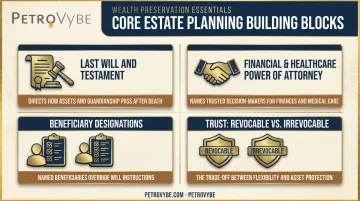
- A last will and testament: names an executor and directs how assets are distributed. Without one, you die intestate, and a state court decides who inherits based on statutory formulas, not your wishes.
- Financial and healthcare powers of attorney: name trusted agents who can act on your behalf if you're incapacitated. Pair this with a living will or advance directive so your medical preferences are documented.
- Beneficiary designations: update these on every retirement account, life insurance policy, and investment account. If you have minor children, name a guardian too, or a court will decide for you.
- A trust, if your situation calls for one: a revocable trust is flexible and amendable but stays in your taxable estate, while an irrevocable trust generally can't be undone but can reduce estate tax exposure and offer creditor protection.
One step people often skip is syncing every document with your financial advisor, since legal instructions are worthless if your accounts aren't titled to match them.
Tax-Efficient Strategies to Protect and Grow Your Wealth
Once the legal framework is in place, the next question is how to shrink your tax bill while you're still building wealth.
Estate-side tools worth knowing:
- Lifetime gifting: the annual gift tax exclusion is $19,000 per recipient in 2025, up from $18,000 in 2024, according to the IRS's 2025 inflation adjustments.
- Lifetime exemption: the federal estate and gift tax exemption sits at $13.99 million for 2025, shielding most estates from federal tax entirely.
- Charitable giving through donor-advised funds: you get an immediate deduction while retaining advisory input on how the funds are eventually distributed.
- Irrevocable trusts: remove assets from your taxable estate when structured correctly.
Income-side levers matter just as much:
- Roth conversions shift future withdrawals to tax-free status
- Tax-loss harvesting offsets capital gains, and up to $3,000 of ordinary income annually
- Structuring which accounts hold which assets to minimize annual tax drag
Alternative Investments as a Tax Strategy
This is where direct-participation investments enter the conversation. Private natural gas development, for example, can generate deductions under the Intangible Drilling Cost (IDC) provision, a rule allowing investors to expense qualifying drilling costs and apply that deduction against active income, including W-2 wages and capital gains, not just passive income.
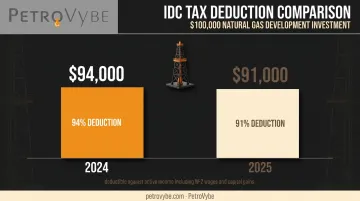
PetroVybe is a useful case study here. The company's accredited investor partners received a 94% first-year tax deduction against active income in 2024, adjusting to 91% in 2025 as IDC deductions tied to capital deployed into its Texas natural gas projects shifted year over year.
On a $100,000 investment, that translates into tens of thousands of dollars in deductions in the first year alone, alongside long-term passive income and multiple-on-invested-capital targets over a 10-year hold.
That said, suitability depends heavily on your accreditation status, risk tolerance, and personal tax picture. Coordinate any alternative investment strategy with a CPA or tax advisor before committing capital: deduction percentages and structures vary by project and tax year.
Aligning Estate Planning With Your Broader Wealth Strategy
Your portfolio's structure affects more than growth. It determines what your heirs actually inherit, and how much they owe in taxes on it.
Portfolio composition matters for transferability. Growth-oriented assets like concentrated stock positions can trigger large capital gains taxes for heirs if not planned around. Stable assets, in contrast, often transfer more predictably.
Retirement accounts need their own coordination plan:
- RMDs from traditional accounts start at age 73 for original owners
- Beneficiary designations determine how quickly inherited accounts must be drained (often within 10 years under current rules)
- Roth conversions during your lifetime can reduce the tax burden your heirs face later
Beyond retirement-account planning, diversification beyond stocks, bonds, and real estate adds another layer of resilience. Alternative assets like energy development projects offer growth potential that doesn't move in lockstep with public markets, providing a genuine diversification benefit for legacy-focused portfolios that goes beyond tax advantages.
Building Your Professional Team and Knowing When to Review
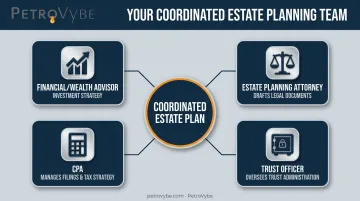
No single professional covers this entire picture. You need a team, and each person plays a distinct role:
- Financial or wealth advisor: handles investment strategy and tax-aware planning
- Estate planning attorney: drafts the legally binding documents: wills, trusts, powers of attorney
- CPA: manages filings and coordinates tax strategy execution
- Trust officer: oversees ongoing trust administration for larger or more complex estates
Once this team is in place, the next question is timing. Certain life events should trigger an immediate review:
- Marriage or divorce
- Birth of a child
- Death of a named beneficiary
- Sale of a business
- Retirement
- Relocation to a new state
Even without a trigger event, set a baseline review every 2-5 years. Beneficiary designations are the most commonly overlooked item: an outdated form can undo years of careful planning in a single stroke.
Frequently Asked Questions
What is the difference between wealth management and estate planning?
Wealth management focuses on growing and preserving your assets during your lifetime through investing and tax strategy. Estate planning is the legal structure that governs how those assets transfer after death or incapacity.
Is $500,000 enough to work with a financial advisor?
Many advisors set investable-asset minimums near $500,000, but plenty of firms work with less. Kitces Research found advisor minimums split roughly evenly below, at, and above that mark — fit matters more than the exact number.
How often should I update my estate plan?
Review it every 2-5 years, or immediately after major life events like marriage, divorce, a birth, or a significant change in assets. Outdated beneficiary forms are the most common gap advisors find.
What happens if I die without a will?
Your assets get distributed according to your state's intestacy laws, which typically favor a surviving spouse and children first. This may not reflect your actual wishes, and it removes your say entirely.
Can alternative investments like oil and gas development be part of an estate plan?
Yes. Direct-participation energy investments can be held in qualifying trusts or passed to heirs, while also generating meaningful tax deductions during your lifetime through provisions like Intangible Drilling Costs (IDC).
Who should I consult first: an attorney or a financial advisor?
Neither alone: both should work together. Your advisor handles investment and tax strategy, while your attorney drafts the legally binding documents that carry out that strategy.