Chasing wealth alone can leave high-income earners with impressive account balances and a nagging sense that something's missing. Prosperity requires both financial capacity and purpose — money that actually serves a life you want to live, not just a number that keeps climbing.
This article breaks down what separates the two, where they overlap, and how strategic wealth-building — through tax efficiency and passive income — becomes the foundation that lets wealth turn into something more.
Key Takeaways
- Wealth is quantifiable: cash, assets, investments, and net worth.
- Prosperity is holistic: security, health, relationships, freedom, and purpose.
- Wealth doesn't guarantee prosperity, though a financial foundation usually helps.
- Tax-efficient passive income frees up time, the link connecting both.
- The goal is building wealth intentionally so it serves prosperity, not the reverse.
Wealth vs Prosperity: Quick Comparison
Before going deeper, here's how the two concepts stack up side by side.
| Factor | Wealth | Prosperity |
|---|---|---|
| Definition | A quantifiable measure of net worth — cash, investments, real estate, business equity | A qualitative state of flourishing that includes financial security plus health, relationships, and purpose |
| Measurement | Dollar amounts, account balances, asset valuations | Life satisfaction, freedom, peace of mind |
| Time Horizon | Can be built relatively fast through income or returns | Cultivated over a lifetime through intentional decisions |
| Primary Source | Income, asset appreciation, investment returns | Wealth plus stewardship, relationships, sense of purpose |
| Risk of Pursuing Alone | Burnout, strained relationships, misplaced priorities | Good intentions without financial support |
The pattern here is simple: wealth answers "how much." Prosperity answers "to what end."
The Consumer Financial Protection Bureau's financial well-being framework captures this idea, defining true financial well-being as control over daily finances, the capacity to absorb shocks, progress toward goals, and freedom to make choices that let you enjoy life. Notice how only one of those four elements is purely about money.
What Is Wealth?
Wealth is the quantifiable measure of net worth — cash, investments, real estate, business equity, and tangible assets. It's the foundational building block of any financial plan, though the raw numbers alone don't determine how you put that foundation to work.
Core benefits of wealth include:
- Financial security and reduced dependence on a single paycheck
- The ability to fund life goals (education, homeownership, retirement)
- Capacity to generate passive income instead of trading hours for dollars
- Optionality: the freedom to say no to work you don't want to do
Diversification matters here. Purely paper assets — stocks, bonds, mutual funds — can lose real value during inflationary periods, and tangible assets like real estate or natural resources don't automatically solve that problem either.
The CFA Institute's research on real assets and inflation found that protection isn't guaranteed across the board, since real assets respond differently depending on whether inflation is expected or a surprise. Certain asset classes, including natural resources, held up better than others during the 2021–2023 inflation stretch.
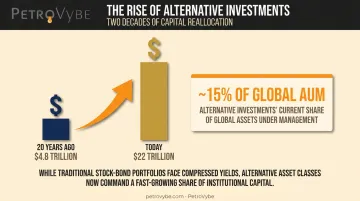
That's part of why alternative and tangible asset classes have grown so quickly. CAIA estimates alternative investments have grown from roughly $4.8 trillion two decades ago to $22 trillion today, about 15% of global assets under management. Investors are looking beyond the traditional stock-bond mix.
Liquid vs Tangible Wealth
Not all wealth behaves the same way:
- Liquid wealth, such as cash, publicly traded stocks, and bonds, is easy to access but fully exposed to market swings.
- Illiquid/tangible wealth, such as real estate, private equity, and oil and gas development assets, takes longer to convert to cash but often carries different risk and return characteristics, including direct exposure to physical, income-producing assets.
This liquidity spectrum shapes portfolio flexibility. A portfolio too heavy in illiquid assets can leave an investor cash-poor during emergencies, while one weighted entirely toward liquid holdings sacrifices the return premium tangible assets often provide.
Use Cases of Wealth
Wealth-building isn't a single event. It shows up differently across financial life stages:
- Accumulation phase: earning years focused on saving and investing aggressively
- Tax planning phase: structuring income and investments to minimize the drag of taxation
- Retirement phase: converting assets into reliable income
- Legacy phase: transferring wealth to family or causes that matter
High-income W2 earners and business owners face a specific version of this challenge: a heavy active-income tax burden with few tools to address it directly. This is where structures like the intangible drilling cost (IDC) deduction in natural gas development come in. Unlike most passive-loss tax shelters, IDC deductions can apply against active income (W2 wages, capital gains, business income), not just passive income.
PetroVybe's own results illustrate the scale of this. Partners who invested in 2024 received a 94% tax deduction against active income, while partners in 2025 received a 91% deduction, with both figures confirmed through actual K-1 filings rather than projections.
One redacted 2025 K-1 shows a $600,000 capital contribution generating $401,772 in deductions, translating to roughly $148,000 in direct tax savings for an investor in the 37% bracket, before a single dollar of production income arrives.
What Is Prosperity?
Prosperity is a holistic state of flourishing that includes financial security but also health, relationships, freedom, and purpose. For investors, it's the "why" behind the wealth-building strategy: the reason the spreadsheet matters in the first place.
Core benefits of prosperity include:
- Reduced financial stress and lower anxiety around money decisions
- More time and energy available for family and personal purpose
- Greater capacity to give generously without financial strain
- Ability to build a legacy that outlasts a single generation
Some frameworks split prosperity into two lanes: personal well-being (health, relationships, time freedom) and purposeful stewardship (legacy, giving, values-driven decisions). Both matter, and neither happens automatically just because a bank account grows.
The Income-Happiness Plateau, Reconsidered
For years, the popular narrative was that happiness plateaus around $75,000 in annual income. That's not quite accurate.
A 2023 adversarial collaboration in PNAS reconciling earlier income-happiness research found the flattening effect was concentrated mainly among the least happy 15% of people, occurring closer to $100,000. For most people, well-being kept rising well beyond that point, and for the happiest group, it actually accelerated.
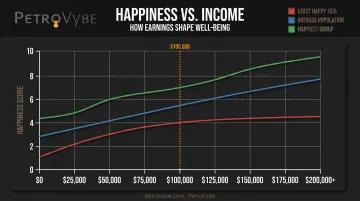
Money still matters, but money alone doesn't guarantee flourishing. How it's used, and what it frees you up to do, matters just as much as how much you have.
Use Cases of Prosperity
Prosperity shows up in tangible, specific moments:
- Retirement freedom: not needing to work, by choice rather than necessity
- Family legacy planning: structuring assets to benefit the next generation
- Charitable giving capacity: the ability to be generous without financial strain
- Time and health freedom: choosing rest, travel, or family moments without guilt
Passive income plays a direct role here. When an investor stops trading hours for active income and instead receives royalty-style distributions, such as monthly income from a producing natural gas asset, that reclaimed time can go toward family, health, or purpose instead of another client call.
PetroVybe's projects, for example, target monthly passive distributions exceeding $10,000 during peak production: income that doesn't require ongoing hours from the investor to generate.
Wealth vs Prosperity: Building One to Achieve the Other
There's no universal formula for balancing wealth accumulation with prosperity-focused decisions. It depends on a few factors:
- Life stage: early career versus established earner
- Risk tolerance: comfort with illiquid or long-hold investments
- Personal values: what "enough" actually looks like
- Family goals: legacy, education, giving, or all three
Early-career earners often need to prioritize accumulation first; there simply isn't enough capital yet to structure sophisticated tax or passive-income strategies.
Established earners face a different problem entirely: they have wealth, but it's structured inefficiently, taxed heavily, and locked into paper assets that don't generate meaningful passive income. For this group, the priority shifts from building more to structuring what's already there, and doing so well is often what unlocks prosperity sooner.
Real-World Application: Turning Wealth into Prosperity
Accredited investors in this second category tend to share a common set of problems:
- A high active-income tax burden with few direct offsets
- Inflation eroding purchasing power on cash and paper assets
- Limited diversification beyond the usual stocks, bonds, and real estate
A structured, tax-efficient passive investment model can address all three at once. PetroVybe's natural gas development partnerships, for example, pair upfront tax deductions with long-term passive income and growth targets. Partners have historically seen first-year deductions in the 91–94% range against active income, alongside a projected 10-year MOIC range of roughly 2.2x to 5.8x and an IRR near 26%.
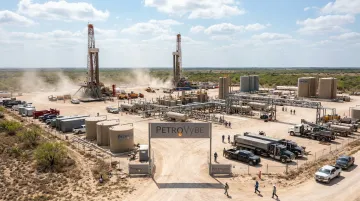
The projects themselves aren't abstract. PetroVybe's flagship development sits in Lavaca County, Texas, backed by a $48 million third-party engineered reserve valuation, with Chief Geophysicist Michael Stamatedes bringing a 48-year track record and a 75.2% well-selection success rate, nearly double the industry average of under 40%.
Passive, tax-advantaged wealth vehicles free up an investor's most valuable resource: time. That time can go toward health, relationships, and the kind of purpose-driven stewardship that defines actual prosperity, not just a growing balance sheet.
If this resonates, explore how PetroVybe's accredited investor partnership model works and whether it fits your own wealth-to-prosperity strategy.
Conclusion
Wealth and prosperity aren't competing goals. Wealth is the tool. Prosperity is the destination it's meant to serve. Reducing tax burden, generating passive income, and building a tangible asset legacy are the practical steps that bridge the gap between the two. These aren't abstract concepts: they show up as real line items on a K-1.
Before choosing your next wealth-building strategy, define what prosperity actually means to you. The number in your account matters less than what that number lets you do with your time.
Frequently Asked Questions
What is wealth and prosperity?
Wealth is quantifiable net worth : cash, assets, investments. Prosperity is the broader state of flourishing that includes financial security along with health, relationships, and purpose.
Can you be wealthy without being prosperous?
Yes. Many people accumulate significant net worth yet experience burnout, strained relationships, or a lack of purpose. Wealth alone doesn't guarantee a flourishing life.
What is the difference between wealth and abundance?
Abundance is a mindset — a sense of sufficiency regardless of your bank balance. Wealth is a measurable financial asset base, tracked in dollars rather than mindset.
How can I turn my wealth into prosperity?
Focus on tax-efficient passive income strategies, values-based giving, and deliberately prioritizing time for relationships and health. Structure matters as much as accumulation.
Does passive income contribute to prosperity?
Passive income reduces the need to trade time for money, freeing up hours for the relationships and purpose that actually define prosperity. It enables prosperity but doesn't guarantee it.
What financial strategies help build both wealth and prosperity together?
Diversification, tax-advantaged investments like IDC deductions, and passive income vehicles all grow net worth while preserving the time and energy prosperity requires.