Introduction
Oil still runs the world. It fuels the cars in your driveway, the planes overhead, and increasingly, the data centers training the next generation of AI.
Global oil demand hit a record 103 million barrels per day in 2024, according to a report from the International Energy Agency.
Most people think of oil as just gasoline. That's a narrow view. Crude oil built empires and shaped wars. Today, it sits at the center of a new electricity demand boom driven by artificial intelligence.
This article breaks down 11 essential facts about oil, from how it forms deep underground to why it's suddenly relevant to anyone thinking about America's energy future.
Key Takeaways
- Oil is a non-renewable fossil fuel traded in standardized 42-gallon barrels
- The U.S. ranks among the world's top oil producers, with Texas refining a third of national capacity
- A single oil barrel yields dozens of products, from gasoline to medicine
- Surging AI and data center demand is renewing investor interest in oil and gas development
The Origins and Basic Nature of Oil
Before digging into production numbers and global rankings, it helps to understand what oil actually is and how the industry measures it. These first three facts cover the basics.
Fact 1: How Oil Is Formed
Crude oil starts as marine organisms: algae, plankton, and other tiny sea creatures. When they die, they sink and get buried under layers of sand, silt, and rock.
Over millions of years, heat and pressure transform that organic material into the hydrocarbons we pump out of the ground today. The U.S. Energy Information Administration confirms this timeline is measured in geologic ages, not a fixed number of years. Some deposits formed hundreds of millions of years ago.
It's a slow, invisible process, and by the time we drill for it, that oil has been cooking underground longer than humans have existed.
Fact 2: Oil Is Measured in Barrels
Every barrel of crude oil traded globally equals 42 US gallons, or about 159 liters. That standard didn't come from a government regulator — it came from Pennsylvania oil producers.
In August 1866, independent producers in Titusville, Pennsylvania, agreed on the 42-gallon measure. The Petroleum Producers Association formally adopted it in 1872. The number stuck because 42-gallon wooden barrels, called tierces, were already a common trade container.
Fun detail: a full barrel of crude weighs roughly 300 pounds.
Fact 3: Oil's Colorful Nicknames
Crude oil has earned some memorable nicknames over the decades. Black Gold dates back to at least 1910, according to Merriam-Webster, tying oil's dark color to its economic value. Texas Tea grew out of Texas's identity as an oil-producing powerhouse, though its exact origin remains undocumented.
Both nicknames capture the same idea: this dark, unglamorous liquid became one of the most valuable substances on Earth.
Oil Production, Reserves & America's Role
Now that you know what oil is, the next question is where it comes from and who controls it. These three facts explore global reserves and America's outsized role.
Fact 4: Global Oil Reserves and Where the US Ranks
Proven oil reserves are concentrated in a handful of countries. According to OPEC's 2025 Annual Statistical Bulletin, the top holders at end-2024 were:
| Rank | Country | Proven Reserves (billion barrels) |
|---|---|---|
| 1 | Venezuela | 303.2 |
| 2 | Saudi Arabia | 267.2 |
| 3 | Iran | 208.6 |
| 9 | United States | 45.0 |
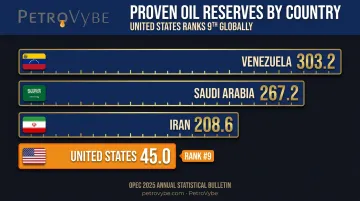
The US doesn't crack the top five in reserves. But it dominates in a different way: production and consumption. According to the U.S. Energy Information Administration, American producers pumped roughly 21.91 million barrels per day in 2023, and the country consumes more oil than any other nation on Earth.
Fact 5: Texas — The Heart of US Oil Refining
Texas isn't just a top producer of crude. It's the epicenter of US refining.
As of January 1, 2025, Texas hosted 35 petroleum refineries with a combined capacity of 6.3 million barrels per calendar day, according to the EIA's refining capacity data. That's about one-third of total US refining capacity running through a single state.
This refining capacity depends on a steady upstream supply chain, one where producers extract the crude and natural gas liquids that keep refineries running. PetroVybe, a natural gas and NGL developer, operates upstream projects in Lavaca County, part of the same South Texas and Gulf Coast Basin region that feeds this infrastructure.
Fact 6: The World's Largest Oil Fields
Zooming out from Texas to the global stage, Saudi Arabia's Ghawar field remains the largest conventional oil field ever discovered. According to Saudi Aramco's 2019 prospectus, Ghawar had a maximum sustained capacity of 3.8 million barrels per day and held 48.25 billion barrels of proved liquids reserves as of year-end 2018.
The field spans six main operating areas: Fazran, Ain Dar, Shedgum, Uthmaniyah, Hawiyah, and Haradh. No single discovery since has matched its scale.
From Crude Oil to Everyday Products
Crude oil's real value shows up after it leaves the ground. These next two facts show how one barrel becomes dozens of products you use daily.
Fact 7: One Barrel, Many Fuels
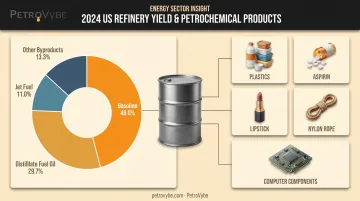
Refineries break crude oil into multiple products through distillation and processing, and in 2024, US refinery yields broke down roughly like this:
- Gasoline: 46.0%
- Distillate fuel oil (diesel/heating oil): 29.7%
- Jet fuel: 11.0%
- Petroleum coke, still gas, and other byproducts: remaining share
That means less than half of a typical barrel becomes the gasoline in your tank. The rest fuels planes, trucks, and industrial processes you never think about.
Fact 8: Petrochemicals Are Everywhere
Oil and natural gas together enable the manufacture of more than 6,000 everyday products, according to the US Department of Energy. That scale makes oil a foundational input for global manufacturing, not just a fuel source.
Items derived from petrochemicals include:
- Plastics and asphalt for packaging and construction
- Aspirin, antihistamines, bandages, and other medical supplies
- Lipstick, shampoo, and deodorant
- Nylon rope and polyester fabric
- Computer and phone components
Look around your house, and chances are oil touched nearly everything in the room.
Oil Through History and Its Environmental Impact
Oil's story stretches back thousands of years, long before anyone drilled a well. But modern extraction carries real environmental responsibility.
Fact 9: Ancient Civilizations Used Oil Thousands of Years Ago
Oil use predates recorded history. Archaeological evidence shows bitumen use in northern Iraq and southwestern Iran between 7000 and 6000 BC. In southern Mesopotamia, sites like Tell el 'Oueili show bitumen use as far back as 5800 BC.
Ancient Sumerians and Babylonians used this thick, tar-like substance for:
- Waterproofing boats and containers
- Sealing mortar in construction
- Coating roads
- Repairing ceramics and securing decorative elements
Oil has been valuable to humans for close to 9,000 years. Gasoline is a modern footnote in a much longer story.
Fact 10: Oil Spills Remain a Serious Environmental Concern
Spills remain the industry's most visible risk. According to ITOPF's 2025 tanker spill data, most large tanker spills historically resulted from collisions and groundings. In recent years, roughly one-third of recorded spills fall into an "other" category combining human error and extreme weather.
There's no single, universally agreed-upon percentage for human error across all spill types. What is clear: careless operations create outsized risk, while disciplined operators with rigorous safety protocols and third-party oversight consistently reduce it.
Fact 11: Oil's Growing Role in the AI-Driven Energy Era
Here's where oil's story takes an unexpected turn: the AI boom is really an electricity boom, and electricity increasingly runs on natural gas.
Data center electricity consumption is projected to more than double, from 415 TWh in 2024 to roughly 945 TWh by 2030, according to the International Energy Agency. To meet that demand, global natural gas generation is expected to rise by 175 TWh, with US natural gas generation alone adding more than 130 TWh annually.
This shift is already underway, opening doors previously reserved for institutions.
Accredited investors can now participate directly in early-stage natural gas development projects, rather than settling for shares of a public energy company. PetroVybe, a Texas-based natural gas developer operating in Lavaca County, structures exactly this kind of opportunity:
- Minimum investment: $100,000 in liquidity
- Tax advantage: 91–94% deduction against active income (W2 earnings and capital gains) in recent years, through Intangible Drilling Cost deductions
- Return targets: 10-year MOIC of roughly 2.2x to 5.8x, with an IRR near 26%
- Passive income: Monthly distributions projected to exceed $10,000 at peak production
- Structure: Equity partnership with K-1 tax reporting, backed by a $48 million third-party proved reserves valuation

PetroVybe's chief geophysicist, Michael Stamatedes, brings a 75.2% success rate on well location picks over a 48-year career, nearly double the industry average below 40%. That kind of track record matters when the entire investment thesis rests on picking the right ground to drill.
As AI keeps pulling more power off the grid, natural gas only grows more valuable as the fuel behind it.
Frequently Asked Questions
How many barrels of oil does the United States consume each day?
The US consumed roughly 20.4 million barrels per day in 2024, ranking first globally according to OPEC's Annual Statistical Bulletin. That's more than any other nation, including China.
What is crude oil primarily used for today?
Transportation fuel remains the largest use, including gasoline, diesel, and jet fuel. Petrochemical-based products, from plastics to pharmaceuticals, make up the rest.
Why is oil sometimes called "black gold"?
The nickname combines oil's dark color with its historical economic value. Merriam-Webster records this usage dating back to 1910.
Which U.S. state produces the most oil?
Texas leads by a wide margin, producing over 5.6 million barrels per day in 2024 and supplying more than two-fifths of total US crude output. It also holds roughly a third of national refining capacity.
Is oil a renewable resource?
No. Oil is non-renewable and finite. It forms over millions of years from buried marine organisms, a process far too slow to replenish what's extracted today.
How can everyday investors gain exposure to oil and natural gas development?
Options range from public energy stocks to private development projects. Accredited investors can also access direct opportunities like PetroVybe's tax-advantaged natural gas development projects in Texas.