That distinction has a name: wealth extraction versus wealth creation. Most people conflate the two, and that confusion leads to portfolios stuffed with assets that shuffle money around rather than generate it. This guide breaks down what wealth extraction actually means, how it differs from wealth creation, where it shows up in today's economy, and how to tell which side of the line your own investments sit on.
Key Takeaways
- Wealth extraction profits from controlling an existing asset (land, credit, patents) rather than producing anything new.
- The bottom 90% of U.S. workers missed out on $79 trillion in cumulative earnings from 1975-2023, per RAND research.
- Not all investment income is extractive: productive investments like energy development sit on the creation side.
- Spotting this distinction opens the door to tax-advantaged, asset-backed alternatives beyond speculative markets.
What Is Wealth Extraction?
Writer and researcher Andrew Sayer, cited frequently by George Monbiot, drew a sharp line between two types of investment. One finances "productive and socially useful activities." The other involves "the purchase of existing assets to milk them for rent, interest, dividends and capital gains." The second category is wealth extraction. Capital doesn't build anything new; it just captures a bigger slice of value that already exists.
This connects to a concept economists call unearned income: money that flows from owning or controlling a scarce resource, not from labor or productive risk-taking. It's not a new idea, either.
- David Ricardo analyzed how landlords captured rent simply from controlling fertile soil, regardless of effort.
- John Maynard Keynes predicted the "euthanasia of the rentier," describing passive capital owners as functionless investors.
- Henry George called private land rent "a fresh and continuous robbery" that repeats every single day, not a one-time transaction.
Ricardo, Keynes, and George worked in different eras, yet reached the same conclusion: mere ownership of something scarce can generate income without producing anything.
The Rentier Economy Explained
A rentier profits from ownership alone (land, patents, monopoly position, financial instruments) without directly creating new goods or services. Consider the classic housing example:
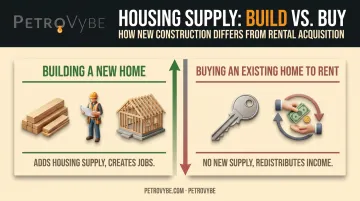
- Building a new home from raw materials and labor adds a physical asset to the economy. It creates construction jobs, uses real resources, and increases the total housing supply.
- Buying an existing home purely to rent it out doesn't add a single square foot of housing. The buyer just repositions themselves to collect a portion of someone else's income indefinitely.
Modern financial-sector data reflects how large this rentier layer has grown. According to BEA figures tracked through FRED, financial industries captured roughly 23% of total domestic corporate profits in 2025. That's a substantial share of the economy's returns flowing to entities that manage existing money rather than produce new goods.
Wealth Extraction vs. Wealth Creation: What's the Real Difference?
Wealth creation adds new value to the economy: new jobs, new products, new infrastructure. Wealth extraction redistributes value that already exists toward whoever owns the asset in question, without adding anything new to the pie.
| Dimension | Wealth Creation | Wealth Extraction |
|---|---|---|
| Source of return | New output, product, or service | Rent, interest, fees, price appreciation |
| Economic contribution | Adds jobs, goods, infrastructure | Redistributes existing value |
| Job/output impact | Direct and measurable | Often none |
| Risk profile | Development and execution risk | Market or ownership risk |
This isn't a fringe political idea. Adam Smith himself described rent as revenue "the owner...enjoys without any care or attention of his own," a line from The Wealth of Nations. Smith wrote those words more than two centuries before modern critics like George Monbiot or Andrew Sayer picked up the argument.
The line extends well beyond housing:
- Funding a startup or building infrastructure = creation. Capital finances something that didn't exist before.
- Speculating on land value or executing stock buybacks = extraction. No new output results; existing shares or land simply change hands at a higher price.
- Charging above-market rent without improving the property = extraction. The landlord's income rises while the tenant receives nothing new in return.
The distinction isn't always black-and-white. Stock market liquidity has genuine utility—it lets companies raise capital and lets investors exit positions. But for individual investors auditing their own portfolios, the question is worth asking directly: is my capital funding something new, or am I just collecting a toll on something that already exists?
Real-World Examples of Wealth Extraction Today
The Financial System
Predatory lending is one of the clearest examples of extraction hitting lower-income households hardest. The Consumer Financial Protection Bureau reports that a common payday loan fee structure ($15 per $100 borrowed over a two-week term) translates to an APR of almost 400%.
Add late fees, rollover charges, or renewal costs, and the effective burden climbs even higher for borrowers who can least afford it.
That's extraction in its purest form: a fee structure that transfers wealth from the financially vulnerable to the capital that controls access to short-term credit, without producing anything.
Corporate and Market Practices
Extraction isn't limited to storefront lenders. It shows up at the top of the corporate ladder too.
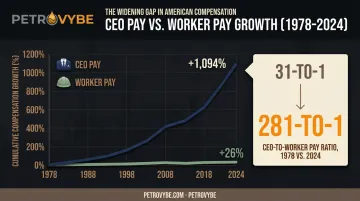
The Economic Policy Institute found that top CEO compensation rose 1,094% from 1978 to 2024, while typical worker compensation grew just 26% over the same period. The CEO-to-worker pay ratio went from 31-to-1 in 1978 to 281-to-1 in 2024.
Other extraction-adjacent corporate practices include:
- Stock buybacks that reward existing shareholders without expanding production capacity
- Monopoly rent-seeking, where market power lets firms charge above-competitive prices
- Executive pay structures disconnected from productivity or output growth
None of these practices are illegal. But none of them create a new product, job, or service either. They redistribute value already sitting in the company toward whoever holds the equity or the corner office.
Why This Distinction Matters for Your Investment Strategy
Here's the uncomfortable part: most retail investors hold portfolios weighted almost entirely toward extraction. Index funds track corporate profits that increasingly lean rentier. REITs collect rent on buildings someone else constructed years ago. Speculative trading captures price swings with zero tie to actual output.
None of that is inherently wrong. But it matters what you actually own.
The alternative sits on the creation side of the ledger: direct investment in tangible, production-based assets. Natural gas development is a straightforward example. Capital funds the drilling, the wells, and the infrastructure that pulls a real commodity out of the ground, one increasingly feeding AI-driven electricity demand as data centers expand across the country.
This is the model PetroVybe operates under. Rather than trading a financial instrument tied to an existing asset, PetroVybe investors fund three specific stages of value creation:
- Drilling: new well development in Lavaca County, Texas, where geological data identifies fresh natural gas targets
- Production: optimizing and reworking legacy assets to sustain and improve existing output
- Infrastructure: reinvesting operating cash flow to scale the physical systems that move gas to market
That's a different starting point than buying shares of a pipeline company or an energy ETF, both of which represent claims on assets that already peaked in their development curve.
There's a tax dimension too. Federal law (IRC 263(c)) allows operators to elect current-year expense treatment for Intangible Drilling Costs (IDCs), a benefit tied directly to funding active drilling, not passive speculation.
PetroVybe's 2024 and 2025 partners received 91% and 94% deductions against active income, respectively, including W-2 earnings and capital gains, something traditional real estate deductions generally can't touch due to passive-loss restrictions.
Beyond the tax treatment, transparency separates a real production model from a sales pitch. Look for:
- Independent, third-party engineering review of reserves
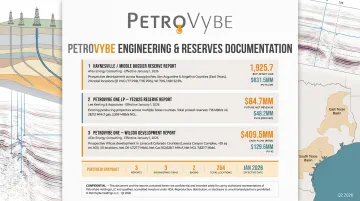
- Verified proved-reserves valuations (PetroVybe's stands at $48 million, PV-09, third-party engineered)
- A track record you can actually check, not just marketing claims
PetroVybe's Chief Geophysicist has a 75.2% career hit rate on well selection over 48 years, against an industry average below 40%. That's the kind of specific, checkable data point that separates a real production track record from a sales pitch.
How to Build Wealth Through Creation, Not Extraction
Shifting toward creation-side investing starts with an honest audit, not a wholesale portfolio overhaul.
- Audit your current holdings. Estimate what percentage sits in purely extractive vehicles (speculative trading, rental arbitrage with no development component) versus productive, asset-backed positions.
- Prioritize measurable output. Energy production, infrastructure, and manufacturing all generate verifiable results. Look for third-party performance data, not just projected returns on a slide deck.
- Diversify beyond stocks, bonds, and residential real estate. Tangible asset classes like natural gas development combine passive income, tax efficiency, and long-term compounding in ways traditional portfolios often miss.
For accredited investors specifically, direct natural gas partnerships like PetroVybe ONE illustrate this shift in practice:
- $100,000 minimum investment per partnership unit
- 10-year hold period with monthly passive distributions
- Distributions projected to peak above $10,000/month during full production
- Active-income tax deduction most passive investments simply can't offer
None of this guarantees returns. Oil and gas development carries real commodity-price and execution risk. But the mechanism is different from clipping coupons on an asset someone else already built.
Frequently Asked Questions
What is the difference between wealth creation and wealth extraction?
Wealth creation generates new value, jobs, or output in the economy. Wealth extraction transfers existing value to asset owners through rent, interest, or speculation without producing anything new.
What are some real-world examples of wealth extraction?
Predatory lending with near-400% effective APRs, rent-seeking on existing property, and stock buybacks that reward shareholders without expanding production are all common examples.
Is buying stocks considered wealth extraction or wealth creation?
It depends on context. Buying newly issued shares that fund business growth leans toward creation, while pure secondary-market speculation on existing shares leans toward extraction.
How does wealth extraction affect the broader economy?
Sustained extraction widens wealth inequality and reduces middle-class purchasing power over time. According to a 2020 RAND Corporation study, this cost the bottom 90% of workers trillions in foregone income since 1975.
What is a "rentier" in economic terms?
A rentier earns ongoing income from owning an existing asset (land, capital, intellectual property) rather than from active production or labor. Keynes called this the "functionless investor."
How can investors identify wealth-creating investment opportunities?
Look for asset-backed, production-based opportunities with third-party verified performance and a direct tie to real economic output, such as energy development projects with independent reserve reports.