

Millennials and Gen Z, now the largest population cohort in the country, hold barely a tenth of that fortune. Meanwhile, Baby Boomers, roughly a fifth of the population, sit on more than half of all household wealth. If you're a younger American wondering why building wealth feels harder than it did for your parents, the numbers back you up.
This article breaks down exactly how wealth splits across generations, why the gap has widened over three decades, and what you can actually do about it today, including tax-advantaged alternative investments most people never consider.
Key Takeaways
- Baby Boomers hold ~$83.3 trillion (51%) of household wealth, despite being just a fifth of the U.S. population.
- Generation X controls $42.6 trillion (26.1%), more than the Silent Generation, Millennials, and Gen Z combined.
- Millennials and Gen Z together hold just $17.1 trillion (10.5%) despite being the largest generation by headcount.
- Wealth has shifted toward retirement-age Americans since 1990, reversing the pattern of working-age households holding most national assets.
America's Wealth Distribution by Generation in 2025
The Federal Reserve's Distributional Financial Accounts quantify the generational wealth gap in stark terms.
| Generation | Birth Years | Net Worth | Share of Total |
|---|---|---|---|
| Silent Generation | Before 1946 | $20.1T | 12.3% |
| Baby Boomers | 1946-1964 | $83.3T | 51.0% |
| Generation X | 1965-1980 | $42.6T | 26.1% |
| Millennials & Gen Z | 1981+ | $17.1T | 10.5% |
Total U.S. household wealth: $163.1 trillion, per the UBS Global Wealth Report 2025.
What Boomer Wealth Actually Looks Like
Boomer wealth skews heavily toward two asset classes:
- Financial assets (stocks, retirement accounts, cash): roughly 29% of holdings
- Real estate net of mortgage debt: about 23% of holdings
The youngest Boomers are just now turning 60-61. That means the entire generation is either at or approaching peak wealth, right as they exit the workforce and start drawing down assets rather than building them.
Generation X, now ages 45-60, holds about half of Boomer wealth. That's not just an age gap. Gen X entered their prime earning years right around the dot-com bust, then got hit again in 2008. Boomers, by contrast, watched markets roughly quadruple during their own prime-earning 30s.
Millennials and Gen Z show a different pattern entirely: private business assets make up a notably larger share (~10.8%) of their wealth than for older generations. It's a more entrepreneurial path to building net worth, even if the overall pie is smaller.
Wealth Distribution by Age (Not Just Generation)
Slicing the data by age instead of birth year tells the same story from a different angle:
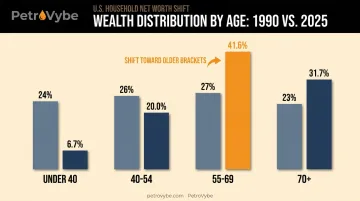
- Under 40: 6.7% of total wealth
- 40-54: 20.0%
- 55-69: 41.6%
- 70+: 31.7%
Compare that to 1990, when wealth was distributed far more evenly across working-age households between 40 and 69. The curve has shifted decisively older. Retirement-age Americans now hold a majority of assets that used to be spread across a broader swath of the workforce.
Why the Wealth Gap Is Widening Between Generations
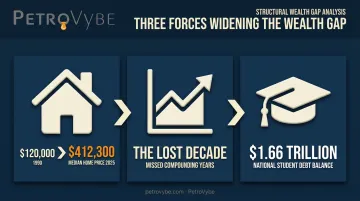
Age alone doesn't explain the gap. Three structural forces do most of the work.
Housing and Real Estate Appreciation
Boomers and older Gen Xers bought homes when price-to-income ratios were dramatically lower. Median new-home prices climbed from $120,000 in 1990 to $412,300 in 2025, a 243.6% nominal increase, according to Federal Reserve data. Median household income over that same period rose from $29,943 to $83,730, a 179.6% increase.
That gap, more than 60 percentage points, means younger buyers today are locked out of the early equity gains that fueled Boomer net worth for decades.
Retirement Accounts and Market Timing
Timing matters enormously with compounding. Boomers spent their 401(k) and IRA-building years riding a historic bull market and the post-2008 recovery. Millennials, by contrast, entered the workforce during the dot-com bust or the Great Recession, missing critical early investing years.
The 2000s were even nicknamed the "lost decade" on Wall Street, with the S&P 500 losing 1.4% after inflation over the full ten years. Missing that first decade of compounding is nearly impossible to make up later.
Student Debt and Wage Stagnation
Add student debt to the mix. Nationwide balances hit $1.66 trillion by late 2025. Public four-year in-state tuition, adjusted for inflation, rose 101% since the mid-1990s alone. Wages haven't kept pace with either tuition or asset prices, leaving younger workers with less capital to invest at exactly the moment compounding matters most.
Here's the twist: the "richest generation" label hides real inequality within it. The wealthiest 10% of Boomer households hold roughly 71% of all Boomer wealth, according to Pew Research Center analysis. Most Boomers aren't nearly as wealthy as the generational average suggests.
The Great Wealth Transfer: What Trillions Moving Hands Means for You
Over the next two decades, an estimated $84.4 trillion will change hands in the largest intergenerational wealth transfer in American history, according to Cerulli Associates. Of that, $72.6 trillion goes to heirs and $11.9 trillion to charitable causes.
As the wealthiest generation, Baby Boomers alone are projected to transfer more than $53 trillion, or 63% of the total.
Here's the part that surprises people: this transfer won't close the generational wealth gap. Instead, it tends to reinforce existing disparities:
- Families with existing wealth pass more to children who are already financially established
- More than half of all intergenerational transfers flow to households already in the top 10% of wealth distribution
- Inheritance widens gaps within a generation more than it narrows the gap between generations
If you're on the receiving end of this transfer, one tax detail is worth knowing: assets like real estate and securities typically receive a stepped-up cost basis. Their taxable basis resets to fair market value on the date of death, which can reduce capital gains exposure if you sell or reposition inherited assets later.
Reinvesting that reset value into tax-advantaged assets, such as direct energy partnerships, can preserve more of the inheritance.
Where Do You Stand? Net Worth Benchmarks for Generational Wealth
There's no single number that defines "generational wealth." Most researchers describe it as enough assets to support your household indefinitely while passing something meaningful to heirs. That range often starts in the multi-millions, depending on lifestyle and family size.
If you're wondering where the top brackets sit, the numbers get more concrete:
- Top 2% net worth threshold: approximately $8.46 million
- Top 1% net worth threshold: approximately $13.67 million
These figures come from Federal Reserve Survey of Consumer Finances data and shift with market performance, so treat them as a snapshot rather than a permanent line. These thresholds far exceed the SEC's $1 million accredited-investor bar that firms like PetroVybe require.
Beyond those percentile marks, education level shapes where households land, and the difference within Boomers is stark:
- Bachelor's degree or higher: median net worth of $1,077,200
- Some college: $330,500
- High school graduate: $239,800
- Less than high school: $77,200
That's more than a 13x gap between the top and bottom education tiers, within a single generation.
How to Build Wealth Outside the Traditional Playbook
The old playbook worked well for Boomers: buy a home in your 20s, max out a 401(k), and ride the market for 40 years. It's a much harder path today given housing costs, market timing, and student debt. Building wealth now requires a different toolkit, one built around tax efficiency and assets outside the standard stock-bond-house trio.
More investors are turning to private, income-generating alternative assets: private business stakes, real assets, and natural resource development. One category gaining real attention is oil and natural gas development, partly because it offers meaningful tax efficiency, and partly because of a demand story tied directly to the AI boom.
Data centers need electricity, and natural gas already supplies nearly half of U.S. electricity generation. That demand isn't slowing down.
This is where a company like PetroVybe fits into the conversation. PetroVybe is a private, Texas-based natural gas development company operating in South Texas and the Gulf Coast Basin. It gives accredited investors direct access to early-stage gas development projects rather than a stake in a publicly traded fund.
A few specifics worth knowing:
- Intangible drilling cost (IDC) deductions can offset active income, including W-2 earnings and capital gains, not just passive income. That's a meaningful distinction from real estate deductions.
- Partners have seen deductions as high as 91-94% against active income in recent years.
- Projects target a 10-year MOIC of roughly 2.2x to 5.8x, with an estimated 26% IRR.
- Minimum investment is $100,000, restricted to accredited investors under SEC rules.

None of this is a substitute for market timing or waiting on an inheritance that may never fully materialize. But it's a concrete example of the kind of tax-aware, asset-based strategy that's replacing the traditional wealth-building playbook for people across every generation.
Closing the generational wealth gap comes down to intentional decisions about where your capital goes today, not just waiting on the Great Wealth Transfer.
Frequently Asked Questions
At what net worth do you have generational wealth?
There's no universal figure. Generational wealth is generally achieved when assets can support your household indefinitely while still passing meaningfully to heirs — often in the multi-million-dollar range depending on lifestyle and family size.
What net worth puts you in the top 1% or top 2%?
Based on the Federal Reserve Survey of Consumer Finances, the top 2% threshold sits around $8.46 million and the top 1% threshold sits around $13.67 million. Both figures shift as markets move and new data is released.
Which generation holds the most wealth in America?
Baby Boomers hold the largest share of U.S. household wealth, roughly 51%, despite representing only about a fifth of the population. Generation X ranks second at 26.1%.
Will Millennials ever catch up to Boomers in wealth?
The Great Wealth Transfer will move significant assets to younger generations over the coming decades. But structural factors like housing costs and student debt mean closing the gap will require alternative, tax-advantaged strategies rather than time alone.
How is inherited wealth from the Great Wealth Transfer taxed?
Inherited assets like real estate and securities typically get a stepped-up cost basis, resetting the taxable gain to the asset's value on the date of death. This reduces capital gains tax exposure when heirs eventually sell.
What counts as "wealth" in these generational statistics?
These figures represent net worth: the market value of assets like real estate, retirement accounts, securities, and private business interests, minus liabilities such as mortgages and consumer debt.