

The top marginal income tax rate sits near 37%. Yet many billionaires and profitable corporations pay far less, sometimes nothing at all. Confusion around words like "dodge," "avoid," and "evade" only muddies the picture further.
This article breaks down what's legal, what's illegal, and where the line gets blurry. It also covers a specific tax-advantaged strategy, oil and gas development investment, that isn't reserved for billionaires. Accredited investors can access it too.
Key Takeaways
- Tax avoidance is legal; tax evasion is a felony, separated by intent and disclosure
- The wealthy layer capital gains arbitrage, asset-backed loans, trusts, and specialized deductions
- Just 1,015 of 878,715 million-dollar earners paid zero U.S. income tax, per IRS data
- Intangible Drilling Cost deductions, a rare tax-code exception, are open to accredited investors
What Does It Mean to "Dodge" Taxes? Avoidance vs. Evasion
"Tax dodging" isn't a legal term. It's a catch-all phrase people use for anything from claiming a mortgage deduction to hiding money in an offshore account. The Tax Policy Center treats it as colloquial shorthand, not a defined category. The real distinction lives in two separate concepts: evasion and avoidance.
Tax Evasion Is a Federal Crime
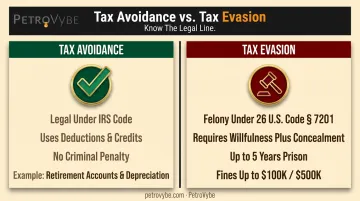
Under 26 U.S. Code § 7201, tax evasion means willfully attempting to evade or defeat a tax you legally owe. It's a felony requiring three elements: willfulness, an actual tax deficiency, and an affirmative act meant to conceal or mislead.
The penalties are steep:
- Up to 5 years in prison
- Fines up to $100,000 for individuals or $500,000 for corporations
- Prosecution costs on top of restitution
Paul Manafort, former campaign chairman for Donald Trump, was convicted in 2018 on tax and bank fraud charges tied to hiding foreign income. He was sentenced to 47 months in prison. That's what evasion actually looks like: concealment, false statements, and a deliberate attempt to hide taxable income from the IRS.
Tax Avoidance Is Built Into the Code
Avoidance is different entirely. The IRS itself states that "avoidance of tax is not a criminal offense." Congress writes deductions and credits into the tax code on purpose, to encourage retirement savings, homeownership, charitable giving, and energy development. Using them isn't dodging anything. It's following the rules as written.
The gray area shows up when strategies are technically legal but designed with no purpose other than minimizing tax. Aggressive tax shelters can draw IRS scrutiny even without crossing into criminal territory. Later sections break down exactly where those legal guardrails sit.
The Wealthy's Playbook: Top Legal Strategies to Reduce Taxes
Once you separate evasion from avoidance, the wealthy's actual playbook becomes easier to understand. None of it is secret. Most of it just requires assets, patience, and good advisors.
Buy, Borrow, Die is the foundation. Wealthy individuals buy appreciating assets like stock or real estate and then borrow against that value instead of selling. Since loan proceeds are not taxable income, they can access cash without triggering capital gains.
When the asset owner passes away, 26 U.S. Code § 1014 provides a "stepped-up basis," resetting the asset's cost basis to its fair market value. This crucial step can make decades of appreciation disappear from a tax perspective.
Capital gains arbitrage works alongside this. Founders and executives often take compensation in stock rather than salary. Long-term capital gains max out around 20%, compared to a 37% top rate on wages. That's roughly half the tax bill on the same dollar of value.
Other tools in the playbook include:
- Trusts like GRATs (grantor retained annuity trusts), which let asset appreciation pass to heirs with minimal gift and estate tax. According to ProPublica research, more than half of the 100 wealthiest Americans have used these structures.
- Offshoring, mostly limited to ultra-high-net-worth individuals and corporations, and now under heavy IRS scrutiny through FATCA and FBAR reporting requirements
- Charitable giving and private foundations, which offset taxable income while funding causes, one of the more publicly accepted forms of avoidance
Most of these strategies require significant existing wealth or complex legal structuring to execute well. But one of the most powerful deductions in the entire tax code doesn't require any of that. It's available to any accredited investor, and it starts with drilling a well.
The Oil & Gas Tax Advantage: A Strategy Even Many Wealthy Investors Overlook
Intangible Drilling Costs (IDCs) are a provision that's been part of the tax code since 1913. Investors in oil and natural gas development can deduct a large share of their investment, the portion tied to labor, drilling services, fracing, and site preparation, against active income in the very first year.
That last part matters more than it might seem.
Why This Deduction Is Different
Most passive losses, including real estate, are restricted under 26 U.S. Code § 469 to offsetting only passive income. If you lose money on a rental property, you generally can't use that loss to reduce your W-2 salary.
Oil and gas working interests are a specific exception written into Section 469(c)(3): they're not classified as passive activity at all, so the usual limitation doesn't apply.
That means a qualifying IDC deduction can offset:
- W-2 wages
- Capital gains
- Other active business income
This is precisely the gap PetroVybe, a Texas-based natural gas development company, was built to fill. PetroVybe gives accredited investors direct partnership access to development projects across South Texas's Gulf Coast Basin, structured specifically around this deduction.
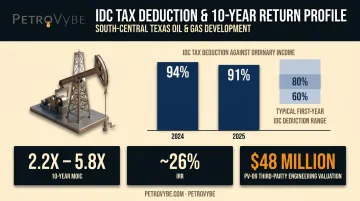
The real-world numbers back it up. PetroVybe partners achieved a 94% total tax deduction against ordinary income in 2024, holding at 91% in 2025. First-year IDC deductions typically fall in the 60-80% range on invested capital, with combined deductions (IDCs plus depreciation and depletion) pushing totals higher over time.
Beyond the tax offset, investors get exposure to a tangible, producing asset. PetroVybe targets a 10-year MOIC of roughly 2.2x to 5.8x and an IRR near 26%, backed by a $48 million third-party engineering valuation (PV-09) of proved reserves.
One caution worth repeating: legitimate oil and gas tax strategies require third-party engineering validation and a licensed operator. PetroVybe operates under an operator's license from the Texas Railroad Commission through its PetroVybe OpCo LLC entity. That kind of documentation is what separates a defensible deduction from an abusive shelter the IRS would eventually unwind.
How Widespread Is Tax Avoidance in America?
The billionaire numbers get headlines, but they're not the whole picture. Corporations tell a similar story.
According to a GAO report on corporate effective tax rates, roughly half of all large U.S. corporations paid no federal income tax in each year studied between 2014 and 2018. Among corporations that were actually profitable, an average of 25% still owed nothing.
Individual taxpayers show a smaller but still notable pattern. IRS Statistics of Income data for the most recent reporting year found:
- 1,015 of 878,715 returns with expanded income above $1 million reported no U.S. income tax
- Using adjusted gross income instead, the number narrows to 101 of 851,031 returns
- These different denominators reflect distinct income definitions, not a shift in taxpayer behavior
Together, these figures confirm the same underlying reality: zero or near-zero federal tax bills among high earners and profitable companies aren't rare anomalies. They're a predictable outcome of how the current code rewards asset ownership over wage income.
Is Tax Avoidance Legal, Ethical, and Sustainable?
Legal doesn't mean unlimited. The IRS has real tools to shut down avoidance that goes too far.
The economic substance doctrine, codified at 26 U.S. Code § 7701(o), requires a transaction to do two things: meaningfully change the taxpayer's economic position beyond the tax benefit, and serve a substantial nontax purpose. Fail either test, and the IRS can disallow the benefit entirely, plus apply a 20% penalty (40% if undisclosed).
There's also a reputational dimension that pure legality doesn't address. Companies and individuals known for aggressive offshore structures often face public backlash even when auditors clear them completely. Legal and popular aren't the same thing.
The practical takeaway: strategies anchored in real assets, third-party validation, and long-standing statutory provisions hold up far better than aggressive loophole engineering. An IDC deduction tied to a physically drilled well with independent reserve reports is a fundamentally different animal than an offshore shell with no operating business behind it. One survives an audit. The other often doesn't.
Frequently Asked Questions
What does it mean to dodge taxes?
"Dodging" is a colloquial term, not a legal one. It covers both legal tax avoidance, using deductions and credits within the law, and illegal tax evasion, willfully hiding income or falsifying records. The key difference is legality and intent.
How many people dodge taxes?
GAO data shows about half of large corporations paid no federal income tax between 2014 and 2018. IRS records show 1,015 of 878,715 million-dollar-plus returns reported zero U.S. income tax in the most recent year studied. Most of this reflects legal avoidance, not evasion.
What's the difference between tax avoidance and tax evasion?
Avoidance is the legal use of tax code provisions to reduce what you owe. Evasion is the willful, illegal failure to report income or pay taxes owed, and it's a felony under 26 U.S. Code § 7201.
What is the "buy, borrow, die" strategy?
Wealthy individuals hold appreciating assets and borrow against them instead of selling, avoiding capital gains tax on the loan proceeds. At death, heirs receive those assets with a stepped-up basis, erasing the built-up gains for tax purposes.
Can tax avoidance ever become illegal?
Yes. Aggressive avoidance can cross into evasion, or trigger the economic substance doctrine, if the IRS determines a transaction's sole purpose was reducing tax with no legitimate business rationale behind it.
Are oil and gas tax deductions only available to the ultra-wealthy?
No. IDC deductions are available to any accredited investor meeting SEC income or net worth thresholds, not just billionaires. That makes it one of the more accessible strategies covered in this article, provided investors work with a licensed operator and verified reserves.