Yet the term gets used as if these are all cut from the same cloth. They're not. A public pension fund and a sovereign wealth fund might sit in the same AUM ranking, but they operate under entirely different rules.
The scale here is hard to overstate. The world's 100 largest asset owners held $29.3 trillion at year-end 2024, up 11.3% in a single year, according to the Thinking Ahead Institute's 2025 Asset Owner 100 report. That's more capital than the GDP of every country on Earth combined except one.
This article breaks down the seven types of asset owners, explains how they differ from asset managers, and shows what individual accredited investors can borrow from institutional playbooks.
Key Takeaways
- Asset owners bear fiduciary duty over capital for beneficiaries; asset managers execute within a mandate
- Seven types: pensions, insurers, sovereign funds, OCIOs, single-family offices, multi-family offices, and endowments/foundations
- Pensions and sovereign wealth funds together dominate global asset owner AUM
- Liability structure, not size alone, drives each type's risk tolerance and liquidity needs
- Direct access to real assets, once institution-only, now reaches accredited individual investors
What Is an Asset Owner?
An asset owner is an entity that holds capital on behalf of a defined group of beneficiaries and carries fiduciary responsibility for how that capital is managed. That responsibility is the defining trait — it's what separates an asset owner from everyone else in the investment chain.
Asset owners set the objectives, constraints, and governance rules for their capital. From there, they either invest directly through internal investment teams or delegate day-to-day execution to external asset managers.
Fiduciary duty stays with the owner. Even when a pension fund hires a dozen outside managers to run different sleeves of its portfolio, the fund's board, not the managers, remains legally accountable to beneficiaries for outcomes.
A Few Concrete Examples
To make this less abstract, here's what an asset owner looks like in practice:
- Public pension: California Public Employees' Retirement System (CalPERS)
- National pension: Japan's Government Pension Investment Fund
- Sovereign wealth fund: Norway's Government Pension Fund Global
- University endowment: Harvard, which reported $56.9 billion in endowment net assets as of its FY2025 financial report
Each of these institutions sits somewhere within that $29.3 trillion figure cited above. Different missions, same underlying job: steward capital for people who aren't managing it themselves.
Asset Owners vs. Asset Managers: Why the Distinction Matters
The relationship between owner and manager is a principal-agent one. The owner sets the mandate. The manager executes it. Authority and accountability flow one direction — from owner to manager, not back.
This isn't a technicality. It explains a lot of behavior that otherwise looks confusing from the outside.
Asset owners are evaluated on governance and long-term obligations. A pension fund's success is measured decades out, against whether it can pay retirees what it promised. Asset managers, in contrast, are evaluated on benchmark performance, often on a quarterly or annual cycle.
That mismatch in evaluation timelines creates real friction:
- Owners can tolerate short-term volatility if it serves a 20-year funding goal
- Managers are under constant pressure to avoid underperforming a benchmark this quarter
- Liability for a failed strategy falls on the owner; managers mostly risk reputational damage
This distinction explains why institutional portfolios look the way they do, and why the biggest allocation decisions almost always originate with the owner, not whichever manager happens to be running a particular sleeve.
The Seven Kinds of Asset Owner Institutions
Asset owners aren't interchangeable. The seven categories below are typically ranked by AUM, and each reflects a different funding source, liability profile, and time horizon.
| Type | Approximate Scale | Defining Trait |
|---|---|---|
| Pensions | $68.3T (P22 markets) | Liability-driven, conservative |
| Insurance general accounts | $8.98T (U.S. only) | Duration-matched to policy liabilities |
| Sovereign wealth funds | $15.1T (global) | No fixed liabilities, long horizon |
| OCIOs | $3.3T+ (U.S.) | Delegated, discretionary authority |
| Single family offices | $3.1T (global, ~8,030 offices) | Full privacy, single-family focus |
| Endowments & foundations | $944.3B (U.S. colleges alone) | Perpetual, no defined payout stream |
| Multi-family offices | $5.2T+ (global, ~1,632 offices) | Shared infrastructure, multiple families |
Pensions
Pensions are the largest asset owner category by a wide margin. Pension assets across the 22 major P22 markets reached $68.3 trillion at year-end 2025, a 9.6% one-year jump, per the Thinking Ahead Institute's 2026 Global Pension Assets Study.
Four subtypes exist under this umbrella:
- National plans: Korea's National Pension Service
- Corporate plans: IBM's pension fund
- Public plans: CalPERS
- Union/Taft-Hartley plans: Central States Pension Fund, a multiemployer plan collectively bargained under labor agreements
What unites all four: liability-driven investing. Pensions know roughly what they owe retirees and when. That certainty pushes most toward conservative, duration-matched portfolios built to fund a known payout schedule.
Insurance Company General Accounts
A general account is the pool an insurer invests from policyholder premiums to grow earnings and fund future claims. U.S. insurers held $8.98 trillion in cash and invested assets at year-end 2024, according to NAIC data.
Three subtypes split that pool differently:
- Life insurers ($5.75T, 64% of the total), such as Northwestern Mutual, hold long-duration bonds and mortgages to match decades-long policy liabilities
- Property & casualty insurers ($2.86T), such as State Farm, need more liquidity for unpredictable, "lumpy" claim payouts (hurricanes, wildfires)
- Health insurers ($359.1B), such as UnitedHealth Group, hold shorter-duration, more liquid assets

The distinguishing trait: portfolio structure follows liability duration. Life insurers can afford illiquid, long-dated assets. P&C insurers can't.
Sovereign Wealth Funds
Sovereign wealth funds (SWFs) are state-owned investment vehicles funded by trade surpluses, budget surpluses, or natural resource revenue. They exist for intergenerational savings, economic stabilization, or national development goals.
As of April 2026, 109 active SWFs held a combined $15.1 trillion, up 14% over 18 months, according to a 2026 sovereign wealth fund report. The largest funds include:
- Norway Government Pension Fund Global ($2.1T)
- China's SAFE ($1.99T)
- China Investment Corporation ($1.57T)
- Abu Dhabi Investment Authority ($1.19T)
Here's the key difference: SWFs generally aren't liability-driven. Without a fixed payout obligation, they can take extremely long time horizons and unconventional allocations that liability-bound pensions simply can't match.
Investment Consultant OCIOs
An Outsourced CIO (OCIO) is a consulting firm given discretionary authority to manage all or part of an asset owner's portfolio, not just advise on it. U.S. OCIO assets exceeded $3.3 trillion at year-end 2024.
The distinguishing trait cuts both ways. OCIOs give smaller institutions access to investment expertise they'd otherwise lack in-house. But handing over discretionary authority reduces the independent checks and balances that segregated advisory-only consulting provides: the consultant and the executor become the same party.
Single Family Offices
A single family office (SFO) centralizes investment, tax, trust, and philanthropic management for one ultra-wealthy family. Deloitte estimates 8,030 SFOs globally, holding roughly $3.1 trillion in combined AUM as of 2024.
What sets SFOs apart: complete privacy and control, at a price. Running a dedicated SFO typically requires enough wealth to absorb high fixed operating costs, which is why this structure stays limited to the wealthiest families rather than becoming mainstream.
Endowments and Foundations
Endowments and foundations are large, typically perpetual pools of capital supporting universities or charitable missions. NACUBO's FY2025 data shows 657 participating U.S. institutions held $944.3 billion and spent $33.4 billion during the year.
What makes endowments unique: the longest time horizon of any asset owner category, with no defined liability stream to match. That freedom gave rise to the alternatives-heavy "Endowment Model" pioneered decades ago. Typical annual payout rates land around 4.9% of AUM, close to the traditional 4-5% range institutions target to balance current spending against perpetual growth.
Multi-Family Offices
A multi-family office (MFO) delivers family-office-style services to several wealthy families instead of one, usually requiring tens of millions in investable assets to join. Globally, 1,632 tracked MFOs manage more than $5.2 trillion, as of December 2025.
The key difference here: shared infrastructure. Families split the cost of investment staff, tax planning, and reporting systems that would be prohibitively expensive to build alone, trading some of the SFO's exclusivity for meaningful cost efficiency.
How Asset Owner Types Differ: Time Horizon, Risk, and Liquidity
Time horizon is the variable that explains almost everything else. Perpetual investors (endowments, foundations, sovereign wealth funds) answer to no fixed payout schedule. Liability-matched investors (pensions, insurers) answer to one every year.
Liability predictability drives risk tolerance directly. A property and casualty insurer might need to pay out billions after a single hurricane season, so its portfolio stays liquid and short-duration.
An endowment funding scholarships fifty years from now has no such constraint. It can lock up capital in illiquid alternatives for a decade without blinking.
That flexibility explains a trend cutting across nearly every asset owner type: growing allocations to private markets and real assets. Institutional allocation to alternatives reached 20% in 2023, up from 18.4% in 2019, according to Preqin's Institutional Allocation Study. Among the largest global asset owners, alternatives now make up 28.4% of total holdings, with private equity the dominant category across most regions.
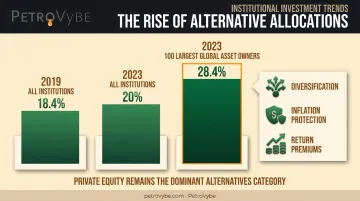
Why the shift? Three reasons keep showing up across institutional research:
- Diversification away from public market correlation
- Inflation protection through real, tangible assets
- Return premiums available in less efficient private markets
These preferences play out differently across institution types. Endowments and public pensions lean toward private equity within that alternatives bucket. Private-sector pensions tilt more toward real estate. The common thread: everyone's chasing the same diversification benefits, just through slightly different doors.
What Individual Accredited Investors Can Learn From Institutional Asset Owners
For decades, direct allocation to real, tangible assets was an institutional privilege. Pensions, endowments, and sovereign wealth funds could write large checks directly into private energy, infrastructure, and real estate deals that individual investors simply couldn't access.
That's changing. Private placements now let accredited individuals step into the same asset categories institutions have relied on for diversification and inflation protection.
The principles institutions prioritize translate directly:
- Tax efficiency: reducing the drag of ordinary income taxes
- Inflation-hedged tangible growth: assets tied to real production, not just financial engineering
- Long time horizons: patience that compounds rather than chases quarterly performance
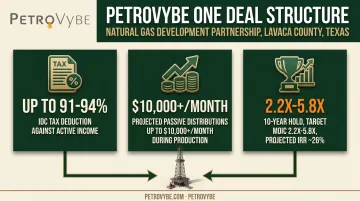
PetroVybe, a private Texas natural gas development company, is one example of this shift playing out in direct energy investment. Through its PetroVybe ONE project in Lavaca County, accredited investors get direct equity in early-stage natural gas development, the same kind of ground-floor asset access institutions have used for years. The project is positioned around growing electricity demand tied to AI data center expansion.
The structure mirrors institutional priorities closely:
- Upfront tax deductions through Intangible Drilling Costs, which can offset active income including W-2 earnings, not just passive income
- Projected passive monthly distributions during the production phase
- A defined 10-year hold with target MOIC of roughly 2.2x-5.8x and projected IRR near 26%
Individual investors evaluating alternatives like this should apply the same diligence institutions use before committing capital:
- Check governance transparency: how decisions get made and reported
- Look for independent third-party validation — such as a licensed engineering firm's reserves valuation
- Verify operating track record — not just projections, but demonstrated results from the team involved
Institutions verify governance, engineering data, and track record before committing capital. Individual investors evaluating PetroVybe or similar opportunities should demand the same evidence.
Frequently Asked Questions
What is an asset owner?
An asset owner is an entity that holds capital on behalf of beneficiaries and carries fiduciary responsibility for how it's invested. Pensions, endowments, and sovereign wealth funds are common examples.
What is the difference between asset managers and asset owners?
Asset owners hold capital and bear fiduciary duty to beneficiaries. Asset managers are hired to invest that capital within the objectives and constraints the owner sets.
What is an example of an asset owner?
Examples span public pensions like CalPERS, sovereign wealth funds like Norway's GPFG, university endowments like Harvard's, and family offices managing private wealth for ultra-high-net-worth families.
Which type of asset owner controls the most assets globally?
Pension funds and sovereign wealth funds hold the largest combined share of global asset owner AUM. According to the Thinking Ahead Institute's 2025 ranking of the 100 largest asset owners, pensions represented 49.0% and SWFs 40.8% of total assets.
Can individual investors access the same asset classes as institutional asset owners?
Yes. Private placements increasingly let accredited individuals access real assets, such as direct natural gas development, that were once reserved almost exclusively for institutions.
Are sovereign wealth funds and pension funds the same thing?
No. Both are large asset owners, but pensions are funded by retirement contributions with defined payout obligations, while SWFs are funded by state surpluses or resource revenue with no fixed liability stream.