The trouble is, even a fundamentally strong company can suffer a sudden, unexpected loss. Schwab's 2020 survey of 1,000 equity compensation participants found that employer equity represented an average of 32% of total net worth among respondents, and 43% among Millennials specifically.
That's a lot riding on one company's fortunes. This article breaks down what concentration risk actually is, how it's measured, and six practical strategies, including a lesser-known one involving alternative real assets, to help you manage it.
Key Takeaways
- Concentration risk ties returns to one stock, sector, or asset class.
- Even star holdings can crash, devastating underdiversified portfolios.
- Six proven strategies reduce exposure without one drastic decision.
- Your ideal mix depends on tax bracket, liquidity, and goals, so seek professional guidance.
What Is Asset Concentration Risk?
Concentration risk occurs when a single security, sector, or asset class makes up an outsized share of your total portfolio value. When that happens, your financial outcome becomes overly dependent on one variable instead of being spread across many.
FINRA describes it plainly: concentration risk amplifies loss potential when a large share of your holdings sits in one investment, asset class, or market segment. It can build up intentionally, through appreciation, or through hidden correlation.
Common Causes of Concentration
- Employer stock compensation — RSUs, stock options, and ESPP shares accumulating over a career
- Inherited legacy positions — shares held for sentimental or tax reasons, sometimes for decades
- Dramatic appreciation — a position that started small but grew to dominate the portfolio
- Hidden correlation — owning an individual tech stock, a tech-sector ETF, and a broad index fund that's already heavy in the same names
That last point trips up a lot of otherwise well-diversified investors. You might think you own 20 different positions, but if half of them move together during a downturn, you're really holding one bet dressed up as many.
How Concentration Is Measured
Two tools help quantify this:
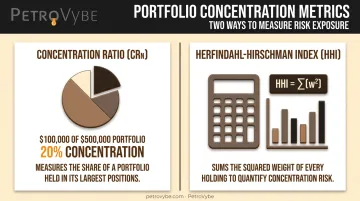
- Concentration ratio (CRn) — the percentage one position represents of total portfolio value. A $100,000 stock position inside a $500,000 portfolio produces a 20% concentration ratio.
- Herfindahl-Hirschman Index (HHI) — the sum of each holding's squared percentage weight, used to measure aggregate concentration across an entire portfolio rather than a single position.
Banks face a related concept called a concentration risk charge. Regulators require institutions to hold additional capital when their loan book leans too heavily on one sector or counterparty, generally capped near 25% of Tier 1 capital under Basel's large-exposure framework.
Individual investors don't file regulatory capital reports, but the parallel holds. Holding an oversized position means you're implicitly paying a risk premium, even if no one sends you an invoice for it.
Why Concentrated Positions Carry Hidden Danger
Blue-chip reputations don't prevent blue-chip collapses. Management scandals, regulatory shifts, or a sudden wave of industry disruption can wipe out years of gains in a matter of weeks.
Enron is the textbook case. Senate records show the stock fell by as much as $75 per share from its high before the company's 401(k) lockdown even began in 2001.
Employees who held concentrated positions in employer stock inside their retirement accounts lost both their jobs and their savings simultaneously. The Government Accountability Office later concluded that diversification could have meaningfully limited those losses.
Beyond sudden price collapses, two other risks compound the problem:
- Illiquidity: restricted stock, private company shares, or non-traded holdings can be difficult to sell quickly, even when you need the cash
- Behavioral bias: loyalty, familiarity, and a reluctance to trigger capital gains taxes lead investors to hold winning positions far longer than the fundamentals justify
None of these risks show up on a standard brokerage statement. They surface only when something goes wrong, usually at the worst possible time.
6 Ways to Manage Asset Concentration Risk in Your Portfolio
No single tactic solves concentration risk on its own. A combination, tailored to your tax situation and liquidity needs, usually works best.
1. Gradually Sell Down the Position Over Time
Selling shares methodically across multiple years spreads out the resulting capital gains liability instead of triggering it all at once. This approach also lets you reduce exposure without betting everything on perfect market timing.
Pairing this with a written liquidation plan, tied to specific price targets or calendar milestones, removes emotion from the equation. It's much easier to sell 10% of a position on schedule than to decide in the moment during a market swing.
2. Hedge Your Holdings With Options
Protective puts let you retain ownership while establishing a price floor below which you won't lose additional value. A collar strategy adds a twist: you sell a call option to help offset the cost of the put, but that caps your potential upside.
Both approaches defer capital gains taxes since you're not selling the underlying shares. The trade-off is real, though. Puts cost premium upfront, and collars limit how much you can gain if the stock takes off.
3. Generate Income With Covered Calls
Selling call options above the current share price generates premium income that partially offsets a decline. It's a way to get paid for holding a position you'd rather not sell outright yet.
The catch: your upside is capped at the strike price. If the stock rallies past that level, shares may get called away, and that sale carries its own tax implications.
4. Contribute to an Exchange Fund
Pooling your concentrated stock with other investors' concentrated positions inside an exchange fund creates instant diversification without an immediate taxable sale. Your original cost basis carries into the fund, so the tax bill is deferred, not eliminated.
Two drawbacks matter here. Lock-up periods typically run seven years before you receive a diversified basket of shares in return. Fees can include an upfront charge plus ongoing annual management costs, on top of minimums that often start around $500,000.
5. Use Charitable Giving Strategies
Donating appreciated stock directly to a qualified charity, or funding a charitable remainder trust (CRT), reduces concentration while generating an immediate tax deduction and avoiding capital gains tax on the transfer.
A CRT pays you or other beneficiaries income for life or up to 20 years, with the remainder going to charity. This works best for investors with genuine philanthropic intent, since the asset leaves your estate permanently. It's not a strategy to pursue purely for tax optimization.
6. Diversify Into Alternative, Uncorrelated Asset Classes
Public-market tactics like hedging and gradual selling only go so far. Allocating a portion of proceeds into private, tangible assets can meaningfully reduce a portfolio's dependence on any single stock or sector.
This is where direct energy development comes in. PetroVybe offers accredited investors direct equity participation in natural gas development projects across South Texas and the Gulf Coast Basin, including active operations in Lavaca County. Rather than buying shares of an energy company on an exchange, investors hold a direct partnership interest in wells and reserves.

The structure carries two distinct advantages for someone exiting a concentrated stock position. Intangible Drilling Cost (IDC) deductions typically apply against active income, including W-2 wages and capital gains, with roughly 70% deductible in the first year alone.
PetroVybe also targets a 10-year MOIC of approximately 2.2x to 5.8x and an IRR near 26%, structured around a 10-year hold with monthly passive distributions once production ramps up.
For an investor selling down a concentrated stock and facing a large capital gains bill in the same tax year, redeploying part of the proceeds into a project like this can offset the gain. It also adds an asset class that doesn't move in lockstep with equities.
Private energy investments carry their own risks, including commodity price swings and illiquidity. They work best as one piece of a broader concentration reduction plan rather than a stand-alone fix.
When to Retain a Concentrated Position
Reducing a concentrated position isn't automatically the right move. Sometimes the tax cost of selling outweighs the benefit of reduced risk, particularly for older investors with substantial unrealized gains.
Here's why: appreciated stock held until death generally receives a step-up in cost basis to fair market value on the date of death. Heirs can then sell with little or no capital gains tax owed, whereas selling during your lifetime locks in that tax bill immediately.
Before deciding either way, run the numbers:
- Compare the tax cost of selling now versus holding until death
- Factor in how many years you realistically expect to hold the position
- Weigh the risk of a sudden decline against the certainty of a tax bill today
A financial and tax advisor can model both scenarios side by side. This isn't a decision to make on gut feeling; too much money is on the line.
Frequently Asked Questions
What is asset concentration risk?
Asset concentration risk occurs when a single stock, sector, or asset class represents an outsized share of a portfolio's value. This makes overall performance overly dependent on how that one component performs.
What is the formula for concentration risk?
The concentration ratio divides one position's value by total portfolio value. The Herfindahl-Hirschman Index (HHI) sums the squared weights of all holdings for a broader concentration score.
What is the asset concentration risk charge?
This regulatory concept requires banks to hold extra capital when exposure to one sector or counterparty runs too high. Individual investors face no formal charge, but an oversized position carries a similar implicit risk.
How much of my portfolio should be in a single stock?
There's no universal rule, but many advisors flag single positions above 10-20% of a portfolio for closer monitoring. The right threshold depends on your wealth, liquidity needs, and risk tolerance.
Can I reduce concentration risk without selling my stock?
Yes. Hedging with protective puts or collars, writing covered calls, and contributing to an exchange fund can all reduce risk exposure while deferring or avoiding an immediate taxable sale.
Are alternative investments like oil and gas a good way to diversify away from stock concentration?
Private real assets such as natural gas development are often less correlated to public equities and can offer real tax advantages. They work best as a complement to a broader concentration reduction strategy, not a stand-alone replacement.