
With market volatility rattling portfolios and inflation quietly eroding savings, more investors want a repeatable, disciplined approach instead of another speculative bet. Value investing offers exactly that.
This guide breaks down what value investing means, how the strategy works in practice, and the tips that separate disciplined value investors from bargain hunters who fall into value traps. We'll also look at how the same "buy below true worth" logic extends beyond public stocks into other income-producing assets.
Key Takeaways
- Value investing means buying assets priced below their intrinsic worth and holding for the long term.
- Margin of safety and contrarian thinking form the backbone of the strategy.
- Graham and Buffett proved these principles hold up through multiple market cycles.
- The same discipline extends beyond stocks into tangible, income-producing assets like natural gas development.
What Is Value Investing?
Value investing is an approach to buying securities or assets trading below their intrinsic worth: the value calculated from a company's fundamentals rather than its stock price momentum. Instead of chasing sentiment, value investors dig into a business's fundamentals to determine what it's actually worth, then wait for the market to catch up. Their research typically covers:
- Balance sheets and debt levels
- Cash flow generation and consistency
- Competitive position within the industry
Where the Discipline Began
Benjamin Graham and David Dodd introduced this framework in their 1934 book Security Analysis, arguing that disciplined analysis, not speculation, should drive investment decisions.
Graham expanded on the idea in his 1949 book The Intelligent Investor, introducing the "Mr. Market" metaphor:
A moody business partner who offers to buy or sell at wildly different prices depending on his mood swings. Smart investors ignore his panic and take advantage of his mistakes.
The core belief hasn't changed since. Markets overreact to news, both good and bad, and that overreaction creates temporary mispricing. A company might miss quarterly earnings by a few cents and watch its stock drop 20%, even if nothing about its long-term business actually changed. That gap between price and value is where value investors operate.
Does the Value Premium Hold Up?
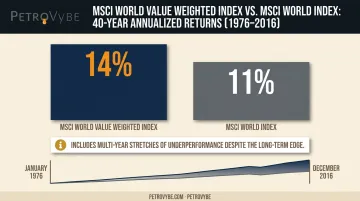
The historical data leans in favor of the strategy, though not without bumps. Over January 1976 through December 2016, the MSCI World Value Weighted Index returned more than 14% annualized, compared to 11% for the broader MSCI World Index. That's a meaningful gap compounded over four decades.
The catch: value's outperformance isn't smooth. It runs through long stretches of underperformance, and part of that early record is back-tested rather than lived through in real time. Still, the multi-decade edge is one reason this strategy has outlasted market fads promising faster riches.
Warren Buffett's Value Investing Strategy
From Cigar Butts to Wonderful Companies
Buffett didn't start out buying quality businesses. Early in his career, he followed Graham's original playbook closely, buying statistically cheap "cigar-butt" stocks: beaten-down companies with one last puff of value left, regardless of how good the underlying business actually was.
Charlie Munger changed that. In his 1989 shareholder letter, Buffett admitted the shift, writing that it's "far better to buy a wonderful company at a fair price than a fair company at a wonderful price." He credited Munger with seeing this first. The 1972 See's Candies acquisition marked the turning point, teaching Buffett that paying up for a durable brand beats chasing rock-bottom multiples.
The Apple Example
Berkshire Hathaway's Apple position shows this evolved approach in action. Buffett wasn't buying Apple as a tech bet. He treated it as a consumer products company with enormous brand loyalty and a moat few competitors could challenge.
Berkshire's stake tells the story:
- Built its first position in early 2016
- Grew the stake to roughly 5% of Apple by mid-2018, worth about $36 billion
- Trimmed the position in 2024 despite continued conviction
- Held a $61.9 billion stake at the end of 2025
That conviction captures Buffett's most quoted line: price is what you pay, value is what you get. He attributed the phrase to Graham in his 2008 shareholder letter.
The lesson holds up well: a cheap price means nothing without an accurate sense of what you're actually buying.
How Value Investing Works
Estimating Intrinsic Value
Value investors start by estimating what a company is truly worth, independent of its current stock price. That means digging into financial statements, free cash flow trends, competitive advantages, and the quality of management making capital allocation decisions. The output is intrinsic value: a reasoned estimate of what the business would be worth to a private buyer holding it indefinitely.
Margin of Safety in Practice
No estimate is perfect, so value investors build in a buffer. Margin of safety means buying at a meaningful discount to estimated intrinsic value, commonly cited in the 30% to 50% range, to protect against analytical errors or unexpected setbacks.
Here's why the discount matters:
- Buy at fair value ($100): if intrinsic value is $100 and the stock climbs to $120, you've earned 20%
- Buy at a 40% discount ($60): if that same stock climbs to $120, you've earned 100%, double the return for owning the identical business
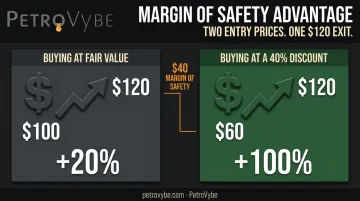
The discount doesn't just cushion mistakes. It amplifies returns when you're right.
The Metrics Value Investors Watch
Calculating a reliable discount depends on trustworthy inputs. A handful of valuation metrics recur across nearly every value screen:
- Price-to-Earnings (P/E): share price divided by earnings per share, showing what investors pay per dollar of profit
- Price-to-Book (P/B): share price divided by book value per share, useful for asset-heavy businesses
- Free Cash Flow (FCF): operating cash flow minus capital expenditures, revealing real cash left after reinvestment
- Enterprise Value to Cash Flow: a broader measure accounting for debt and cash on the balance sheet, not just share price
Why the Market Gets It Wrong
These metrics only matter because markets frequently misprice assets in the first place. Value investing rejects the idea that markets are always efficient. Investors are human. They overreact to bad headlines, underreact to slow-building good news, and pile into whatever's popular. Loss aversion and herd behavior show up repeatedly in behavioral finance research as recurring drivers of stock market volatility.
Stocks become undervalued for predictable reasons:
- A market-wide crash drags down good and bad businesses alike
- A single piece of bad news triggers an overreaction disproportionate to its actual impact
- The company operates in an unglamorous, out-of-favor industry
- Few analysts cover the stock, so mispricing lingers longer than it should
Value Investing Strategies & Tips for Getting Started
Getting started requires patience and a willingness to read past the headlines. Institutional resources aren't necessary.
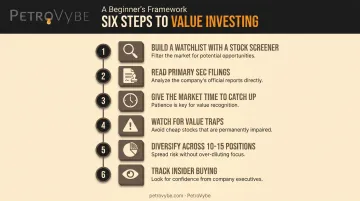
- Build a watchlist with a stock screener. Filter for low P/E and P/B ratios, plus strong balance sheets, to generate a shortlist worth deeper research.
- Read the primary filings. A quarterly earnings headline doesn't tell the full story. Pull the 10-K and 10-Q directly from SEC filings to review risk factors and management discussion beyond the headline numbers.
- Give the market time to catch up. Undervaluation can persist for years before it corrects. This strategy rewards patience, not quick trades.
- Watch for value traps. A cheap stock isn't automatically a bargain. Warning signs include declining earnings, management turnover, shrinking margins, and a business model losing relevance—not just short-term noise.
- Diversify across 10 to 15 positions. Spreading capital across sectors limits the damage from one bad pick while keeping the portfolio manageable enough to track closely.
- Track insider buying. When executives buy meaningful amounts of their own stock, it can signal confidence that the market's pessimism is overdone. Treat it as one data point among many, not a guarantee.
Value Investing vs. Growth Investing
Value and growth investing often get framed as opposites, but the differences come down to emphasis more than incompatibility.
| Factor | Value Investing | Growth Investing |
|---|---|---|
| Core philosophy | Buy established businesses below intrinsic worth | Pay a premium for above-average future growth |
| Risk profile | Lower volatility, business-quality risk | Higher volatility, expectation risk |
| Typical industries | Financials, energy, industrials, consumer staples | Technology, biotech, emerging consumer brands |
| Best market conditions | Rate hikes, market corrections, unloved sectors | Low-rate expansions, bull markets |
Style leadership swings back and forth depending on the economic cycle. Value can trail for a year or two, then lead sharply once sentiment resets.
Buffett himself has argued the two approaches are less separate than they appear, noting that growth is always part of the calculation behind any company's true value. A business with strong growth prospects simply has a higher intrinsic value than one without, all else equal.
Beyond the Stock Market: Applying Value Principles to Alternative Assets
The principles behind value investing weren't built exclusively for public stocks. Intrinsic value, margin of safety, and long-term patience apply to any asset where price and true worth can diverge, including private and alternative investments.
Accredited investors increasingly look beyond stocks, bonds, and even real estate toward tangible, income-producing assets like natural gas development, applying that same "buy below true value" logic to a different asset class entirely.
How PetroVybe Applies the Same Discipline
PetroVybe, a Texas-based natural gas development company operating in Lavaca County and the broader Gulf Coast Basin, offers accredited investors direct entry-point positions in development projects rather than pre-priced, publicly traded shares.
The parallels to traditional value investing show up in specific ways:
- Third-party validation replaces guesswork. PetroVybe's projects carry a $48 million proved reserves valuation (PV-9), determined by a licensed third-party engineering firm, giving investors an independent check on asset value.
- Track record substitutes for market sentiment. PetroVybe's chief geophysicist brings a 75.2% well-selection success rate across a 48-year career, well above the industry average of under 40%.
- Entry point mirrors margin of safety. Investors enter at the development stage, before production value is fully realized, rather than buying an asset that's already been marked up and passed through several hands.

Unlike public value stocks, direct development investments like PetroVybe ONE add a lever traditional stock investing doesn't offer: significant tax deductions against active income.
In 2025, PetroVybe partners received a 91% deduction against active income, including W-2 earnings and capital gains, through intangible drilling cost deductions, a benefit real estate and public equities generally can't match dollar for dollar. That's a meaningful intrinsic-value enhancer layered on top of the underlying asset economics, available to accredited investors with $100,000 or more in liquidity.
Frequently Asked Questions
What is value investment strategy?
Value investing means buying securities or assets priced below their intrinsic worth, based on fundamental analysis rather than market sentiment. Investors hold these positions long term, waiting for price to reflect underlying value.
What is Warren Buffett's value investing strategy?
Buffett evolved from Graham's original "cigar-butt" approach of buying statistically cheap stocks toward buying wonderful companies with durable competitive advantages at a fair price. Patience and business quality now matter as much as entry price.
What is the 70/20/10 rule in investing?
This is a personal budgeting guideline, not a core value-investing principle. It typically splits income into 70% for expenses, 20% for savings or investing, and 10% for debt repayment or giving.
What is the 3-5-7 rule of investing?
This is commonly used as a risk-management guideline for position and sector sizing, limiting single positions to roughly 3-5% and sector exposure to around 7-10%. It isn't an official Graham or Buffett value-investing rule.
What are the biggest risks of value investing?
The main risks include value traps (cheap stocks with genuinely deteriorating fundamentals), prolonged underperformance before the market corrects, and misjudging intrinsic value due to flawed assumptions.
Is value investing still profitable today?
Value trailed growth in some recent years, including 2024, but has also shown strong stretches, including international value outperformance in 2025. Over multi-decade periods, value has historically outperformed, though results vary by cycle.