
Global dividend-focused funds pulled in $23.7 billion in the first half of 2025 alone, the strongest first-half haul in three years, according to Reuters reporting on global fund flows. Monthly payers are a growing slice of that demand.
This guide compares three distinct income vehicles: individual stocks, ETFs, and UK investment trusts. You'll also learn how monthly payouts get selected, how they're taxed, and where they fit next to other passive income strategies.
Key Takeaways
- Monthly payers cluster in REITs, BDCs, mortgage REITs, and specialty ETFs, delivering 12 payments a year instead of 4
- Yields above 8% often carry real risk, including rate sensitivity, leverage, and recent BDC and mortgage REIT dividend cuts
- Investment trusts paying true monthly dividends are almost exclusively a UK phenomenon, and the list keeps shrinking
- Direct energy development, such as PetroVybe's oil and gas projects, offers accredited investors an alternative tax-advantaged income stream
What Are Monthly Dividend Stocks, ETFs, and Trusts?
Most public companies pay dividends quarterly. Monthly payers are a smaller, deliberate subset built for investors who want income that lines up with monthly expenses like a mortgage or utility bill.
REITs and BDCs dominate this space for a structural reason. To maintain their tax status, REITs must distribute at least 90% of taxable income to shareholders each year, per IRS Form 1120-REIT instructions. That mandatory payout pressure pushes many REITs toward frequent distributions, and monthly scheduling has become a competitive differentiator.
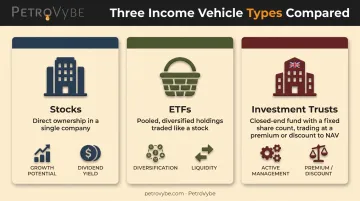
Three vehicle types show up in this guide, each with a different ownership structure:
- Stocks – Direct ownership in a single company (REIT, BDC, or mortgage REIT)
- ETFs – Pooled, diversified baskets of dividend-paying securities traded like a stock
- Investment trusts – Closed-end, UK-listed companies with a fixed share count, trading at a premium or discount to net asset value
Top Monthly Dividend Stocks to Watch
These five were picked for sector diversity — REIT, mortgage REIT, and BDC exposure — plus a consistent monthly payout history.
Realty Income (O)
Known as "The Monthly Dividend Company," Realty Income runs a triple-net-lease portfolio of single-tenant retail and commercial properties. It's an S&P 500 constituent and a Dividend Aristocrat, with 15,511 properties at 98.9% occupancy as of December 2025.
What makes it stand out is decades of uninterrupted monthly payments alongside geographic diversification across the US, UK, and Spain.
| Metric | Detail |
|---|---|
| Sector/Business Model | Retail & commercial REIT, triple-net lease structure |
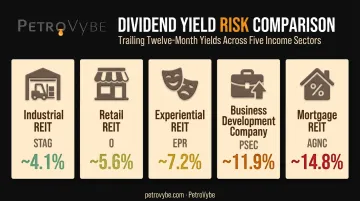
| Dividend Yield | 4.93% trailing, 4.95% forward (as of July 2026) |
| Market Position | S&P 500 constituent; 15,511+ properties under long-term leases |
AGNC Investment Corp (AGNC)
AGNC is an internally managed mortgage REIT that invests in agency mortgage-backed securities using leverage. It manages a $97.2 billion portfolio as of mid-2026.
The appeal is a high double-digit yield, but that comes paired with real interest-rate and prepayment risk. Actual constant prepayment rates rose from 6.4% in Q4 2025 to 13.0% in Q2 2026, a trend worth watching closely.
| Metric | Detail |
|---|---|
| Sector/Business Model | Agency mortgage-backed securities REIT |
| Dividend Yield | 12.83% trailing and forward (as of July 2026) |
| Key Risk Factor | Rising prepayment rates and rate-spread sensitivity |
Prospect Capital Corp (PSEC)
PSEC is a leading BDC, providing debt and equity capital to middle-market companies across 89 portfolio companies in 31 industries.
Diversification is a strength here, but recent quarters show income pressure. Net investment income fell to $78.5 million in Q1 2026, down from $90.9 million the prior quarter, as interest income softened.
| Metric | Detail |
|---|---|
| Sector/Business Model | Business Development Company – private debt and equity |
| Dividend Yield | 23.87% trailing (as of June 2026); recent earnings trend downward |
| Portfolio Scale | 89 portfolio companies across 31 industries |
STAG Industrial (STAG)
STAG focuses on single-tenant industrial real estate — warehouses and logistics buildings — spread across 41 states.
The recession-resistant nature of logistics tenants, combined with a steady monthly payout history, is what earns STAG a place on this list.
| Metric | Detail |
|---|---|
| Sector/Business Model | Industrial REIT (warehouse/logistics) |
| Dividend Yield | 3.70% trailing, 3.77% forward (as of July 2026) |
| Portfolio Size | 601 buildings, 120.3M sq. ft., $10.2B enterprise value |
EPR Properties (EPR)
EPR invests in experiential real estate: movie theaters, ski resorts, and entertainment venues rather than traditional office or retail space.
That niche diversification into non-traditional real estate is the differentiator, offering exposure that doesn't move in lockstep with typical REIT sectors.
| Metric | Detail |
|---|---|
| Sector/Business Model | Experiential/entertainment REIT |
| Dividend Yield | 5.99% trailing, 6.19% forward (as of July 2026) |
| Total Investment Scale | ~$7.1B total investments; 335 locations across 42 states and Canada |
Top Monthly Dividend ETFs to Watch
These four ETFs were selected for asset size, expense ratio efficiency, and reliability of the monthly schedule.
JPMorgan Equity Premium Income ETF (JEPI)
JEPI generates monthly income by layering an options overlay (selling call options) on top of a large-cap US equity portfolio. The result is strong yield with less volatility than pure growth-stock exposure.
| Metric | Detail |
|---|---|
| Strategy | Covered-call/options income overlay on equities |
| Expense Ratio & Yield | 0.35% expense ratio; 8.06% 12-month rolling dividend yield (June 2026) |
Global X SuperDividend ETF (SDIV)
SDIV tracks 100 of the world's highest-dividend-paying equities, REITs, and MLPs. It's built for investors wanting global diversification across sectors and countries rather than a US-only tilt.
| Metric | Detail |
|---|---|
| Strategy | Global high-dividend equity index tracking |
| Expense Ratio & Yield | 0.58% expense ratio; 9.24% 30-day SEC yield (July 2026) |
iShares Preferred and Income Securities ETF (PFF)
PFF concentrates on preferred stocks, heavily weighted toward banks and utilities. It's one of the largest funds in the category, with a track record dating back to 2007.
| Metric | Detail |
|---|---|
| Strategy | Preferred stock and hybrid securities index tracking |
| Expense Ratio & Yield | 0.45% expense ratio; 6.51% 30-day SEC yield (June 2026) |
Invesco S&P 500 High Dividend Low Volatility ETF (SPHD)
SPHD applies a dual screen: high dividend yield paired with low price volatility, drawn from the S&P 500. The defensive sector tilt toward utilities and consumer staples suits investors prioritizing stability over yield maximization.
| Metric | Detail |
|---|---|
| Strategy | Low-volatility, high-dividend equity index tracking |
| Expense Ratio & Yield | 0.30% expense ratio; 4.30% 30-day SEC yield (July 2026) |
Top Monthly Dividend Investment Trusts to Watch
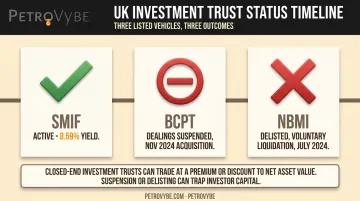
True monthly-paying investment trusts are rare and concentrated almost entirely in the UK, via the London Stock Exchange. The universe has also shrunk recently — two of the three trusts once commonly cited here no longer trade.
TwentyFour Select Monthly Income Fund (SMIF)
SMIF is the primary AIC-listed monthly dividend trust, investing across fixed income and asset-backed securities. It carries a dividend yield of 8.59% and traded at a 1.85% premium to NAV as of July 2026. Its ongoing charge of 1.13% runs higher than a typical open-ended bond fund.
BMO Commercial Property Trust (BCPT)
BCPT once offered diversified exposure to UK commercial property across office, retail, industrial, leisure, and student housing assets, and was a FTSE 250 constituent. The trust was taken into an acquisition process in 2024, with dealings suspended that November, a reminder that trust structures carry corporate-action risk beyond typical market swings.
NB Global Monthly Income Fund (NBMI)
NBMI targeted traditional and alternative credit, hedged to GBP, for consistent monthly payouts. It entered voluntary liquidation and was removed from the Official List in July 2024.
The lesson from BCPT and NBMI: trust structures can trade at meaningful premiums or discounts to net asset value, and closure or delisting risk can materialize without warning.
Beyond Traditional Dividends: Diversifying Your Passive Income Strategy
Dividend income isn't automatically tax-friendly. Ordinary dividends are taxed as regular income; only dividends meeting IRS holding-period and issuer tests qualify for the lower 0%, 15%, or 20% capital-gains rates, per IRS Topic 404.
Most REIT and BDC dividends fall into the ordinary category, which can erode net returns for high earners.
Yield sustainability matters as much as yield size. Dividend cuts are common during rate cycles. KKR Real Estate Finance Trust cut its dividend 42% to $0.25 per share in early 2024, and shares dropped as much as 14.5% the same day, according to a Reuters report.
Several BDCs trimmed distributions in 2025 as easing rates reduced floating-rate portfolio income.
That's why some investors look outside publicly traded dividend vehicles entirely. Direct energy development is one alternative, and it works differently than anything on this list.
PetroVybe, a Texas-based oil and gas development company, offers accredited investors direct equity in upstream natural gas projects rather than shares of a fund.
The structure differs from REITs and ETFs in a few important ways:
- **Upfront tax deduction against active income** – PetroVybe partners received a 94% deduction in 2024 and 91% in 2025, applied against W-2 wages and capital gains, not just passive income
- Asset-backed development – The current project sits on 58,000 acres in Lavaca County, Texas, with roughly 400 producing wells and 57+ planned new wells
- Long-horizon return targets – A targeted 10-year MOIC of 2.2x to 5.8x and an IRR near 26%, with monthly passive distributions projected to peak above $10,000/month during peak production
- Minimum entry of $100,000 – Restricted to accredited investors with third-party verification
This isn't a substitute for dividend stocks or ETFs. It's a different asset class with its own risk profile, illiquidity, and long hold period.
But for investors already maxed out on REIT and BDC exposure, it's worth understanding as a genuinely uncorrelated income source.
Before allocating capital to any monthly income vehicle, weigh expense ratios, payout history, sector concentration, and total return — not yield in isolation.
A blended approach, combining liquid dividend payers with tax-advantaged alternative assets, tends to hold up better across a full rate cycle than betting on a single income source.
Frequently Asked Questions
Which investment trusts pay monthly dividends?
True monthly-paying trusts are rare. TwentyFour Select Monthly Income Fund (SMIF) is the primary current example on the AIC list. Most other UK trusts pay quarterly or semi-annually instead.
How much do I need invested in investment trusts paying monthly dividends to make $10,000 a month?
At SMIF's current 8.59% dividend yield (GBP-denominated; USD equivalent shown), generating $120,000 annually would require roughly $1.4 million invested. This is a pre-tax estimate and assumes the yield stays constant.
Are monthly dividend stocks better than quarterly dividend stocks?
Payment frequency is a cash-flow timing preference rather than a driver of total return. Monthly payouts suit investors who rely on investment income to cover regular monthly expenses.
How are monthly dividends taxed?
Qualified dividends meeting IRS holding-period rules get taxed at 0%, 15%, or 20%. Ordinary dividends, which is how most REIT and BDC payouts are classified, get taxed as regular income.
What is a good dividend yield for monthly dividend stocks?
Good yields vary by sector: REITs often run 4-6%, while mortgage REITs and BDCs can exceed 12-20%. Very high yields often signal elevated risk of a future dividend cut.
Are monthly dividend ETFs safe investments?
Diversification reduces single-company risk, but leverage, credit quality, and expense ratios still affect overall safety. Research the underlying strategy before investing, not just the headline yield.