
The problem? Most explanations of feeder funds bury readers in jargon: blockers, aggregators, master-feeder mechanics. Few connect the dots to what actually matters, how the structure touches your capital, your fees, and your tax bill.
This guide breaks down what a feeder fund is, how the mechanics work, where the benefits and drawbacks sit, and how the model stacks up against direct investment approaches in real assets, including energy development.
Key Takeaways
- Feeder funds pool investor capital and route it into one master fund
- Lower minimums widen access to institutional-grade managers, but add an extra fee layer
- Onshore, offshore, and blocker versions mainly manage investor-specific tax exposure
- Direct investment structures suit investors who prioritize tax efficiency and asset ownership
What Is a Feeder Fund in Private Equity?
A feeder fund is a pooling vehicle. It aggregates capital from multiple investors and channels it into one specific master, or target, private equity fund rather than having each investor commit directly to the manager.
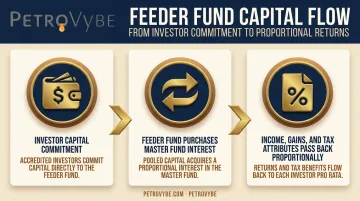
The capital flow follows three steps:
- Your money enters the feeder fund as a capital commitment.
- The feeder fund purchases an interest in the master fund on your behalf.
- The master fund's income, gains, and tax attributes pass back through to you proportionally.
The SEC's Form PF defines this arrangement by one condition: the feeder invests all or substantially all of its assets into a single master fund.
Why does this structure exist at all? Institutional PE funds often carry commitment minimums in the multi-million-dollar range. Feeders aggregate smaller individual checks so a group of investors can collectively meet that threshold as a single limited partner.
This pooling need isn't new. Feeder structures started inside private banking divisions serving high-net-worth clients, where a bank would pool client allocations and interact with the manager as one entity. Tech-enabled platforms have since expanded that model, bringing minimums down considerably from where they started.
How the Master-Feeder Relationship Works
Returns flow through proportionally. If Feeder A contributes $100 to a master fund and Feeder B contributes $200, Feeder A receives one-third of the distributed returns and Feeder B receives two-thirds, an exact match to each feeder's share of capital.
Here's the part investors often miss: feeder funds remain legally distinct entities from the master fund, even though their returns depend entirely on the master's performance. The feeder is organized, reported, and taxed separately; it simply has no independent investment outcome apart from what the master fund generates.
Key Components of the Feeder Fund Structure
A feeder structure typically has four moving parts, each solving a different investor problem:
| Component | Function |
|---|---|
| Master Fund | The central vehicle where all feeder capital lands and where actual portfolio decisions get made |
| Onshore Feeder | Built for domestic investors, usually a Delaware LP or LLC aligned with local tax reporting |
| Offshore Feeder | Built for international or tax-exempt investors, commonly domiciled in the Cayman Islands |
| Blocker Entity | A corporate layer inserted to prevent flow-through tax issues like UBTI for pension funds or foreign investors |
Aggregators and SPVs work similarly but on a tighter focus, often built for one investor group or a single co-investment opportunity rather than broad access to the master fund.
These structural layers matter beyond compliance — they directly shape how low the entry point can go for individual investors. Mayer Brown's analysis of feeder structures documented a customary underlying-fund commitment set against a much smaller aggregator entry point:
- $5 million typical commitment size required at the master fund level
- $50,000 entry point historically offered through high-net-worth aggregators
- $50,000–$75,000 minimums now common on newer technology-enabled platforms
These figures are illustrative, not a universal industry standard, but they show the direction access has moved.
Benefits of Feeder Fund Structures for Investors
A few advantages consistently show up in how feeder funds get pitched to investors:
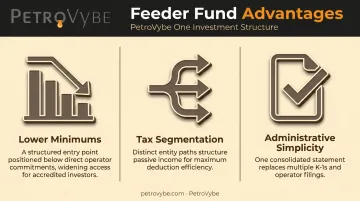
- Lower minimums. Aggregation converts a multi-million-dollar master commitment into a ticket size individual investors can actually write.
- Tax segmentation. Onshore, offshore, and tax-exempt investors get routed through structures suited to their status, rather than forcing one tax treatment on everyone.
- Administrative simplicity. The feeder interacts with the master fund's back office as a single LP, giving investors one point of contact instead of the manager's full reporting apparatus.
None of this changes what's actually happening underneath. You're still buying exposure to one manager's strategy and one fund's performance. The feeder just makes the entry point smaller and the paperwork lighter.
Drawbacks and Risks to Consider
Feeder funds solve an access problem. They don't solve the underlying risks of private equity itself, and in some cases they add new ones.
An added fee layer. Feeder funds frequently charge their own management or administrative fee on top of whatever the master fund already charges. That stacking dilutes net returns, and the exact terms vary by feeder. Always check the LPA and subscription documents rather than assuming a flat structure.
Withholding tax exposure. Offshore feeders serving non-U.S. investors can trigger U.S. withholding on certain payments. IRS Publication 515 sets a default 30% Chapter 3 withholding rate on U.S.-source dividends and similar income paid to foreign persons, unless a treaty or exemption reduces it. This isn't a blanket tax on the whole feeder — it applies to specific FDAP income types.
Long lock-up periods. A lower minimum doesn't shorten the hold period. Debevoise's private equity fund guide describes a typical investment period of five to six years inside a fund term commonly running ten years, often with extension rights and restricted transfers. Feeders inherit that same illiquidity.
Loss of control. Investors cede every investment decision to the master fund manager. When multiple investor groups sit inside the same master fund with different priorities, conflicts over timing, reporting, or exit strategy can surface, and a feeder investor has little recourse.
Feeder Funds vs. Direct Investment: Which Fits Your Portfolio?
Before comparing feeders to direct investment, separate feeders from a related but distinct vehicle: the fund-of-funds. A feeder fund gives you exposure to one target fund, while a fund-of-funds spreads capital across a basket of managers, sometimes ten, twenty, or more.
That structure creates a real risk-return tradeoff. A feeder concentrates your outcome in a single manager's performance; a fund-of-funds diversifies, but stacks a second fee layer on top of underlying fund fees.
Either way, you're still an indirect owner. Capital passes through a pooling vehicle before it ever touches the underlying asset, which can delay distributions and blunt tax benefits that would otherwise flow through more cleanly.
Direct investment models skip that layer entirely. Taking a direct working interest in oil and gas development, for example, means holding a partnership stake in the underlying asset itself, with no fund-of-funds structure sitting between you and the wells being drilled.
PetroVybe's model illustrates the distinction. Accredited investors take a direct position in natural gas development projects across South Texas and the Gulf Coast Basin, including active operations in Lavaca County.
Reserve valuations run through third-party engineering review, with PetroVybe's most recent proved reserves valuation (PV-09) at $48 million. Investors receive K-1 tax documents tied directly to the partnership, not fund-level reporting.
The tax distinction matters more than most investors realize:
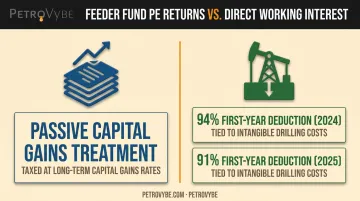
- Feeder fund PE returns typically get taxed as capital gains or passive income, following whatever character the master fund passes through
- Direct working interests in oil and gas can generate substantial first-year deductions through Intangible Drilling Costs, applicable against active income, including W-2 wages and capital gains, not just passive income
- PetroVybe partners saw a 94% first-year tax deduction against active income in 2024 and 91% in 2025, driven primarily by IDC treatment under IRC Section 263(c)
These differences compound at the structural level. The table below breaks down how feeders and PetroVybe's direct partnership model compare:
| Factor | Feeder Fund | PetroVybe Direct Partnership |
|---|---|---|
| Exposure | Single target fund | Direct stake in underlying asset |
| Tax treatment | Capital gains or passive income | IDC deductions against active income |
| Minimum investment | Varies by fund, often pooled | $100,000 per unit |
| Investor reporting | Fund-level statements | K-1 tied directly to partnership |
So which fits your portfolio? A feeder fund remains a reasonable entry point into institutional PE if you want diversified, professionally managed exposure across many portfolio companies and you're comfortable with capital-gains-style taxation.
If you're prioritizing tax-advantaged direct ownership, monthly passive income potential, and a tangible asset rather than a layered fund interest, a direct development partnership is worth evaluating instead.
Frequently Asked Questions
What is a feeder fund in private equity?
A feeder fund is a pooled vehicle that channels investor capital into a single master fund, giving smaller investors access to funds that carry high minimums. It's legally distinct from the master fund even though returns depend entirely on it.
How do feeder funds differ from fund-of-funds?
Feeder funds invest in one specific target fund, while fund-of-funds diversify across a basket of many funds and managers. That difference changes the risk-return profile: concentrated exposure versus diversified, fee-layered exposure.
What are the tax implications of investing through an offshore feeder fund?
Offshore feeders can face U.S. withholding tax, up to 30% by default, on certain U.S.-source dividend income paid to foreign persons. They also help segregate tax treatment for non-U.S. or tax-exempt investors from domestic ones.
What is the typical minimum investment for a feeder fund?
Tech-enabled feeder platforms have brought minimums down to roughly $50,000–$75,000 in recent examples, compared to multi-million-dollar minimums for direct institutional fund commitments. Figures vary by platform and manager.
Are feeder funds only used in private equity, or also hedge funds?
Master-feeder structures are common in both private equity and hedge funds. They're particularly useful for combining domestic and international investor capital under one umbrella while keeping tax treatment separated by feeder.
What's an alternative to feeder funds for gaining direct exposure to real assets like oil and gas?
Direct development partnerships, like those offered by PetroVybe, let accredited investors hold direct working interests with associated IDC tax deductions rather than pooled fund shares. This means direct asset ownership instead of layered fund exposure.