Here's the confusion in a nutshell: dividends and cash flow are tightly connected, but the relationship flips depending on which side of the transaction you're on. For the company paying them, dividends are money going out. For the investor receiving them, that same dividend is money coming in. Mixing up where each shows up on a financial statement leads to real misreadings of a company's health.
This guide breaks down what a cash flow dividend actually means, exactly where it lands on the cash flow statement, why free cash flow (not earnings) tells you whether a dividend can survive, and how much capital you'd realistically need to generate $10,000 a month in dividend income.
Key Takeaways
- A "cash flow dividend" just describes how payments appear—an inflow when received, an outflow when paid.
- Dividends never touch the income statement. They reduce retained earnings and cash directly.
- Free cash flow, not net income, is the metric that predicts whether a dividend survives a rough year.
- Hitting $120,000 a year in dividend income takes anywhere from roughly $1.7 million to over $10 million, depending entirely on yield.
What Is a Cash Flow Dividend?
A cash flow dividend is the portion of a company's cash that gets distributed to shareholders, viewed through the lens of the cash flow statement rather than the income statement. That distinction matters more than it sounds.
Most people learn "dividend" as an accounting term tied to profit. But profit and cash are not the same thing. A company can report solid net income while its actual bank balance shrinks, because earnings include non-cash items like depreciation and accrued revenue that haven't turned into real dollars yet.
Dividends have two faces depending on which side of the check you're standing on: for the paying company, it's a cash outflow classified under financing activities, while for the receiving investor, it's a cash inflow generally classified under operating activities.
This is exactly why "cash flow dividend" and "dividend sustainability" tend to get discussed in the same breath. A company can only pay out cash it actually has. Declaring a dividend based on accounting profit alone, without the cash to back it, is how companies end up cutting payouts investors were counting on.

Cash Dividends vs. Stock Dividends: What's the Difference?
Not every dividend involves cash leaving the building. A stock dividend distributes additional shares to existing shareholders instead of money. Because no cash changes hands, stock dividends never appear on the cash flow statement at all. The accounting reallocates equity accounts instead.
Cash and stock dividends also diverge on taxes and share structure. Cash dividends are taxable in the year received and reported on Form 1099-DIV, reducing the company's actual cash balance. Stock dividends, by contrast, dilute the share count but generally trigger no immediate tax event; your cost basis spreads across the new, larger share total instead.
If you're trying to judge a company's real cash position, stock dividends are a non-issue. Cash dividends are where the analysis gets interesting.
How Are Dividends Shown and Calculated on the Cash Flow Statement?
Every cash flow statement breaks into three buckets:
- Operating activities: cash generated from core business operations.
- Investing activities: cash used for or generated from long-term assets.
- Financing activities: cash flows between the company and its owners or lenders.
Dividends paid land in financing activities, because they represent capital returned to shareholders, not an expense of running the business.
Dividends received by an investor holding company (say, from a subsidiary or investment stake) typically show up in operating activities under most accounting frameworks. IFRS gives companies some flexibility here that U.S. GAAP doesn't.
The Accounting Mechanics, Step by Step
Here's what actually happens behind the scenes:
- Declaration date: the company debits retained earnings and credits "dividends payable," a liability account.
- Payment date: the company debits dividends payable and credits cash, which is the entry that finally shows up as a cash outflow on the statement.
When a company doesn't explicitly disclose dividends paid, analysts often back into the number using:
Dividends Paid = Net Income − Change in Retained Earnings
Pull net income from the income statement and beginning/ending retained earnings from two consecutive balance sheets. Just be careful: this formula assumes no stock dividends or other direct adjustments to retained earnings, so it's an estimate, not a guarantee.
Key Dates That Affect Dividend Cash Flow Timing
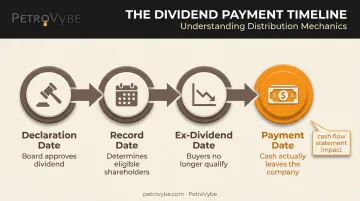
Four dates govern the dividend process, but only one actually moves cash:
| Date | What Happens |
|---|---|
| Declaration date | Board approves the dividend; it becomes a legal liability |
| Record date | Determines which shareholders qualify |
| Ex-dividend date | First trading day a buyer won't receive the upcoming dividend |
| Payment date | Cash actually leaves the company; this is what hits the cash flow statement |
Investors sometimes assume the declaration date is when the "cash flow impact" happens. It isn't. Nothing moves on the cash flow statement until the payment date.
Why Free Cash Flow Is a Better Predictor of Dividend Sustainability Than Earnings
Earnings can lie. Not maliciously, but earnings include non-cash accounting entries that can make a company look more profitable than its actual bank account supports. This is how a dividend trap forms: a company keeps raising or maintaining its dividend even as the cash available to fund it steadily erodes.
General Electric is the textbook case. In November 2017, GE cut its quarterly dividend in half, from $0.24 to $0.12 per share, and management said the move was meant to align the payout to cash flow generation. Investors who had been reassured by GE's earnings history were caught off guard because they weren't watching the cash flow side of the ledger.
The Free Cash Flow Payout Ratio
This is why serious dividend investors calculate the free cash flow (FCF) payout ratio instead of relying on the standard earnings-based payout ratio:
- Free cash flow = Cash flow from operations − capital expenditures
- FCF payout ratio = Dividends paid ÷ free cash flow
A ratio above 100% means the company paid out more than it generated in free cash that period, a warning sign no matter how healthy earnings look. You can calculate both inputs directly from a company's cash flow statement in its 10-K or 10-Q filings.
The payoff for favoring FCF-backed dividends shows up in performance data too. The S&P 500 Quality FCF Aristocrats Index, which screens for companies with at least a decade of positive free cash flow alongside dividend growth, returned 10.73% annualized from April 2001 through December 2024. That compares to 8.79% for the S&P 500 overall, with lower volatility to boot.
Cash-backed dividends aren't just safer. Historically, they've outperformed.
How Much Do You Need to Invest to Earn $10,000 a Month in Dividends?
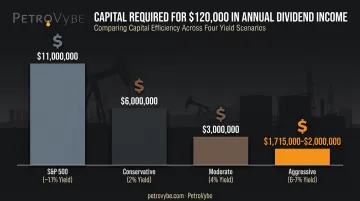
Ten thousand dollars a month works out to $120,000 a year. The formula for figuring out how much capital that requires is straightforward:
Required Portfolio = Annual Dividend Target ÷ Average Dividend Yield
Here's how that plays out at three yield assumptions:
| Yield Assumption | Capital Needed for $120,000/Year |
|---|---|
| Conservative (2%) | $6,000,000 |
| Moderate (4%) | $3,000,000 |
| Aggressive (6-7%) | ~$1,715,000 – $2,000,000 |
For context, the broad S&P 500's trailing dividend yield sits around 1.1%, which would require nearly $11 million to hit $120,000 a year from index-level dividends alone. Higher-yield indexes narrow that gap, but not without added risk.
The Yield Trap Trade-Off
Chasing higher yields shrinks your required capital, but it isn't free. Unusually high yields often signal a stock priced down because the market expects a cut, exactly the dividend trap discussed earlier. Reaching for yield without checking the FCF payout ratio is how income investors get burned.
A few ways to close the capital gap without taking on that risk:
- Reinvest dividends to compound your share count and income over time, reducing the fresh capital needed later.
- Extend your time horizon so compounding does more of the heavy lifting.
- Diversify income sources rather than concentrating in a handful of high-yield names.
Don't Forget Taxes
A $10,000/month target before tax isn't $10,000/month in your pocket. Non-qualified dividends are taxed as ordinary income at rates up to 37%, while qualified dividends get the more favorable 0%, 15%, or 20% long-term capital gains rates.
High earners may also owe an additional 3.8% Net Investment Income Tax on top of that. Gross up your target accordingly, or the math won't add up when the deposit hits your account.
This tax drag is one reason more income-focused investors are looking past publicly traded dividend stocks entirely, toward direct cash-flow assets that come with a different tax profile from the start.
Beyond Traditional Dividend Stocks: Diversifying Into Direct Cash Flow Investments
Public dividend stocks carry market volatility, board-level discretion over payouts, and standard tax treatment on every dollar received.
That's pushed a growing number of accredited investors toward alternative income sources, including real estate, private credit, and energy development. These returns tie to physical assets, not a corporate dividend policy a board can revise at any meeting.
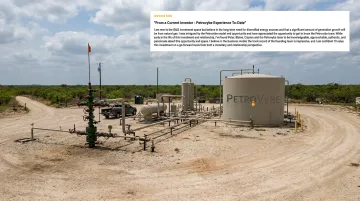
PetroVybe is one example of this shift. It's a private natural gas development company offering accredited investors direct working-interest participation in producing wells across South Texas and the Gulf Coast Basin, including its flagship project in Lavaca County.
Instead of a share of corporate profit, investors hold a position in the actual asset. They receive monthly or quarterly cash flow distributions generated directly by production.
A few structural differences worth understanding:
- K-1 vs. 1099-DIV: distributions flow through a partnership K-1, not a standard dividend tax form.
- Production-linked timing: payouts track actual cash flow from wells, not a board-set quarterly calendar.
- Upfront tax treatment: working-interest investments can generate first-year Intangible Drilling Cost (IDC) deductions of 60-80% of invested capital, applied against active income like W-2 wages and capital gains.
Direct cash flow investments serve a different purpose than a dividend portfolio, with a distinct risk profile, a longer runway before first distribution (typically two to three years), and tax treatment publicly traded dividends can't match.
For investors already comfortable with market-based dividend income, direct cash flow assets add a useful complement to that strategy.
Frequently Asked Questions
What is a cash flow dividend?
A cash flow dividend is not a distinct dividend type. It describes how a payment is treated on the cash flow statement: an operating inflow when received, or a financing outflow when paid.
How are dividends shown and calculated on the cash flow statement?
Dividends paid appear as a cash outflow in the financing activities section. When not disclosed directly, analysts estimate the figure using Net Income minus the change in retained earnings.
How much money do I need to make $10,000 a month in dividends?
It depends heavily on yield. At a 4% average yield, you would need roughly $3 million; at 7%, around $1.7 million, both figures pre-tax and assuming the yield holds steady.
Are dividends good or bad for a company's cash flow?
Dividends are a cash outflow that reduces available funds, but that is not inherently bad. Companies with strong, consistent free cash flow can sustain dividends without straining operations.
Do dividends affect a company's net income?
No. Dividends are not an expense and never appear on the income statement. They only reduce retained earnings on the balance sheet and cash on the cash flow statement.
What's the difference between dividend yield and dividend payout ratio?
Dividend yield is dividend per share divided by stock price, showing income relative to your investment. Payout ratio measures dividends against earnings or free cash flow, showing sustainability.